Tony Mullane
And the 300 Game Winners
Tony Mullane
n 1894, 284 game winner Tony Mullane still had an arm, but was cast adrift from major league baseball. No one shed a tear. That same year Charles Comiskey quit the Cincinnati Reds and became a minor league club owner in St. Paul, Minnesota. Comiskey got Mullane to join him for the ride. The two hit bottom together.
The 35-year old Mullane would be a first baseman and third string pitcher. The pressure was off. But he was a pitcher of such renown that he may have supplanted the manager-owner as drawing card of the club. Mullane had taken his lumps in ’93 and ’94 with the new pitching distance, but never had significant arm trouble in a thirteen year career. He was one of six major league pitchers that could dominate the landscape. Destiny rolled out a red carpet for Mullane. Destiny said he would win 300 games and take his place in the Hall-of-Fame.
But some people spit in the face of destiny.
There were five other 1880’s right-handers that shared this destiny… this exalted status. These were the first 300 game winners in baseball history: Pud Galvin, Tim Keefe, Mickey Welch, Charles Radbourn, and John Clarkson. They all debuted between 1879 and 1882, and they all retired between 1891 and 1894. These were the pitchers that gave us the pitching mechanics of today: the set position, the stretch position, the pitches, the leg kick, and the days of rest and rotations. But its important that the modern fan understand that the idea of “300 wins” did not reach public consciousness until Cy Young’s career was winding down, say 1907 or 1908. Everything I write here about that milestone, or the “race to 300”, is only written by having assembled the past from the future.
The first was James “Pud” Galvin, the uneducated street urchin from St. Louis that learned how to eat with a fork in 1875. Galvin was the short and chubby “Little Steam Engine” who won his 300th late in 1888. He first gained attention in the International Association of the late 1870’s. In 1877 Galvin went 13–6 with Pittsburgh, and in 1878 went 29–9 with Buffalo. During these two seasons he also started 130 exhibition games which included a 20–18 record against NL teams. Overall, Galvin went 57–37 and 67–24 with 895 and 845 innings pitched, respectively, and became famous for these efforts. Galvin had the best control of these exalted aces, spent his first six years in a “one man rotation”, and thus reached 365 wins by pitching in 75% of his teams’ games. He threw feet planted from the era of the 45 foot pitching line.
Everybody liked Pud. Galvin was humble and genial and as nice as Ernie Banks, and a well respected ace. He even has some Yogi Berra sounding quotes, but they are only interesting for their uneducated crudeness. Outside of Buffalo in 1878 he never pitched for a contender. His fastball was “top eight” in most discussions, and it was charming to hear him yell “Look out!” before throwing a pitch. In 1882 he had a “Whoop-da” pitch which consisted of him throwing the ball and yelling “Whoop-da.” He threw underhanded for most of his career. When overhand pitching was allowed in 1885, he threw “from the shoulder”, and developed a standard right-hander’s curve ball. I’m betting it was cuddy-thumb. He was as fidgety as Gaylord Perry, and licked his fingers on every pitch, but never threw the spitball. Had Galvin pitched as often as the others, say 4,800 career innings, he would not have reached 300 wins. That extra work that got him to 300 also made him the only pitcher to lose twenty games in a season ten times.
The second was Timothy Keefe, a Boston yout’ whose relatively refined manner earned him the “Sir Timothy” handle. Keefe notched 300 with the 1890 New York Players League using a baseball with his name stamped on it. (His baseball equipment start-up provided the balls for the Players League.) Keefe had a finished curve ball as a rookie, and the greatest untelegraphed change of pace to that point in baseball history — better than Al Spalding’s. He used multiple arm angles, but adopted mostly overhand pitching while it was still being debated late in 1884. He threw without much apparent effort, and could be critiqued for having an “all arm delivery.” The word “command” permeates descriptions of Keefe’s career. This starts with his MLB record 0.86 ERA in his rookie season, to his 19 game winning streak of 1888, to his dominating record of 2,508 pre-1893 strikeouts.
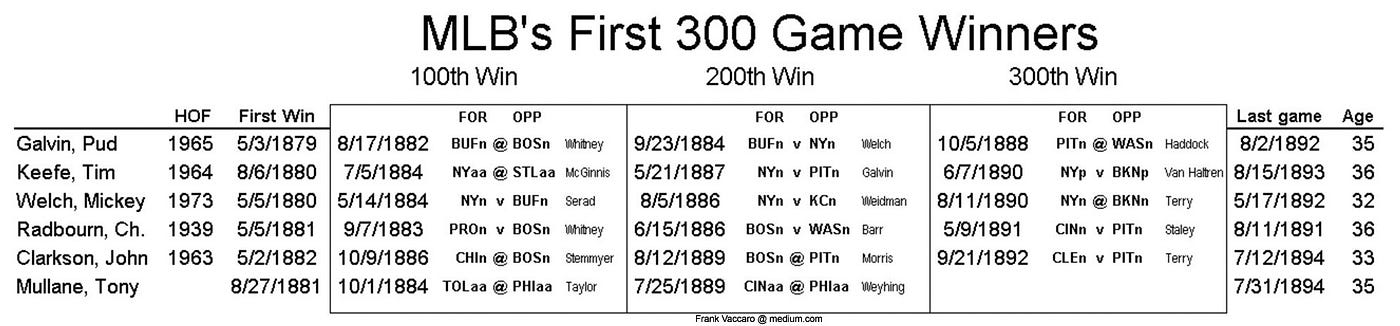
Eight weeks after Keefe did it, his old teammate Mickey Welch became the third to win 300, and at 5’ 8” and 160 lbs. Welch was the smallest of the lot. Welch had his own routine which included pawing the dirt with one foot, tossing the ball from gloveless hand to gloveless hand, and posing with one leg out. He also “danced and twisted” on occasion in a way that made batters anxious. He was “Smiling Mickey” for upper teeth exposed as he squinted hard at the catcher from under his cap. This “smile” appeared bigger because he never grew a mustache. Like Keefe, Welch didn’t have a fastball to write home about, so these two hurlers helped extend catcher Buck Ewing’s hands and career. Welch and Keefe were teammates for eight seasons and the “race to 300” saw them tied in career wins seventeen times between 1887 and 1889. On August 26, 1889 both were tied, for the last time, at 281 wins. When Welch finally reached 300, he held a momentary 300–200 career record.
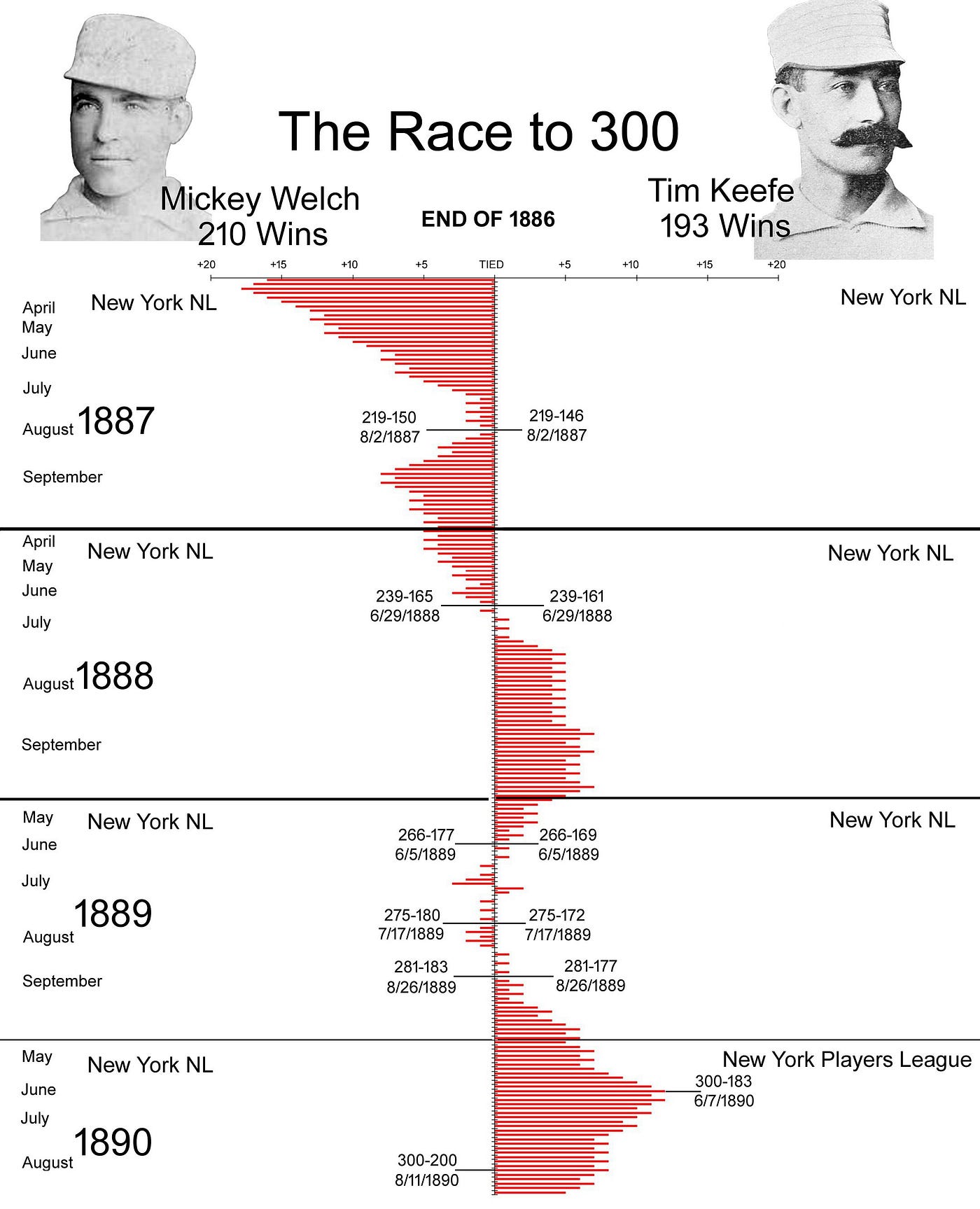
The red bars lean to the pitcher with the advantage in career wins. Tim Keefe and Mickey Welch were tied for second place in career MLB wins seventeen times between 1887 and 1889. However, at no time prior to 1900 were any players or fans aware of “lifetime wins” as a stat.
Charles Radbourn was the fourth to the milestone, and was the oldest and crankiest of the group. An Illinois country boy, he developed his first trick pitch — a drop ball — when he was 24, and made the majors two years after that. He almost quit after winning #299 in 1890. He opened a hotel and announced his retirement, but the hotel sputtered and Rad sheepishly appeared at Spring training, 1891. Its a good thing no one came to his hotel; he reached the milestone with his first win of that year. His drop ball was more eephus than sinker, and each pitch started with him facing the first baseman. Rad took tiny steps in the pitcher’s box prior to delivery, and then used body English after the release. He used slow balls if the bases were empty, but varied speeds with runners on. He kept his underhand style throughout his career. Conserving like this, more than any other pitcher, allowed Rad to put up some impressively high-inning seasons. His crowning achievement, a 60-win 1884 in 678 innings that defies comparison. That August he pitched 22 consecutive games for the Providence team, winning 18 of them in a row. In late October, in the first World’s Series ever, he single-handedly beat the AA New York Metropolitans with three complete game wins in three days.
The fifth and final 300 game winner of the era was John Clarkson who, like Keefe, was a Cambridge boy. He was tall and lean, quiet and unassuming, and he had by far the best fastball of the group. In fact, his fastball was the first known pitch to “jump”, so you know it sizzled the air. He never took steps in the box, but instead threw from a planted back foot — a decidedly modern style suggesting leg strength gave him an edge. He threw overhand throughout his career, constantly drawing protests for this in the 1884 North West League where he nearly struck out 400 in three months of play. Sportswriters of the 1880’s noted a “particular elastic movement” in Clarkson’s pitching, which again, hints at pitching mechanics that were ahead of their time. He shook hands with everyone using his left hand. Clarkson was taught to pitch in the back yard of third baseman Art Whitney during the 1883–1884 off-season, and as a result I’ve always considered Whitney the first pitching coach in baseball history.
All five of these pitchers maximized their careers by playing by the rules. There’s a smattering of bad behavior, and slaps on the wrists, and injuries, but no pitcher shot himself in the foot. Galvin owned the worst transgression. In a contract disagreement with Buffalo in 1880, Galvin went West in March and signed with the San Francisco Athletic. Mid May, Buffalo finally telegraphed agreement with Galvin’s terms. On May 18th Galvin, under the name “Ryan”, snuck onto a train East. If his wife and child were his heart, he left his heart in San Francisco. Around Cincinnati he jumped off a train and walked 36 miles to avoid detectives, but was collared near Wadsworth, OH, and forced to cough up the $200. The imbroglio caused him to miss about five starts. He missed about 10 more starts in 1885 shortly after being being sold to Pittsburgh due to a dislocated shoulder.
Tim Keefe missed about eight turns at the start of the 1888 and 1889 as negotiations with the New York Giants dragged. He also lost about 20 starts with broken fingers in July of 1882 and late August 1890. Mickey Welch missed about five starts at the start of Troy’s 1882 season with a sore arm, and John Clarkson missed about six starts due to a sprained ankle, April of 1890. Radbourn, the sour puss of the lot, never missed any starts, although Providence investigated him mid-1884, and the AA blacklisted him after he retired, which I have always considered a typographical error. That’s 13 missed starts from the careers of the first five 300 game winners in baseball history, mostly from sundry hold outs. The group also lost about 40 starts due to injuries.
Now let’s do Mullane. Buckle up.
Although he did not reach that 300th win, or receive Hall-of-Fame recognition, Mullane walked with these exalted. He brought the same gravitas and the same presence, as these “immortals”, and in his prime was the highest paid of the bunch, with the most beautiful wife, and the best on-field moustache.
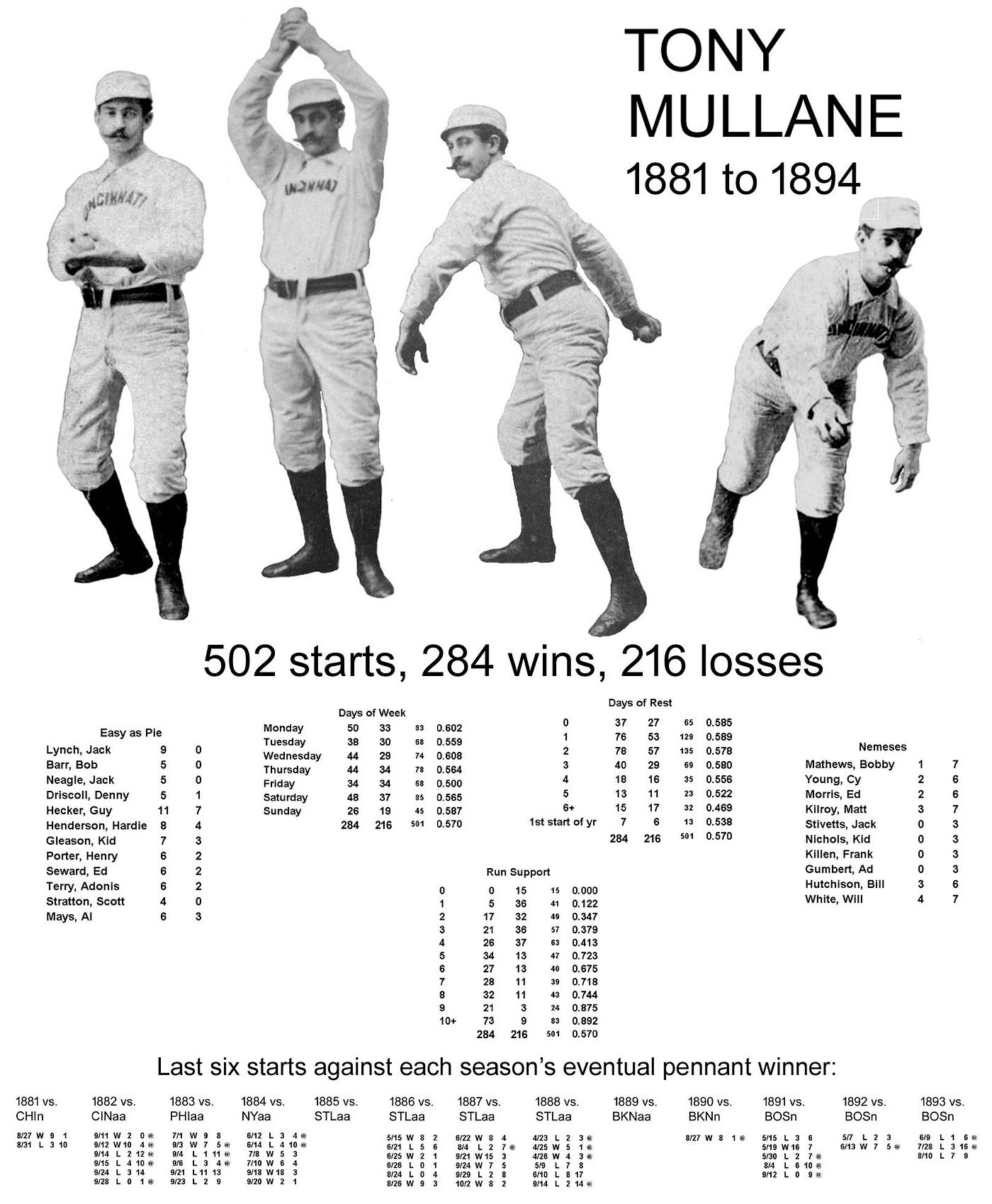
After a 6–10 loss in Brooklyn, on Memorial Day, 1888, Cincinnati President Aaron Stern “took a solemn vow... that he would never put Mullane in against Brooklyn again.” Henry Chadwick had recently noted that Mullane won only three against Brooklyn in 1887, while Elmer Smith won eight. This irrelevant statistical fact, by a renown baseball writer, combined with one poor performance, may have helped Brooklyn win two pennants.
Mullane was the marquee idol of these six: the “Apollo of the Box.” He was the tallest of the group if you cede to him half an inch for a thick pompadour of curly black locks. He pitched as gracefully as a dancer, sported a pirate’s mustache, never smiled, and worked quickly. Despite excessive pitch counts for walks, and snapping at teammates that lollygagged or misplayed, Mullane’s game times were fast. He skipped and ran in the pitcher’s box, when running was allowed, and constantly stepped over the line. His fastball was a “cannon shot” and may have been second best of the group, which was offset by his bewildering lack of control. His hit by pitch totals, wild pitches and walks are off the charts. He was baseball’s first all-time hit-by-pitch leader, until passed by Gus Weyhing, and is still the MLB career leader in wild pitches with 343. He was helped by having six and then five balls to a walk through much of his career. From 1886, Mullane is the first pitcher I am aware of that had a set position, a stretch position, and a leverage generating forward leg kick… almost like every pitcher today. He rushed his pitches, and lacked modern composure and timing. He also lacked a modern knee lift which indicates little leg use.
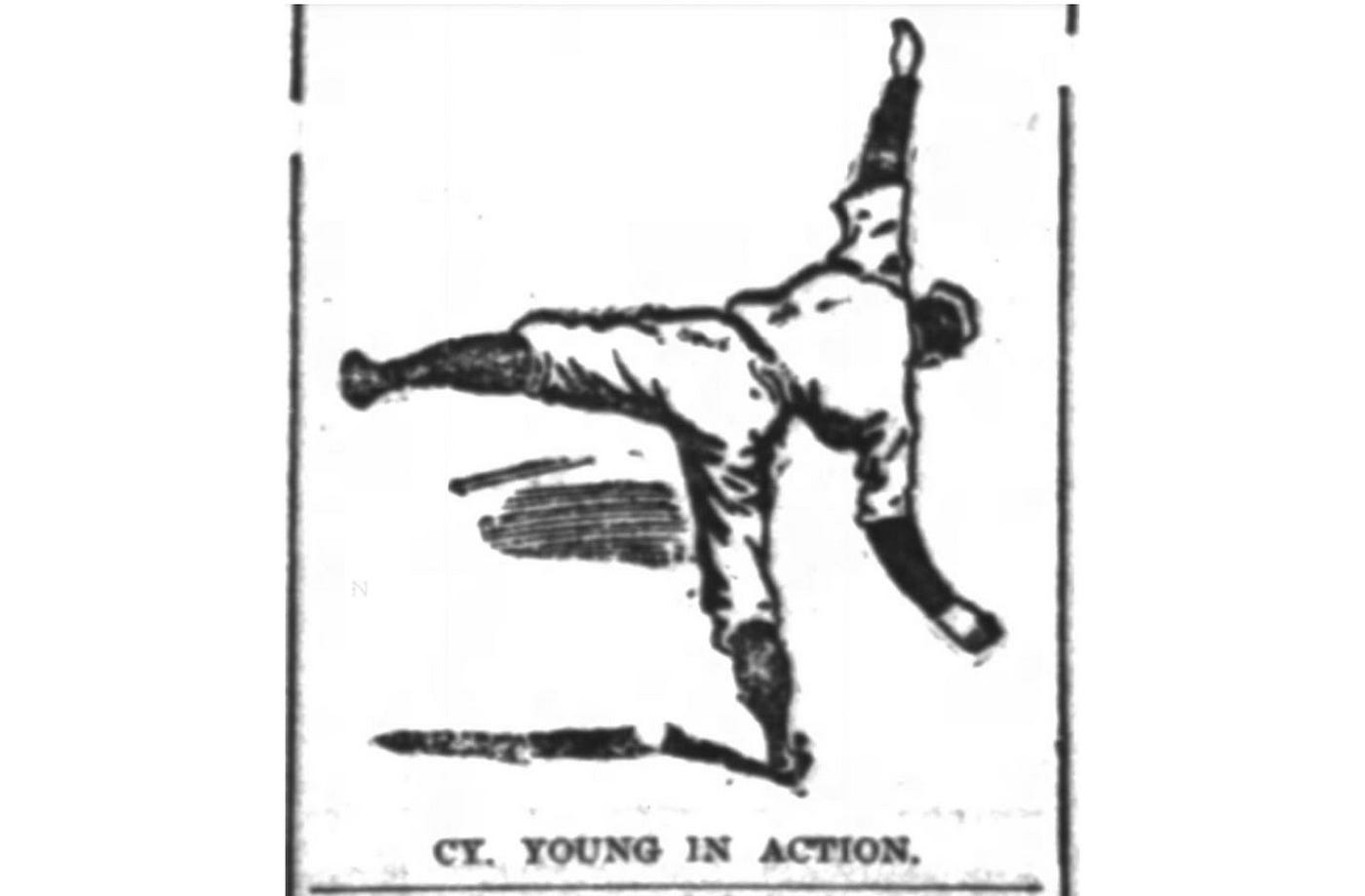
Cy Young from the Louisville Courier, April 23, 1897. Its a certainty that he and Amos Rusie threw 90 MPH +.
Cy Young was the first pitcher to throw from his legs. Cap Anson called him a freak and used to laugh at him when he ran laps around the park before a game. Today, every single pitcher runs those same laps. Cy did not utilize a knee lift. Cy’s front leg generated momentum by coming up and out, similar although not as high as Satchel Paige. The pitcher that finalized the mechanics with the pace and timing we have today was Christy Mathewson.
Ireland born, in County Cork, Mullane came to America as a toddler. His family settled in Erie, PA, and he played on grown man Erie teams at the age of fifteen. For a dollar, he’d switch teams. He appeared with Franklin and Youngstown and Geneva where ownership had players farm hay and corn on off days for $4 a week. Late in 1878 he switched to the Oil City, PA, team where he matched up against Pud Galvin when Buffalo stopped by for an exhibition game — one of Galvin’s 130 exhibition games. Mullane lost, but gave up only four hits. He was the best on every team in which he appeared, but stood apart from the rest of the players, just as he did in Erie when he was the child prodigy. Baseball was Mullane’s only profession. In some early off seasons he worked as an Erie municipal street lamp lighter.
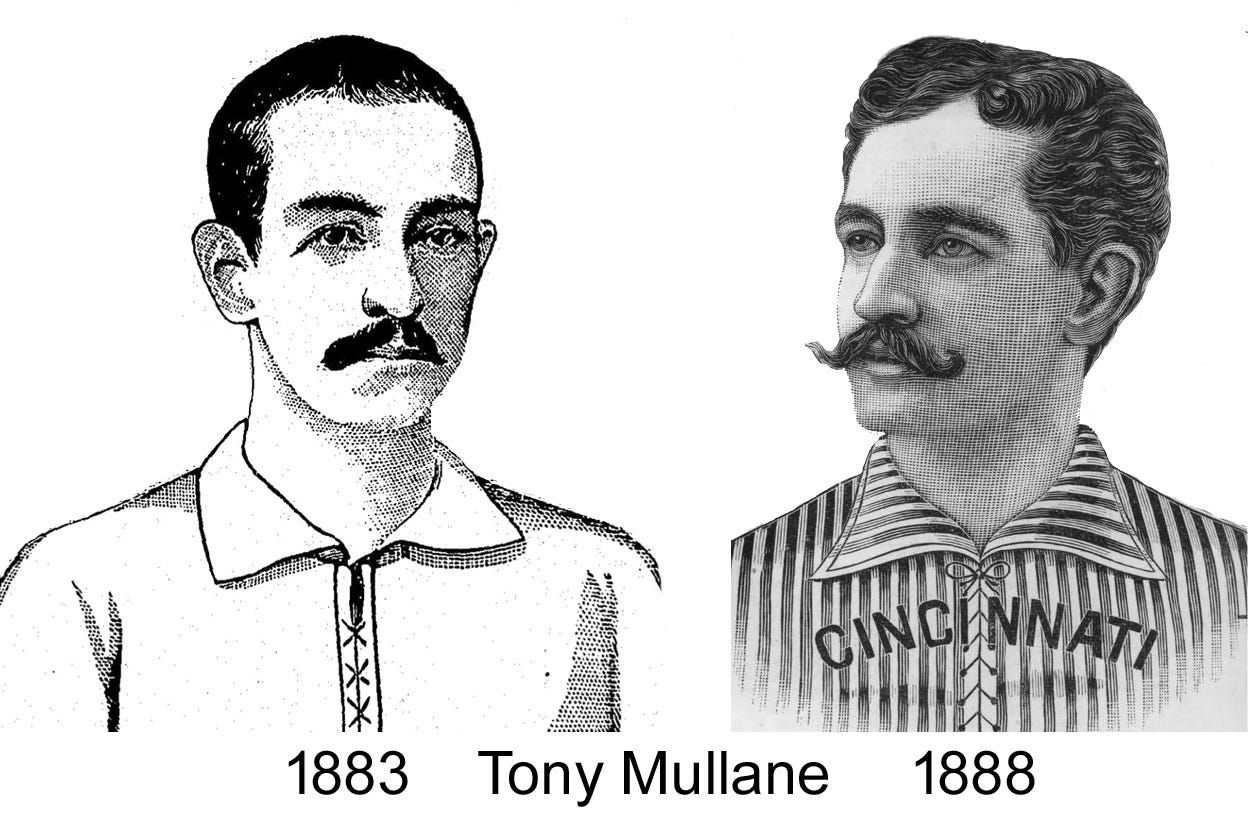
You can take the man out of the shotgun shack…
Mullane was one of the first pitchers identified as throwing overhand in baseball history. This may have prevented him from joining professional teams. In 1879 he started with the Socials, a Buffalo, NY, semi-pro club of all-Irish players, but was scooped up by the Bradford, PA, semi-pro club late July. Bradford beefed up with Guy Hecker at first base in 1880, but the team dissolved before the Fourth of July. Mullane jumped from small teams to smaller teams in North Western Ohio for most of that Summer, with appearances, presumably, not recorded in box scores. On July 3rd, the itinerant hired gun pitched for the Jefferson, Ohio, “Occidental” in a game at Conneut. Three weeks later he’s in Titusville for Cambridge, PA. In September, Charlie Morton’s Akron club signed Mullane for a game against Anson’s Chicago White Stockings and Mullane led Akron to a 2-hit, 4–3 win, with 13 strikeouts. Mullane stayed with Akron for about one year before debuting in MLB with Detroit, August 27, 1881. He beat Cap Anson again that day.
Detroit didn’t keep him. A terrible overall record was likely due to not being allowed to throw overhand in the National League. Mullane joined Louisville for 1882, then a founding member of the American Association. Mullane led the Association in starts and strikeouts and finished top five in nearly everything else. He pitched overhand to many complaints, and even fan chants against it. He was paid $90 a month and in July pitched ten consecutive Louisville games, going 5–5. In the third game of that run, July 18, he complained of a sore arm at Baltimore. Losing 1–7 to the last place Orioles, Mullane successfully pitched the bottom of the fourth inning with his left hand, making him the first of five ambidextrous MLB pitchers. Some errors regarding Mullane’s 1882 stats include a shutout he doesn’t deserve, June 15th, as he entered the game in relief. On the other hand, he seems to be cheated out of a June 24th relief win, and lost a 5–4, fifth inning lead at St. Louis, a week later, when Louisville captain Denny Mack pulled the team off the field. In September Mullane pitched fifteen consecutive hitless innings. Louisville president John Henry Pank promised to reward Mullane with a $1,200 contract, and Mullane gave verbal acceptance, but Charles Comiskey offered $1,500 and Mullane jumped to St. Louis for 1883.
Mullane was even better with St. Louis but couldn’t win the pennant alone. He lost two games in Philadelphia, September 4 and 6, the first against “Jumping Jack” Jones, and the second to Cub Stricker’s late game rbi-double. The Athletics swept and claimed the pennant. Von der Ahe rewarded Mullane anyway with the promise of a $1,900 contract, but Mullane jumped again, November 6, and signed with St. Louis of the Union Association for $2,000 plus a $500 advance. A reserve clause was in Mullane’s 1883 contract.
Over that Winter, Toledo manager Charlie Morton, who had managed Mullane at Akron, took a steamship to Mullane’s home in Erie and badmouthed the Unions. Mullane, now fearing the blacklist, signed February 1 with Toledo for the same $2,500. When the Unions lost him, St. Louis owner Chris von der Ahe appreciated the lesser of two evils, and quieted down about reserving the ace. Henry Lucas however, the St. Louis Union owner, and the president of the Union Association, took out an injunction against Mullane and sued for breach of contract; legal moves that scared Mullane. The battle made its way to the United States Sixth Circuit court where one judge John Baxter, appointed by Rutherford Hayes, issued a brutal appeal dismissal, May 13, 1884: “Baseball is beneath the dignity of the courts to notice.”
Oof.
For fear of arrest Tony Mullane did not pitch a game in St. Louis between September 1883 and April 1887. Mullane was splendid in Toledo. As arm heights came up, and as Mullane took steps with each pitch, there was a short period of time late in the year when Mullane looked like a cricket bowler. After Charles Radbourn pitched in 22 consecutive August-to-September games, something I referenced above, Mullane ran his own streak of 14 consecutive complete game starts mostly with catcher Tug Arundel. This streak ended October 4th, with only two games ending as losses. (When Pittsburgh’s Ed Morris started ten straight in 1885, he won only three.) The trick of pitching double-digit consecutive team games never again occurred.
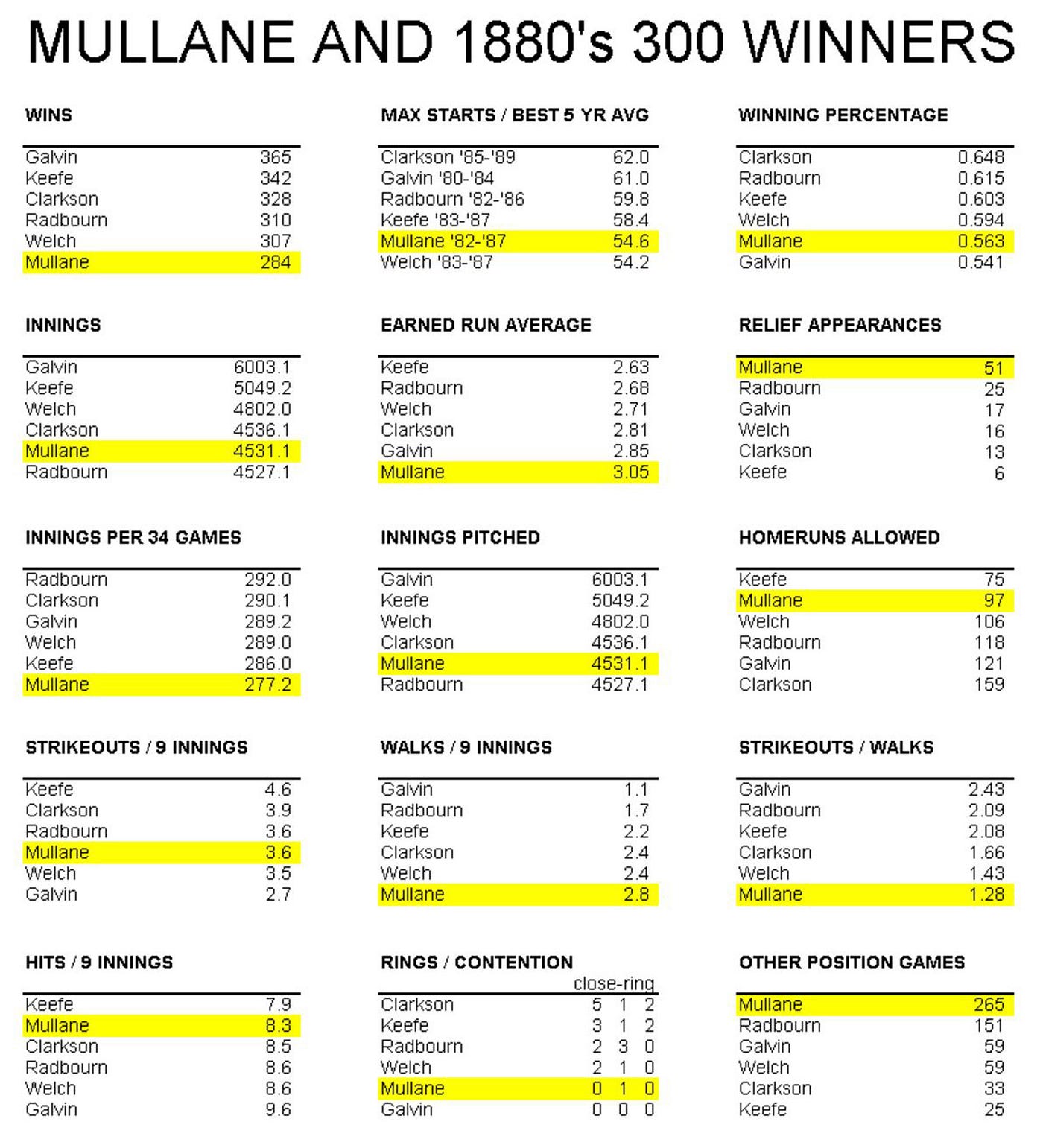
Remember, Mullane’s unserious attitude toward his own pitching career cost him about 170 starts.
Toledo lost money and the franchise disbanded October 25, 1884. The day before disbanding, Toledo sold Mullane back to von der Ahe’s St. Louis Browns. Von der Ahe had Mullane sign in front of a notary, October 24, 1884, to an agreement that he would sign a $3,500 St. Louis contract when he became eligible, November 4. Mullane enthusiastically told von der Ahe he would sign right after midnight. But on that day, Mullane snuck away from the hotel and signed with Cincinnati for $3,000 and a $2,000 bonus. This made Mullane the first $5,000 a year player. Von der Ahe, enduring a second jump now, was so angry that he lobbied for Mullane’s expulsion from baseball. On December 9th, the Amercan Association’s arbitration committee split the difference and suspended Mullane for one year, the season of 1885. Cincinnati paid Mullane $3,200 for sitting in the grandstand and smoking cigarettes. Mullane opened a Cincy saloon and promised fans a championship when he returned in 1886.
“I do not care what people say or think of me, just so long as I get paid.” Tony Mullane, December 8, 1884.
But Mullane opened 1886 decidedly out of practice. A loss June 4th, dropped him to an 8–10 record. The next day the Cincinnati Times Star ran a “Tony The Traitor” headline and accused Mullane of throwing that game, played in Brooklyn. Mullane sued the tabloid for $20,000, but the Enquirer did its own investigation and reportedly found evidence corroborating not only the June 4 game, but a May 24th game in Philadelphia. Mullane did not pitch the May game, Jack McKeon did, but Mullane had reportedly sent telegrams to two Indianapolis saloon owners advising how to bet. The American Association held an emergency meeting, June 30, in Cincinnati, and Mullane was cleared when, among other things, the saloon owners failed to show. Brooklyn owner Charlie Byrne pushed for a lifetime ban. Mullane won only one of eleven starts during this turmoil but still finished with 33 wins.
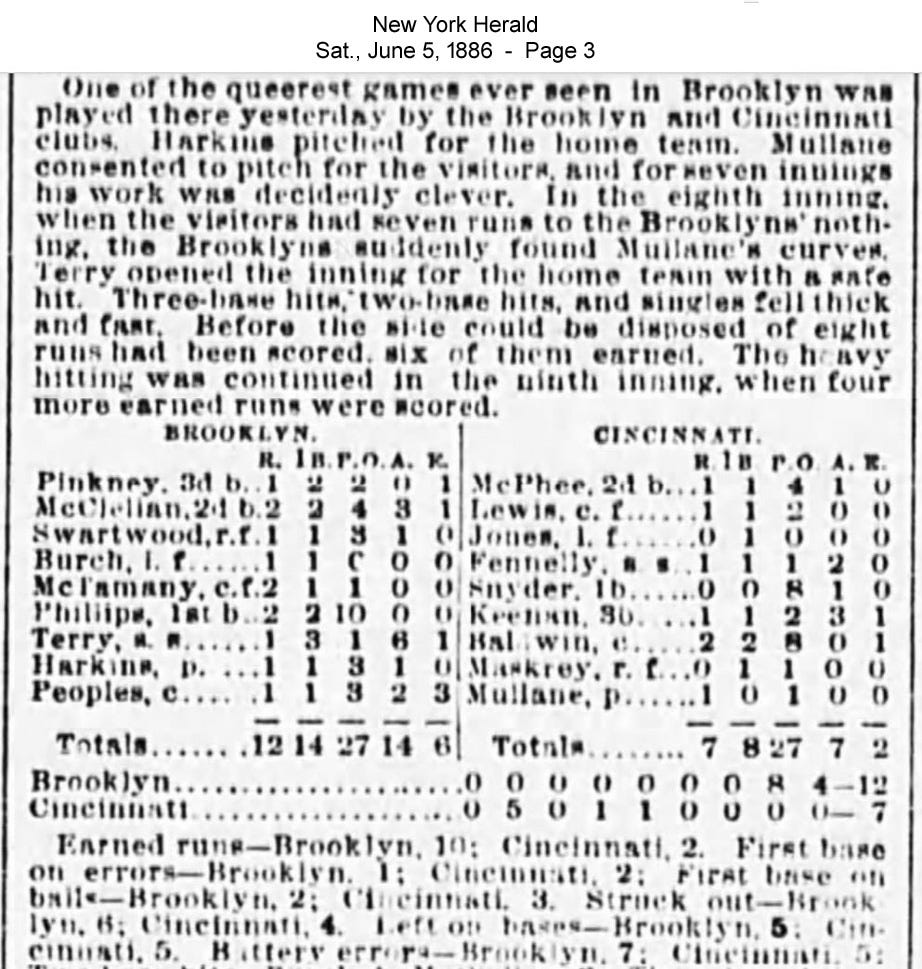
This game almost got Mullane thrown out of baseball for good. The Cincinnati Enquirer reported that letters from Mullane regarding how to bet on this game were sent to Indianapolis saloon owners. These letters never materialized.
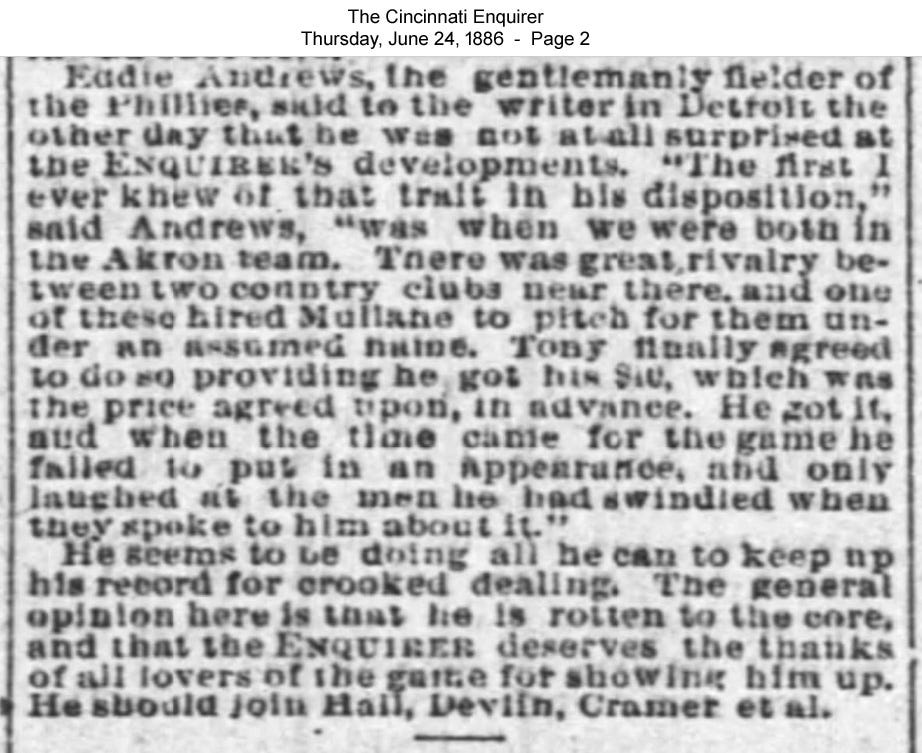
During the 1886 run up to Tony Mullane’s possible expulsion from baseball, Phillie infielder Ed Andrews related a story of how Mullane used to steal money from fledgling independent teams in 1881. (Cincinnati Enquirer, June 24, 1886, page 2)
In 1887, Mullane opened 8–2, but complained about pitching more than two games per week. On May 18, Mullane refused to take the field “unless I get extra pay for it.” he said. Manager Gus Schmeltz fined him $100, sent Mullane home, and announced he would see Mullane contractually reserved, paying the “five-hundred dollars per year indefinitely to keep him from pitching.” Mullane then jumped the Reds for Rutland, VT, June 4th, where he signed to play with a country club team for $200 and profit sharing. Using untested rookie pitchers, Cincinnati went from 2nd place, three and one-half games back to sixth place, under .500. Season ruined. Schmeltz trudged it to Rutland, June 15th, and won back the recalcitrent pitcher by agreeing to pay him $10 more for each third or fourth start Mullane made during a calendar week. Despite missing 35 days, Mullane still notched 31 wins on the season. While Mullane was in Vermont he lost his $2,000 life’s savings in a bank run.
1888 hoped to be a first Cincy season without a distraction. He opened 11–3, but was arrested July 31, during a win at Brooklyn that put Cincy 2.0 games behind St. Louis. Mullane was not playing that day, but had ignored a $218 liquor bill for his now closed Cincinnati saloon. (This was not the 1882 $200 bar tab that he was also sued for.) Sheriffs threw him in Brooklyn’s Raymond Street Jail for two nights for contempt of court. Then he lost four of five while fighting the charges. After an ugly loss against Brooklyn, Cincy owner Aaron Stern announced that he would never use Mullane against Brooklyn again. Mullane started wearing a top hat when in civilian clothes, and the other players referred to him as bad luck. Schmelz, left Mullane in Cincinnati for the team’s last Eastern road trip, and Mullane was pitching for Cincinnati’s amatuer Shamrocks, while the Reds dropped out of contention. Schmelz shopped the 29-year old pitcher around during that idle month, but Baltimore manager Billy Barnie rejected a straight-up trade for outfielder Mike Griffin. Mullane’s streak of five 30-win seasons ended. You can’t make this stuff up.
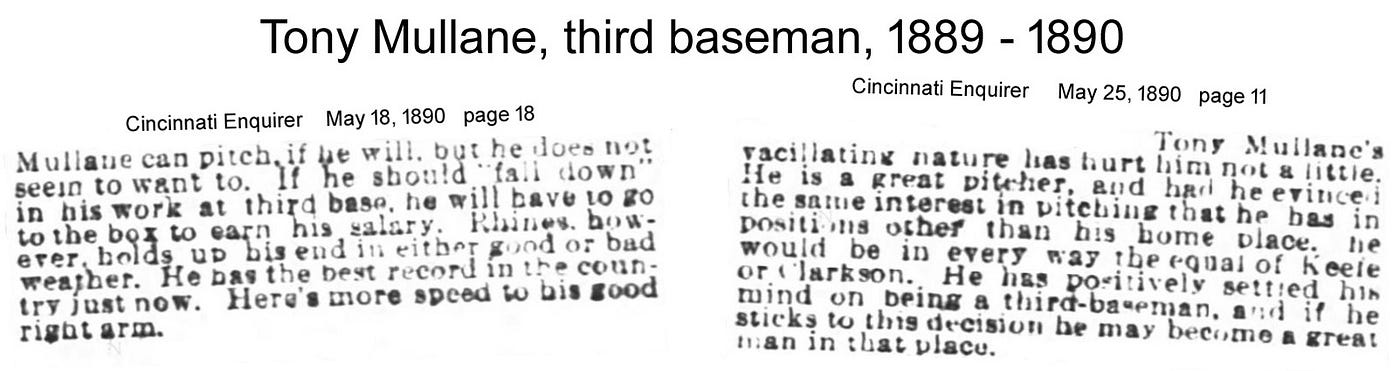
Tony Mullane wrecked his 1889 and 1890 seasons by trying to be a third baseman. The Reds went along with this ridiculous cosplay.
A little more focus in 1889? No. In Spring training Mullane announced he wanted to be a third baseman. Cincinnati president Aaron Stern, and manager Tom Loftus went along with this ridiculous cosplay and actually released third baseman Hick Carpenter, who was second on the team in batting. Mullane sucked, and the Reds were under .500 in the middle of June. Mullane rejoined the pitching rotation half-heartedly and won eleven games for the year. This exact same script repeated in 1890.
Finally, on July 20, 1890, the Cincinnati Enquirer wrote: “It is a source of wonderment that Mullane is not used more frequently in the box.” Mullane returned to pitching full time six days later. In 1891 had his first inconsistent season, but found his groove in 1892 and was on-track for a 40-win season. However, on Sunday, July 3rd, after he won his major league leading nineteenth game, the team met at the Gibson House and was handed down immediate 20% pay cuts, a league wide mandate that reflected the owners new monopoly position. Mullane made himself the only player in the National League to refuse this cut. He was immediately released, but won his 20th and 21st games during the ten-day period in which his contract expired. He debuted as a singer at Cincinnati’s Highland House theater, on Mt. Adams, July 17, in the play “Our Married Men”. In full baseball uniform he sang “Not in a Thousand Years” (would he leave baseball if offered the right salary). This engagement lasted one week. Mullane almost returned to the team then, but Reds owner John Brush announced Mullane’s pay cut would be 50%. In Mullane’s defense, it should be remembered that of all the players in baseball, only Mullane was suspended an entire season for disrespecting a contract. His expectation that MLB owners would honor the signed paper he had in 1892 was understandable, if naive.
“Cold, selfish, exclusive,” the Brooklyn Eagle wrote, Mullane “has a stinginess that makes him unpopular.”
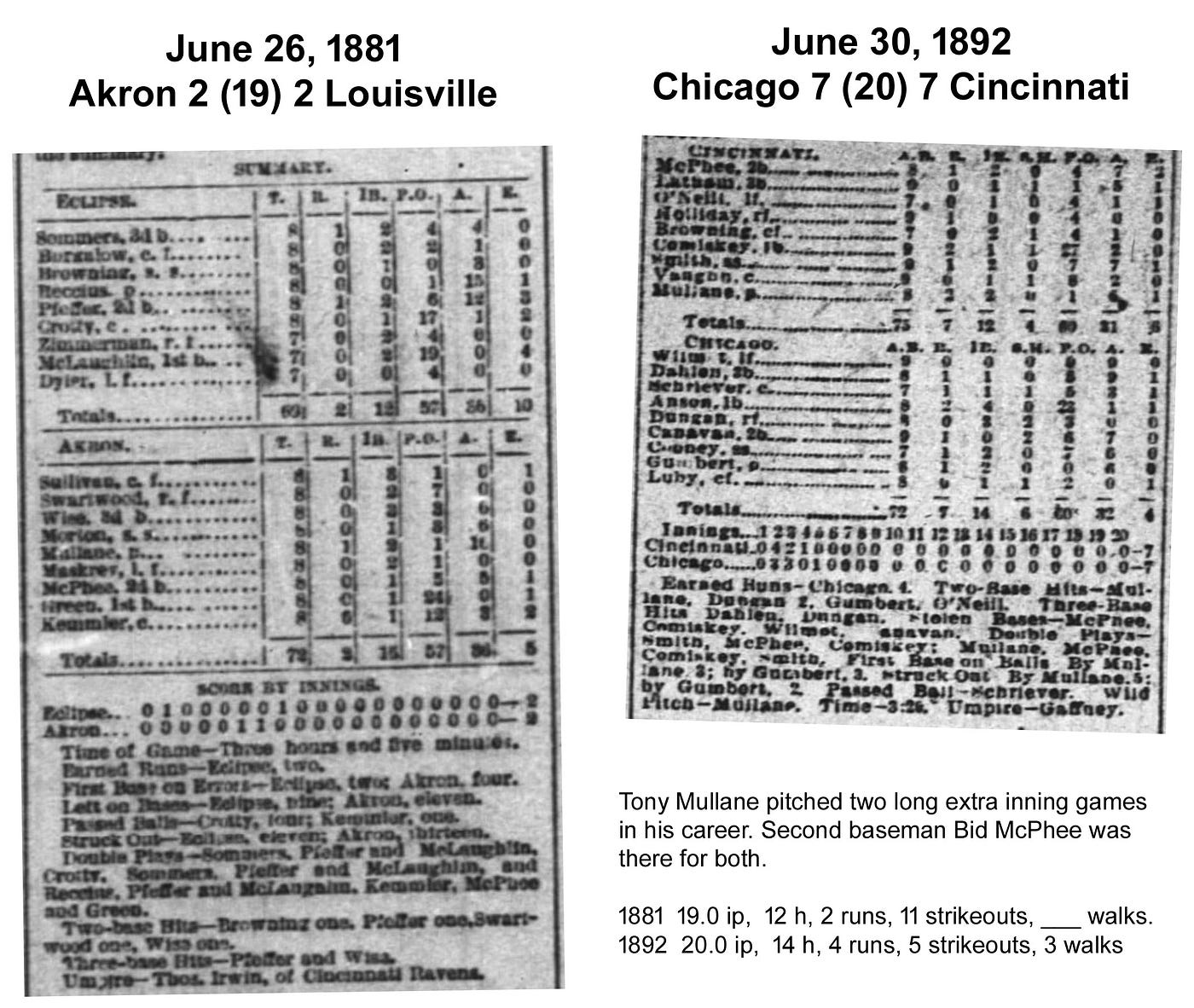
Mullane was known for pluck and endurance. He pitched a nineteen inning game in 1881, and a twenty inning game in 1892. Both were ties.
On August 14, 1892, as Cy Young passed Mullane with his 22nd win, Mullane debuted for Butte in the Montana State League. Butte ownership was making an effort to promote the town to have Butte considered the Montana capitol. Mullane went 4–3 in seven starts and helped Butte win the state championship. When Mullane rejoined Cincinnati in 1893, he recommended Jud Smith, and Comiskey signed the Butte third baseman. It was later reported to be a spite move after Smith turned out to be a heroin addict.
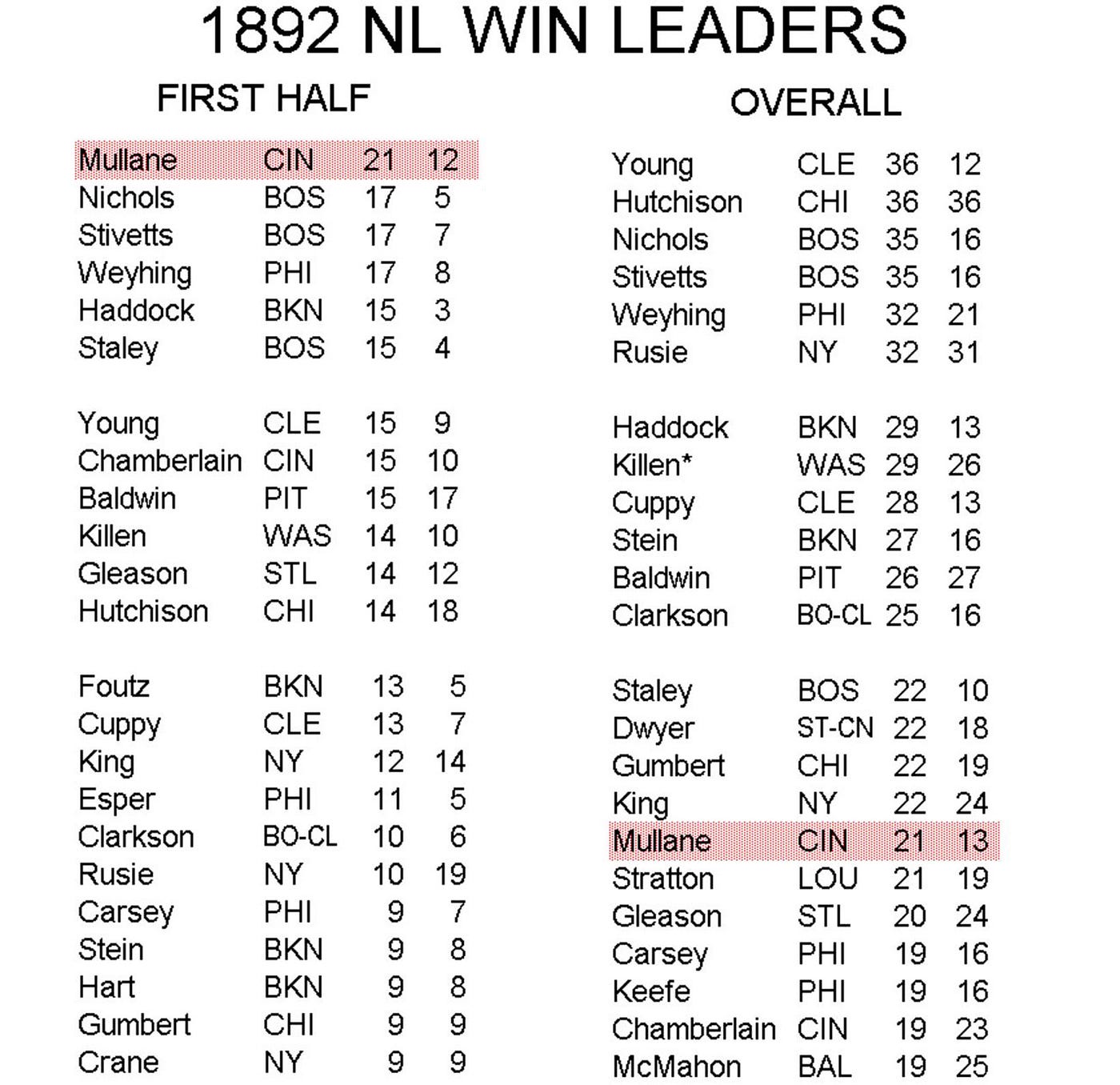
Mullane was leading the NL in wins, by far, when he refused a pay cut and was released, July 3rd. He pitched for Butte, Montana, in the second half.
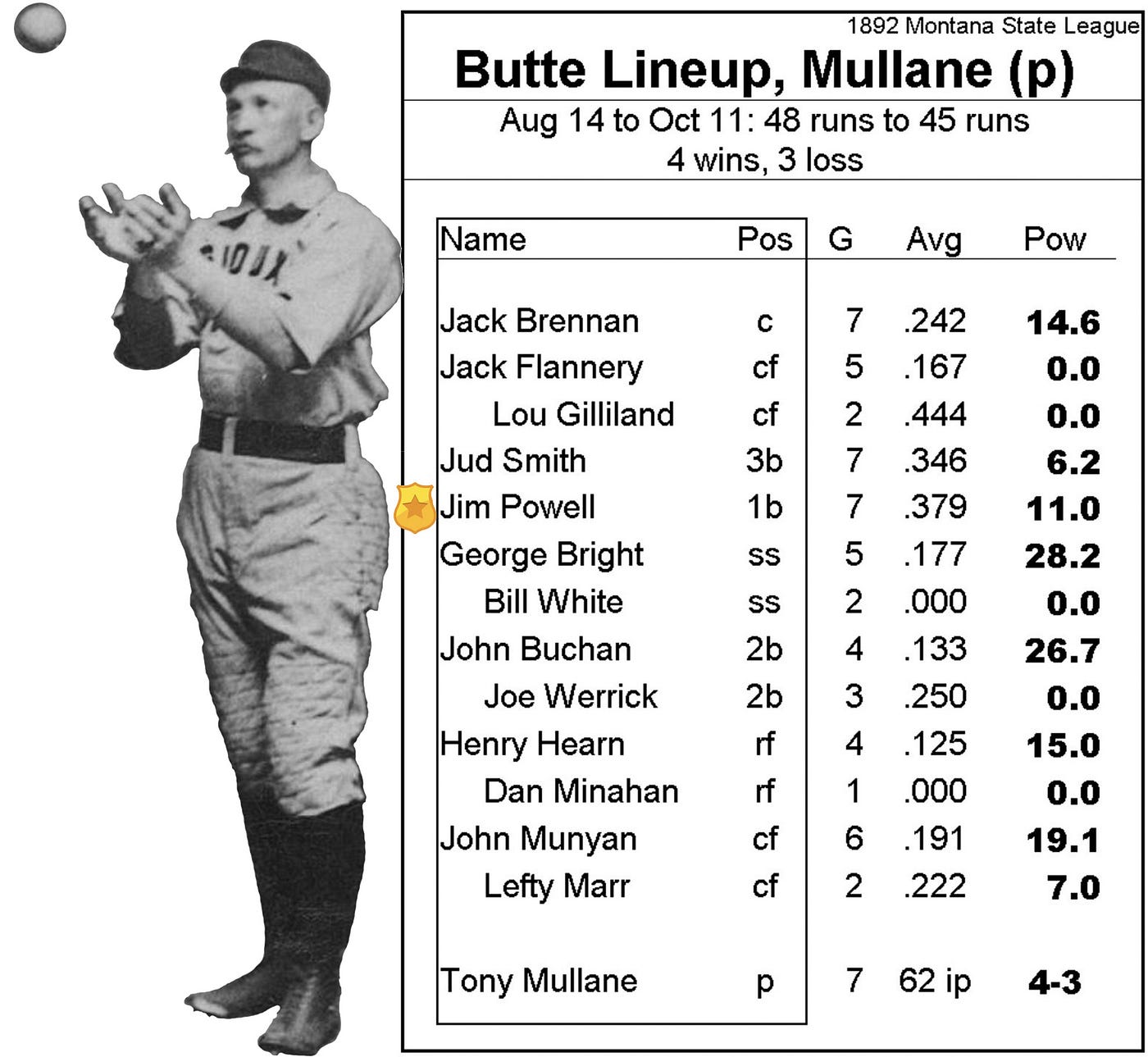
Butte, Montana, shown for the seven games Tony Mullane pitched. Mullane also played the outfield when Toree S. Caplinger pitched. Player-manager-captain Jim Powell, shown, was inundated with ex-major and Western leaguers who flooded the Montana State League after Mullane made his jump.
Cincinnati discarded Mullane early in 1893, and Baltimore picked him up. To mid-’94 Mullane seemed to be troubled by the increased pitching distance. On June 18, 1894, Mullane allowed 16 runs, all earned, in the bottom of the first inning at Boston, to this day, the most runs given up by one pitcher in one inning. That doesn’t happen by accident. He had an ingrown nail, and tried pitching for Cleveland, but was released for good, July 31, 1894. His wife, the former Barbara Lawless, had just won her divorce case against him. They were married from November 4, 1887 to July 12, 1894, and she had been considered one of the most beautiful women in Cincinnati. She charged “cruelty”, but her mother and sister were implicated in a Kentucky kidnapping plot in 1903. I’m sensing Barbara knew more about cruelty than she told the court.
How’s that for a career?
There’s a cherry on top. In 1975, civil rights historian Ocania Chalk, in his book “Pioneers of Black Sport”, unearthed a Mullane quote on Fleet Walker, his African American catcher with Toledo in 1884. While Walker was still living, Mullane said: “I had it in for him. He was the best catcher I ever worked with, but I disliked a negro and whenever I had to pitch to him I used to pitch anything I wanted, without looking at his signals.”
Walker suffered a broken collar bone, July 12, the likely result of a foul tip. Did Mullane’s not signalling occassion this career ending injury? Walker came back to catch Mullane five times through Labor Day, but was released in early September for lameness.
Mullane’s signing with Comiskey in 1895 is not only a humbling reset for the once great pitcher, but a pivot point from where he exhibited better behavior over eight minor league years. He umpired some, became a policeman in Chicago, and outlived nearly all of his teammates.
He spent his career penny wise and pound foolish. After Schmelz promised him $10 for additional starts per week, Mullane earned that bonus twice. Mullane jeapordized his chance for 300 wins for twenty dollars. Had Mullane for a moment understood his role as a professional athlete, and not some feral animal that accidentally made it near the buffet table, he would have close to 380 wins. As it is, presuming Roger Clemens will eventually be forgiven, to have Mullane as the pitcher with the most wins not in the Hall-of-Fame is to have symmetry in the universe.
Do not weep for Tony Mullane.
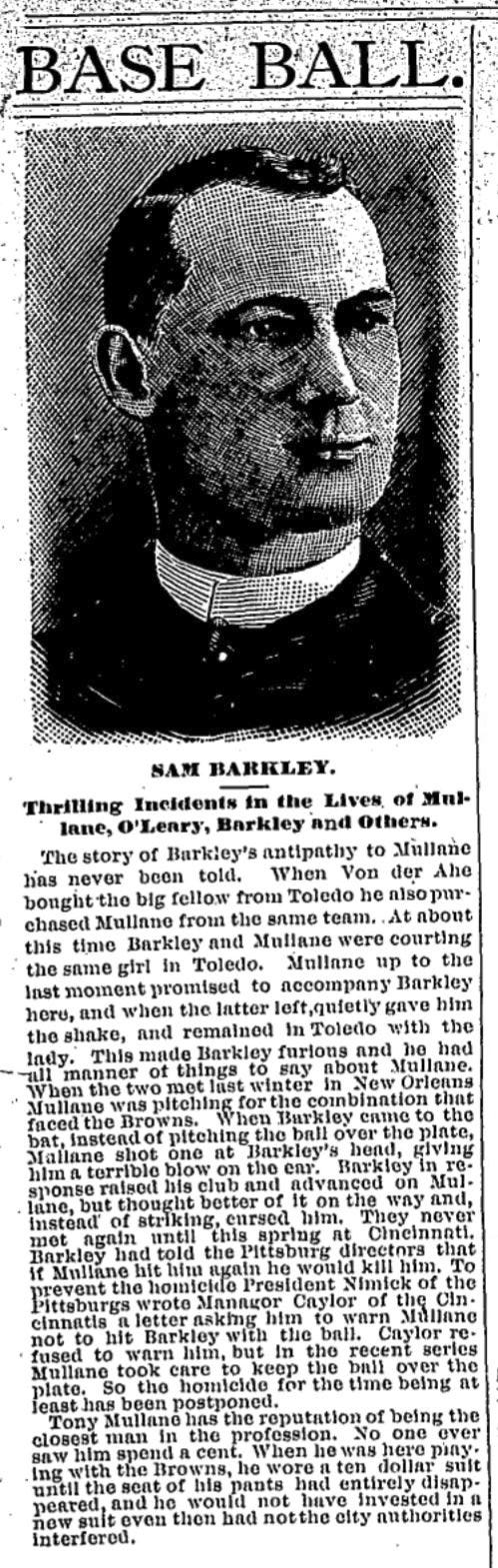
Mullane and Sam Barkley feuded over a Toledo woman late in 1884. Later, Mullane beaned Barkley as promised, in New Orleans, December 20, 1885. Barkley winged the bat at Mullane, per the New Orleans Times Picayune. No one was hurt or ejected. (The Sporting News, May 10, 1886, page 5.)
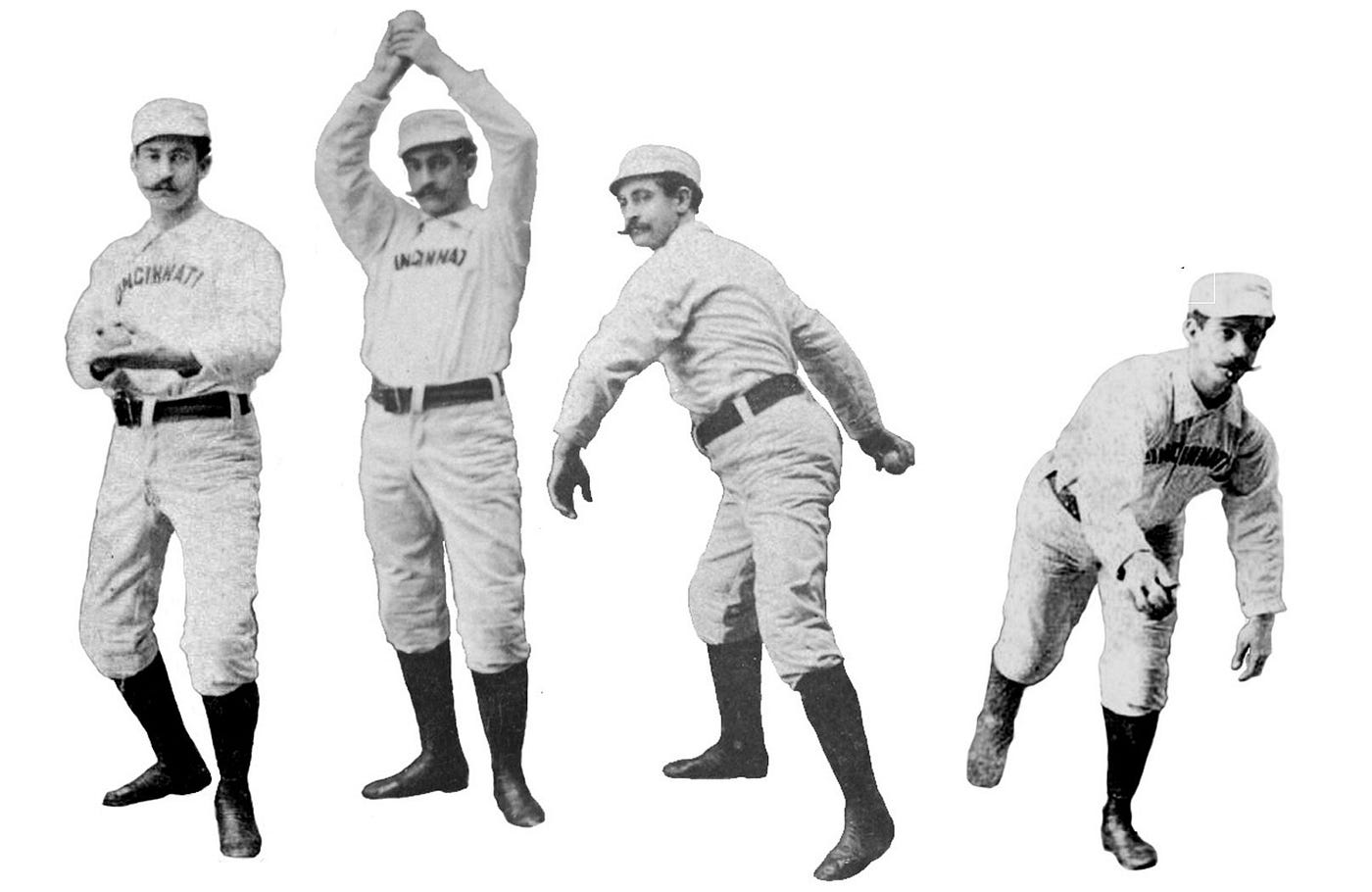
Tony Mullane from 1888 Old Judge baseball cards. Note the dangling left arm in the fourth image. 1880’s pitchers had not yet learned to generate rotational torque with their non-throwing arms. The arms just seem to hang there in most photos like an arm on a T-Rex. In my opinion, with the possible exception of John Clarkson, they did not throw 90 miles an hour yet. Photos of Tim Keefe, available on line, also show this.
메타데이터
- post_id
- e4e42626efbb
- slug
- tony-mullane-e4e42626efbb
- url
- https://medium.com/@infofrankvaccaro/tony-mullane-e4e42626efbb
- canonical_url
- https://medium.com/@infofrankvaccaro/tony-mullane-e4e42626efbb
- author_url
- https://medium.com/@infofrankvaccaro
- status
- ok
- fetched_at
- 2026-06-27 07:40:21