7 D2C Statistics That Prove Broken Order Management Is Killing Your Growth
If your orders are messy, your growth is already bleeding. Here is the data that proves it.
7 D2C Statistics That Prove Broken Order Management Is Killing Your Growth
If your orders are messy, your growth is already bleeding. Here is the data that proves it.
The Indian D2C market is one of the fastest-growing in the world. Brands are scaling fast, ad budgets are going up, and customer acquisition is becoming more aggressive by the quarter. But there is a silent killer sitting right in the middle of most D2C operations, and it is not your CAC, your ROAS, or your return rate in isolation.
It is broken order management.
Most founders and ops leads underestimate how directly their order management system in India impacts growth. They fix the storefront, optimize the ads, and obsess over packaging, but the moment an order is placed, the cracks start showing. Wrong SKUs shipped. Delayed fulfillments. Inventory mismatches. WISMO (Where Is My Order?) tickets piling up. And customers who never come back.
Choosing the right order management system in India is one of the highest-leverage operational decisions a growing D2C brand can make.
This blog breaks down seven statistics that make the cost of broken order management impossible to ignore, and what it actually takes to fix it.
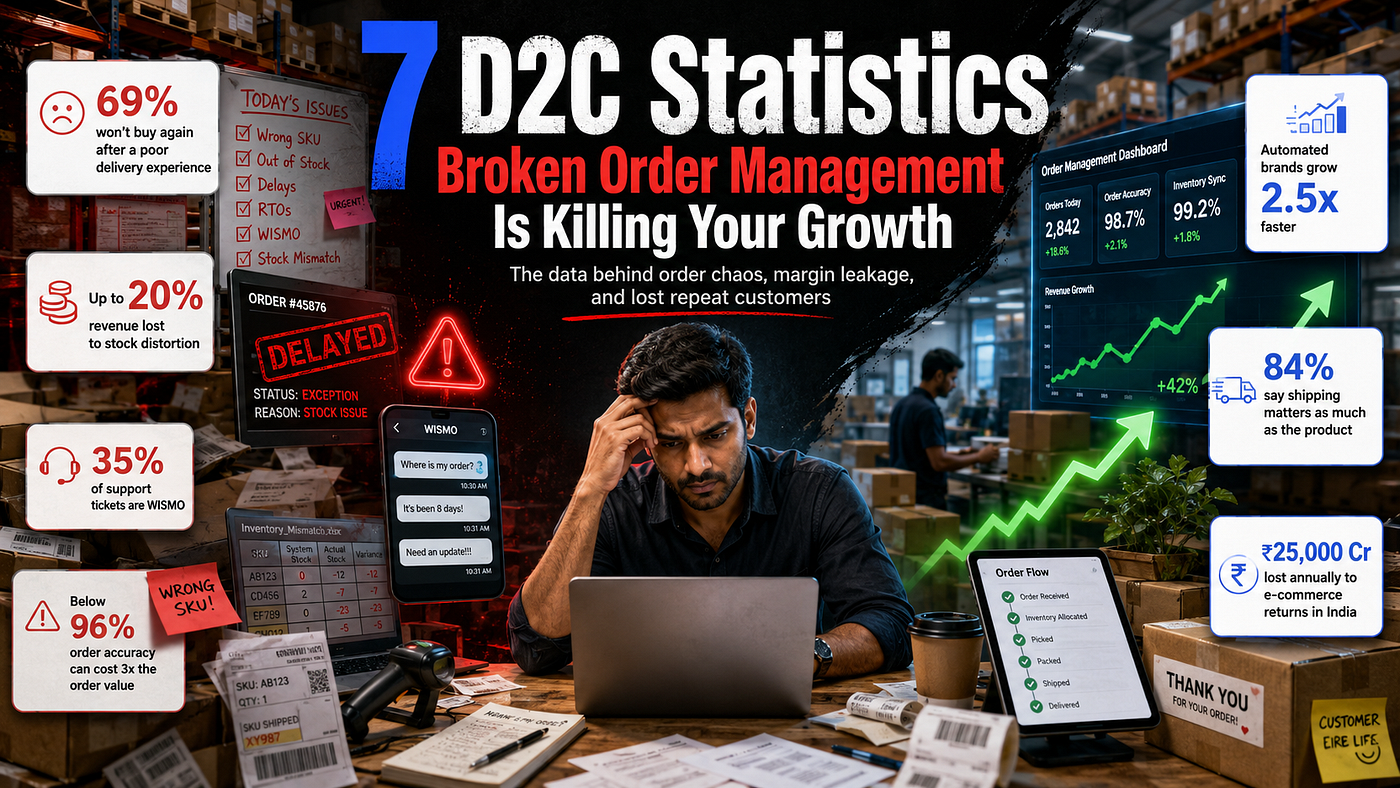
1. 69% of customers will not shop with a brand again after one poor delivery experience
One. That is all it takes.
A 2023 survey by Metapack found that 69% of consumers are unlikely to shop with a retailer again after a negative delivery experience. For D2C brands spending anywhere between ₹300 and ₹1,500 to acquire a single customer, that is an extraordinary amount of LTV being destroyed by a logistics failure that often has nothing to do with the product itself.
The delivery experience is not just a logistics problem. It is a data problem. And the data lives inside your order management system in India. When order status updates are delayed, when warehouse handoffs are manual, when fulfillment teams are working off spreadsheets, the customer experience suffers before the courier even picks up the package.
Reference: Metapack Consumer Research Report, 2023, https://metapack.com/consumer-research
2. Businesses lose up to 20% of revenue due to out-of-stock and overstock situations
Inventory inaccuracy is one of the most expensive operational problems in D2C, and it is almost entirely preventable.
According to IHL Group, retailers globally lose over $1.75 trillion annually due to overstocks, out-of-stocks, and needless returns. When scaled to a mid-size D2C brand in India, even a 5 to 10% inventory inaccuracy can mean lakhs of rupees in lost revenue every quarter.
The root cause is almost always the same: an order management system in India that does not sync inventory in real time across channels. When your Shopify store, your marketplace listings, and your warehouse are not talking to each other, overselling and stockouts become inevitable.
OMS Platforms are built to solve exactly this, giving D2C brands a single source of truth for inventory across all channels, so what the customer sees online is what actually exists in the warehouse.
Reference: IHL Group, “Inventory Distortion Study”, https://ihlservices.com/inventory-distortion
3. WISMO calls account for up to 35% of all customer service tickets
If your support team is drowning, there is a good chance a broken order management system in India is why.
Research from Narvar shows that “Where is my order?” queries account for 35% or more of total inbound customer service volume for e-commerce brands. At scale, that is hundreds of hours of support time spent on a problem that should not exist, because real-time order tracking and automated status updates should handle it.
Every WISMO ticket is a signal. It means a customer is anxious, a fulfillment update was missed, and your ops team did not catch it before the customer did. The cost is not just the support agent’s time. It is brand trust, repeat purchase probability, and review ratings, all taking a quiet hit.
An intelligent order management system in India eliminates most WISMO volume by automating status updates at every fulfillment milestone, from packing to dispatch to last-mile delivery.
Reference: Narvar Consumer Report, https://narvar.com/research
4. Order accuracy rates below 96% can cost a brand 3x the value of the original order
Returns are expensive. But the cost of a wrong order goes far beyond the reverse logistics fee.
A study by the Reverse Logistics Association estimates that processing a return costs a brand 3x the original order value when you factor in shipping, restocking, customer service, and lost lifetime value. For D2C brands in India with average order values between ₹500 and ₹2,000, a wrong order does not just erase the margin, it creates a net loss.
Order accuracy is directly tied to how well your order management system in India communicates with your warehouse management system. Disconnected tools, manual pick-and-pack instructions, and no barcode verification at dispatch are the three most common reasons accuracy rates fall below 96%.
OMS Platforms helps D2C brands close this gap with end-to-end order flow automation that reduces manual intervention and brings accuracy rates up to 99%+.
Reference: Reverse Logistics Association, https://reverselogisticstrends.com
5. D2C brands that automate fulfillment operations grow 2.5x faster than those that do not
This is the growth statistic most founders do not see until they are already behind.
McKinsey research on e-commerce operations found that brands that invest in fulfillment automation, including order routing, inventory management, and carrier selection, grow significantly faster than those relying on manual processes. The operational leverage compounds: as order volume scales, automated brands handle the growth without proportional headcount increase. Manual brands hit a wall.
For Indian D2C brands specifically, the order management system in India is often the bottleneck at the ₹5 crore to ₹20 crore revenue stage. Founders find that what worked at 100 orders a day breaks completely at 1,000. The gap is not team size. It is the system underneath.
Order Management Systems are designed for exactly this inflection point, giving growing D2C brands the infrastructure to scale order operations without scaling chaos alongside it.
Reference: McKinsey & Company, “The future of fulfillment”, https://mckinsey.com/capabilities/operations/our-insights
6. 84% of customers say the shipping experience is as important as the product itself
Your product might be flawless. But if the order experience is broken, customers do not separate the two.
A Forbes and Convey study found that 84% of consumers consider the shipping and delivery experience equally important as the product when deciding whether to purchase again. In a market like India, where cash on delivery still accounts for 40 to 50% of D2C orders and return windows are a key conversion lever, the post-purchase experience is not a nice-to-have, it is a competitive advantage.
The order management system in India you choose directly shapes this experience. From automated dispatch confirmations to real-time tracking links to proactive delay notifications, every touchpoint after “Order Confirmed” is powered by your OMS. Brands on disconnected or legacy tools have no visibility into these moments and no way to intervene when something goes wrong. Upgrading your order management system in India is the single fastest way to reclaim that visibility.
Reference: Convey + Forbes Insights, “Shipping and the Customer Experience”, https://getconvey.com/resources
7. Indian e-commerce returns cost the industry over ₹25,000 crore annually
Returns are not just a D2C problem. They are a sector-wide crisis, and order management is at the center of it.
According to a 2023 report by Redseer Strategy Consultants, the Indian e-commerce sector loses over ₹25,000 crore annually to returns. A significant portion of these returns are not driven by product dissatisfaction, they are driven by wrong items shipped, delayed deliveries that led the customer to purchase elsewhere, or damaged packaging from poor fulfillment handling.
All three of those causes trace back to the order management system in India. Wrong items ship when pick-and-pack is not validated. Delays happen when warehouse handoffs are manual and routing is not optimized. Damaged goods result when packing instructions are not embedded in the order workflow.
OMS helps D2C brands reduce return rates by building quality checkpoints directly into the order management flow, from SKU verification at picking to automated carrier selection based on delivery SLAs.
Reference: Redseer Strategy Consultants, Indian E-Commerce Returns Report 2023, https://redseer.com/reports
What these Seven Statistics are Really Telling You
Put them together and the picture is clear.
Broken order management does not just create operational headaches. It erodes customer trust, inflates support costs, destroys margins on returns, and prevents the kind of compounding growth that D2C brands are chasing. In India, where the market is growing fast but customer patience is short and competition is one scroll away, the cost of bad order management is measured in retention, not just revenue.
The good news is that this is a fixable problem. Not with more headcount. Not with more spreadsheets. With the right order management system in India.
Brands that invest in robust order operations, real-time inventory sync, automated fulfillment workflows, accurate dispatch, and proactive post-purchase communication, are the ones compounding their LTV while their competitors are busy firefighting.
Base.com is built for D2C brands ready to make that shift. From multi-channel inventory management to ERP-integrated order workflows, it gives growing brands the operational foundation to scale without breaking.
If any of the seven statistics above felt familiar, that is your signal. The right order management system in India is not a back-office investment, it is a frontline growth decision. And OMS makes it easier than ever to get started.
Key takeaways
- Delivery experience directly drives repeat purchase rates, and 69% of customers do not give a second chance after a bad one.
- Inventory inaccuracy and disconnected systems cost brands up to 20% of revenue.
- WISMO tickets are a symptom of a broken order management system in India, not a support team problem.
- Order accuracy below 96% creates net losses on every wrong shipment.
- Fulfillment automation is a growth lever, not just an ops fix.
- Post-purchase experience is as important as the product for 84% of customers.
- India loses ₹25,000 crore annually to preventable returns.
메타데이터
- post_id
- e4e620646fa8
- slug
- 7-d2c-statistics-that-prove-broken-order-management-is-killing-your-growth-e4e620646fa8
- url
- https://medium.com/@p.chandrasekaran/7-d2c-statistics-that-prove-broken-order-management-is-killing-your-growth-e4e620646fa8
- canonical_url
- https://medium.com/@p.chandrasekaran/7-d2c-statistics-that-prove-broken-order-management-is-killing-your-growth-e4e620646fa8
- author_url
- https://medium.com/@p.chandrasekaran
- status
- ok
- fetched_at
- 2026-07-16 16:34:10