Supersymmetry: A Grand Idea under Pressure
For decades, supersymmetry was the shining favorite to take particle physics beyond the Standard Model. It promised elegant mathematics…
Supersymmetry: A Grand Idea under Pressure
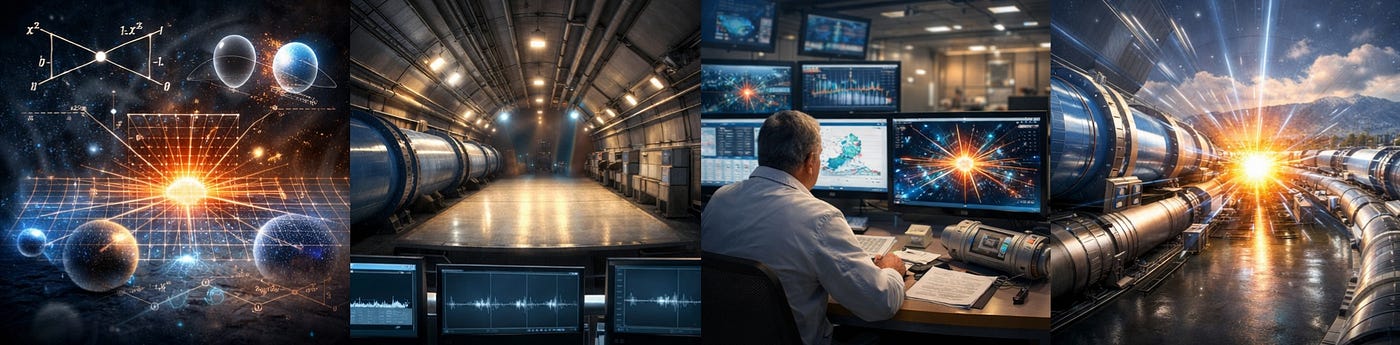
For decades, supersymmetry was the shining favorite to take particle physics beyond the Standard Model. It promised elegant mathematics, deep unification, and even a candidate for dark matter. When the Large Hadron Collider (LHC) near Geneva came online, many physicists expected supersymmetric particles to appear in the data like long awaited celebrities stepping onto the red carpet.
More than a decade later, the red carpet is still empty.
So is supersymmetry finished? And will future LHC experiments finally settle the question once and for all?
The story is more interesting than a simple yes or no.
What supersymmetry tried to fix
The Standard Model is stunningly accurate. It predicted the Higgs boson long before its discovery in 2012. But it leaves nagging questions unanswered:
• Why is the Higgs mass so small compared to the Planck scale? • What is dark matter made of? • Why does the universe behave so neatly, despite quantum chaos beneath the surface?
Supersymmetry offered a beautifully structured answer: every known particle has a heavier partner. The mathematics smooths out the ugly infinities that plague the Higgs, and some of those partner particles could make up dark matter.
It looked perfect on paper.
The LHC was the machine built to test such bold ideas. It smashed protons together at unprecedented energies, creating fleeting showers of exotic particles. If supersymmetric partners existed near the TeV scale, the LHC should have seen them.
It did not. Run after run, the collaborations released new results. Nothing.
Well, not nothing: the Higgs was confirmed. But the super partners remained invisible. As limits tightened, once promising supersymmetry models were pushed off the map.
The versions that were once considered “natural” now seem more like lucky guesses that never proved correct.
So is supersymmetry dead?
Not quite.
Supersymmetry is not a single theory. It is a vast landscape. When experiments exclude one region, theorists can adjust assumptions and move to another. This flexibility is both a strength and a problem. The theory survives, but becomes less predictive and less elegant.
There are still versions in which:
• super partners exist but are simply too heavy to detect • signals are subtle or rare • particles live long enough to evade standard searches
These possibilities are harder to rule out experimentally.
What the next phase will tell us
The High Luminosity LHC, starting later this decade, will vastly increase data collection. It will sharpen the search and probe more elusive effects. If supersymmetry exists at energies not too far beyond the Higgs mass, the upcoming experiments have a real chance to uncover it.
But here is the key point:
The LHC will never be able to test every corner of the supersymmetry landscape. There is no finite experiment that can.
The theory can retreat to higher masses and more exotic configurations indefinitely. That does not make it wrong. It simply makes it a hypothesis that physics may one day decide is no longer the simplest explanation.
A shift in mood
Two decades ago, many young researchers saw supersymmetry as the future. Today, the tone is more restrained. Interest has diversified. New frameworks compete for attention. Precision measurements, neutrino physics, and cosmology are now driving fresh lines of discovery.
Supersymmetry still lives in the toolbox. It remains mathematically powerful and conceptually appealing. But it is no longer the default answer.
Where this leaves us
Supersymmetry has not been proved. It has not been disproved. It has been cornered.
The LHC has already reshaped the theory, narrowing what is plausible and making many earlier expectations look naive. The coming years will push even harder.
And yet, the deeper lesson may be this:
Nature is not obliged to follow our sense of elegance.
Sometimes the universe is stranger, messier, and more surprising than even our most beautiful equations suggest.
Which, for science, is perhaps the most exciting possibility of all.
메타데이터
- post_id
- e4ea7e7ee9aa
- slug
- supersymmetry-a-grand-idea-under-pressure-e4ea7e7ee9aa
- url
- https://medium.com/@peter_24654/supersymmetry-a-grand-idea-under-pressure-e4ea7e7ee9aa
- canonical_url
- https://medium.com/@peter_24654/supersymmetry-a-grand-idea-under-pressure-e4ea7e7ee9aa
- author_url
- https://medium.com/@peter_24654
- status
- ok
- fetched_at
- 2026-06-09 15:37:30