What Happens When Redis Cache Expires?
Most systems feel fast… until the cache disappears.
What Happens When Redis Cache Expires?
Most systems feel fast… until the cache disappears.
This week, I ran a performance experiment to answer a simple question:
What really happens when Redis cache expires under load?
The answer is more surprising than expected — because the problem is almost invisible.
Experiment Setup
I built a simple test using:
- Spring Boot API
- Redis (TTL = 30 seconds)
- Simulated database delay (~100–300 ms)
- JMeter load test
Endpoint
GET /api/cache/test/1All requests hit the same key — important to simulate real cache behavior.
Real Test Result (Production-like Load)
From JMeter Summary Report:
- Total Requests: 1,734,951
- Average Latency: 3 ms
- Max Latency: 556 ms
- Throughput: 14,462 req/sec
At first glance, everything looks perfect.
But there’s a problem hidden inside this result.
The Hidden Spike
Even though the average latency is only 3 ms, some requests took over 500 ms.
These slow requests happened exactly when:
- Cache expired
- Requests hit the database
- The cache was rebuilt
This is the moment where performance briefly collapses.
Why You Don’t See It
Because averages lie.
Out of 1.7 million requests, only a tiny fraction hit the database.
So:
- Avg = 3 ms
- Reality = occasional 500+ ms spikes
📊 Visualizing the Spike
Here’s what actually happens over time:
- Most requests: fast (cache hit)
- At TTL boundary: sudden spike
- Then back to normal
This creates a repeating pattern:
👉 Fast → Fast → Fast → 💥 Spike → Fast → Fast
I generated a dataset to clearly show this behavior.
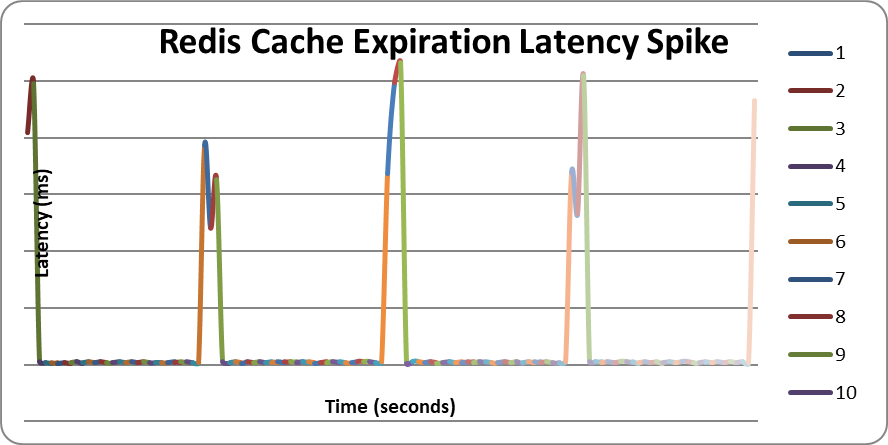
Redis Cache Expiration Latency Spike
Simulated Spike Data (Clear View)
To make the behavior visible, I ran a controlled dataset:
- Baseline latency: 3–6 ms
- Expiration spike: 200–550 ms
- TTL: 30 seconds
This produces a clear latency wave:
- Stable performance
- Sudden spike at expiration
- Recovery
What’s Really Happening
At expiration time:
- Cache entry disappears
- All incoming requests miss the cache
- Multiple requests hit the database
- Latency spikes
- Cache gets rebuilt
This is known as:
Cache Stampede
Why This Matters
In production systems:
- High traffic amplifies the problem
- Multiple services may expire at once
- Database gets sudden load spikes
This leads to:
- Unstable latency
- Performance degradation
- Hard-to-debug issues
The Most Important Lesson
Average latency hides real problems.
Your system may look fast:
- Avg = 3 ms
But users may experience:
- 300–500 ms delays
How to Measure It Properly
Instead of average, monitor:
- P95 latency ⭐
- P99 latency
- Cache hit ratio
These metrics reveal the real story.
How to Fix It
1. Add TTL Jitter
Duration.ofSeconds(30 + random.nextInt(10))Prevents simultaneous expiration.
2. Use Cache Lock
Only one request rebuilds the cache.
3. Preload Cache
Refresh before expiration.
4. Serve Stale Data
Return old data while refreshing in the background.
Final Thoughts
Redis cache expiration is not just a cleanup process.
It’s a performance event.
And if you don’t measure it correctly…
You won’t even see it happening.
🔖 Thanks for reading.
- If you enjoyed this article, please consider giving it a clap.👏
- I would appreciate hearing your thoughts in the comments below! 💭
- Follow me for ongoing learning and connection!🔔
메타데이터
- post_id
- e4eb3155c290
- slug
- what-happens-when-redis-cache-expires-e4eb3155c290
- url
- https://blog.stackademic.com/what-happens-when-redis-cache-expires-e4eb3155c290
- canonical_url
- https://blog.stackademic.com/what-happens-when-redis-cache-expires-e4eb3155c290
- author_url
- https://medium.com/@nithidol
- status
- ok
- fetched_at
- 2026-06-24 04:09:36