The 17-Gigawatt Opportunity: Why North Kalimantan Is Southeast Asia’s Next AI Data Center Frontier
How abundant clean hydropower, a world-scale green industrial estate, and a maturing digital backbone position Kaltara to capture the…
The 17-Gigawatt Opportunity: Why North Kalimantan Is Southeast Asia’s Next AI Data Center Frontier
How abundant clean hydropower, a world-scale green industrial estate, and a maturing digital backbone position Kaltara to capture the gigawatt-scale AI compute build-out.
Artificial intelligence has rewritten the rules of where the world’s most valuable infrastructure gets built. For decades, the deciding factor for a data center was network latency. That era is ending. Today, the single most important input for an AI training campus is abundant, low-cost, around-the-clock clean electricity and that is precisely the resource North Kalimantan (Kaltara), Indonesia, holds in extraordinary surplus.
This brief makes the affirmative case. Kaltara is not a province searching for investment; it is a province sitting on one of the largest concentrations of bankable, renewable, baseload electricity anywhere in emerging Asia. As the global AI build-out collides with a hard ceiling on available green power, the question is no longer whether sites like Kaltara matter, it is which one moves first.
1. The Resource: 17,000 MW of Clean, Bankable Power
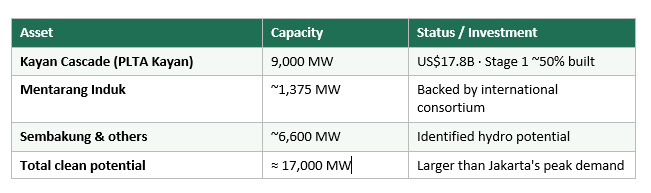
Kaltara’s rivers represent a generational energy endowment. The Kayan River alone runs 576 kilometers and anchors the planned Kayan Cascade hydroelectric project, a 9,000 MW development with a stated investment value of US$17.8 billion (≈ Rp275.9 trillion). Combined with the Mentarang and Sembakung systems, the province’s hydro potential exceeds 17,000 MW. A figure larger than the peak electricity consumption of Jakarta at its most intense, and roughly three times the entire dam-based generating capacity of West Java.
Crucially, this is not theoretical capacity. First-stage construction of the Kayan Cascade has reached approximately 50%, with the initial phase targeted for completion later this decade. The project has attracted some of the most credible names in global infrastructure: PowerChina, Sumitomo Corporation, and Hyundai Engineering confirming that the asset is engineering-validated at world-class scale.
Comparison: West Java’s combined reservoir-based PLTA + floating solar capacity is roughly one-third of the Kayan Cascade alone.
Why this matters for AI
AI training campuses now scale in gigawatts per site, not megawatts. A single Kaltara cascade could host multiple hyperscale training campuses simultaneously, a profile almost no other location in Southeast Asia can offer from a single, contiguous, renewable source.
2. The Timing: An AI Power Crunch Looking for Green Gigawatts
The demand side of this equation is exploding. Frontier AI developer Anthropic estimates that by 2027, training a single large AI model will require 5 GW of power, and that the U.S. AI sector alone will need an additional 50 GW of electricity capacity by 2028, equivalent to twice the peak demand of New York City. Independent analyses project global AI data center power demand could reach roughly 68 GW by 2027 and over 300 GW by 2030, against a total global data center capacity of just 88 GW in 2022.
This demand is increasingly chasing clean power. In 2024, Big Tech companies signed 43% of all clean-energy power purchase agreements globally, and Google, Meta, and Amazon are now the world’s largest corporate buyers of renewable energy. Google’s hydroelectric framework with Brookfield — unlocking up to 3 GW of carbon-free capacity — shows exactly the kind of long-term, hydro-backed procurement that Kaltara is built to supply.

The strategic fit
The world’s hyperscalers need vast, stable, carbon-free electricity on 20-to-30-year horizons. Hydropower is uniquely suited to this: it is firm, dispatchable, and decades-durable, unlike intermittent solar or wind. Kaltara offers exactly the input the market is now bidding aggressively to secure.
3. The Regional Market: A US$30 Billion Build-Out Next Door
Southeast Asia is one of the fastest-growing data center regions on earth. The market is projected to more than double from US$13.71 billion in 2024 to US$30.47 billion by 2030 (a 14.2% CAGR), while regional capacity is expected to triple to between 5.2 and 6.5 GW by 2030, driven by a tenfold increase in AI computing. The region’s generative-AI market alone is forecast to grow from US$0.8B in 2023 to US$13B by 2030 at a 50% CAGR.
Hyperscalers have already committed more than US$50 billion across the region. The neighbors’ momentum is Kaltara’s tailwind, not its threat. Every gigawatt of AI demand that lands in Johor, Batam, or Jakarta deepens the regional ecosystem of talent, supply chains, and connectivity that an adjacent green-power hub can plug into.

Indonesia specifically is moving fast. The national AI-optimized data center market is set to climb from US$0.66B in 2025 to US$1.44B by 2030, and the broader hyperscale market from US$3.49B to nearly US$8B. In July 2025, the government launched an AI Center of Excellence with NVIDIA, Cisco, and Indosat, while Indosat already markets NVIDIA H100 clusters under its “GPU Merdeka” sovereign-AI brand. The national appetite for AI compute and the policy will to localize it, is firmly established.
4. The Anchor: A World-Scale Green Industrial Estate
Kaltara’s power will not strand for want of an anchor tenant. The Indonesia Green Industrial Estate (KIHI/KIPI) at Tanah Kuning–Mangkupadi spans more than 30,000 hectares positioned to be the largest green industrial zone in the world, with an estimated investment pipeline of roughly US$132 billion, a projected annual economic contribution of around Rp1,000 trillion, and capacity to absorb up to 200,000 workers.
The estate is designed for exactly the kind of power-intensive, future-facing industries that pair naturally with AI infrastructure: green aluminium smelting (an initial 500,000 tons/year scaling toward 3 million tons), EV batteries, polysilicon, and solar manufacturing. The first international port phase and initial smelter production are already underway. A co-located AI data center campus would share grid, port, water, and workforce infrastructure with this anchor, dramatically de-risking the build and accelerating time-to-power.
A premium, exportable advantage
Pairing the Kayan Cascade’s clean power with KIHI lets Kaltara produce certified low-carbon aluminium and metals that command a 15–30% premium in European markets under the EU’s Carbon Border Adjustment Mechanism. The same zero-carbon power that wins those buyers is the power that wins AI hyperscalers, a single endowment serving two of the highest-value export markets on earth.
5. The Connectivity: A Digital Backbone Coming Online
Indonesia is investing heavily in the connective tissue an AI hub needs. Tarakan sits on the Kalimantan (Borneo) fiber Ring, a 6,664 km backbone integrated into the national Nusantara Super Highway. Nationally, 2025 saw a Joint Initiative Statement for Subsea Connectivity Ecosystem Development signed in Jakarta, while major new systems, Google and Meta’s Echo, and the Meta/Keppel Bifrost cable come live across 2025–2026, and new cable landing stations expand eastern-Indonesia capacity.
Tarakan achieved international airport status in August 2025, with direct routes to Tawau and Kota Kinabalu under development. Opening a regional gateway for engineering teams, equipment, and operators. For AI training workloads which are latency-insensitive and value cheap, abundant power above all. Kaltara’s profile is already compelling, and its connectivity is on a clear upward trajectory.
6. The Investment Thesis
Layer these factors together and the case becomes self-reinforcing. Kaltara offers a combination that no regional competitor can match from a single location:
• Scale of clean power: ≈17,000 MW of firm, renewable hydroelectricity -gigawatt-class supply for gigawatt-class AI campuses.
• Cost and carbon: Low-cost, 24/7 carbon-free electricity on 20+ year horizons, exactly the procurement profile hyperscalers now compete for.
• A ready anchor: A US$132B, 30,000-hectare green industrial estate to share infrastructure and de-risk the build.
• Policy momentum: National sovereign-AI initiatives, NVIDIA/Microsoft partnerships, and a US$50B+ regional hyperscaler pipeline.
• Improving connectivity: A national fiber ring, new subsea systems, and an upgraded international gateway at Tarakan.
The most realistic path is a three-layer stacking strategy, dedicating capacity simultaneously to (1) AI hyperscale and sovereign-compute campuses, (2) green aluminium and green ammonia/hydrogen export, and (3) domestic baseload and cross-border supply to Sabah and Sarawak under the ASEAN Power Grid. This diversifies offtake, maximizes value captured per megawatt, and gives investors multiple credible revenue routes.
The window
The realistic opportunity window for AI training facilities and sovereign-AI compute in Kaltara is 2027–2032 precisely as Stage 1 of the Kayan Cascade comes online and the global AI power crunch peaks. Early movers who secure long-term offtake now will lock in the lowest-cost green gigawatts in the region.
North Kalimantan holds a 17,000 MW gift in an age when clean power is the constraint on AI. The fundamentals: scale, cost, carbon profile, anchor demand, and policy alignment, point in one direction. For investors building the next decade of AI infrastructure, Kaltara is not a question of whether, but of who moves first.
메타데이터
- post_id
- e4fa8805c56c
- slug
- the-17-gigawatt-opportunity-why-north-kalimantan-is-southeast-asias-next-ai-data-center-frontier-e4fa8805c56c
- url
- https://medium.com/@skivanoc/the-17-gigawatt-opportunity-why-north-kalimantan-is-southeast-asias-next-ai-data-center-frontier-e4fa8805c56c
- canonical_url
- https://medium.com/@skivanoc/the-17-gigawatt-opportunity-why-north-kalimantan-is-southeast-asias-next-ai-data-center-frontier-e4fa8805c56c
- author_url
- https://medium.com/@skivanoc
- status
- ok
- fetched_at
- 2026-06-29 22:44:20




