Volunteer educators to help India overcome its Learning Crisis
The learning crisis has been worsened due to COVID-19 and we need educated members of the society to help save the future of our children.
Volunteer educators to help India overcome its Learning Crisis
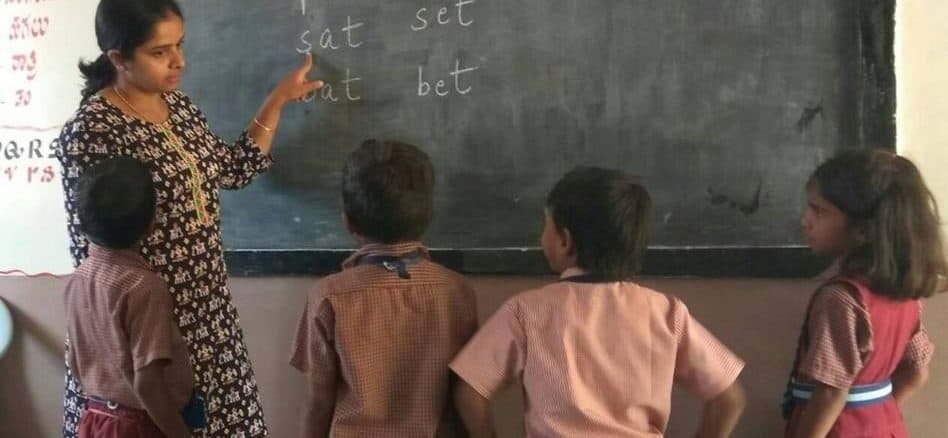
Source: bengaluru.citizenmatters.in
India’s education system is severely crippled. If remedial steps are not taken immediately then sustenance and employment in the 21st century will become very difficult for our Generation Alpha (children born after 2010). And the problem is too vast for the state (at least with its current capacity) to deal with by itself. To avert a major learning crisis in India, it is vital for educated members of our society to step in as volunteers.
Take the current pandemic times for example. As members of the civil society, haven’t we all given our time and effort to help out by making verification calls on leads, organizing logistics around plasma donation, and running up to deliver essentials to an elderly couple in the neighbourhood? Even the NITI Aayog is exploring possibilities to involve civil volunteers in ‘non-specialized’ tasks to assist with COVID relief measures. Similar involvement is required from society to help with the learning crisis.
But before we talk about the solution, we must understand the problem first.
The Problem
If you’re reading this, then it is safe to assume that you had the privilege of getting a good foundational education in your early years. If you didn’t and can still read this text, then you probably are someone who has had to work hard to develop foundational literacy skills later on; in which case, you would understand the challenges of pursuing education when you don’t acquire foundational literacy skills in your early years.
Foundational Learning in simple terms is the gateway skills that a child needs to acquire in their initial years to make the best of the education that they receive through the rest of their lives. For example: What is going on with you at this very moment? You are learning new facts as you read this text with comprehension. In our initial years, we were able to ‘Learn to Read’ so that we could ‘Read to Learn’. (Check out this video by Central Square Foundation to find out what is Foundational Literacy and Numeracy and why it matters).
Therefore, Foundational Learning becomes indispensable in a child’s education. Even before the pandemic, our education system grossly failed at delivering meaningful learnings to our children. This is despite having put them through years of formal education. This was widely attributed to the lack of focus on learning outcomes in our schools. While the Sarva Shiksha Abhiyan managed to get most of our children into schools, it did little to help them learn.
If we continue to teach our children without a focus on Foundational Learning, we will end up with nothing but high dropout rates and crores of unemployable youth. This is the reason why the nation (and all stakeholders in the education system) needs to work in a ‘mission mode’ to achieve Foundational Learning for all our children by 2030. However, we are far from achieving this objective and the pandemic has set us back even further.
The Solution
With an already skewed teacher-student ratio, time crunch and the issue of multi-grade classrooms, it is not easy to develop a system with our existing human resource that will help India achieve UN’s Sustainable Development Goal — 4 of universal Foundational Learning (also highlighted in the NEP).
However, there is a method that, if contextualized for education, can serve as the solution. A method that has been used every time our populous nation has faced a shortage of trained professionals — mobilizing and using part-time volunteers to do the job.
The idea may seem intuitive and a good solution to the above problem. But some critical aspects of the vision and implementation principles need to be considered first.
Degree of Responsibility and Duration
Are volunteers reliable? Yes, if their responsibilities are designed to not get too burdensome.
Doesn’t it take the focus away from building the state’s capacity to attend to the Foundational Learning needs of our children? No. Simultaneous efforts to build state capacity need to be taken up while ensuring that millions of children in today’s date do not suffer.
Helping with foundational learning requires the teacher to pay individual attention to students. Therefore, if volunteers are to replace teachers at this task, it will be advisable that a volunteer be responsible for not more than 3–4 children. This will allow the volunteer to pay proper attention to each child and develop a bond with the student, which is a crucial factor in the learning process of children. A small number of assigned children will make for better monitoring of performance and ensure high learning levels in the children. Further, the volunteer will not feel as burdened and therefore show continued commitment towards the role.
It is also important that any such program to involve volunteers must not come at the cost of the state’s long-term solution. The volunteer program must be put in place to address only immediate concerns around Foundational Learning. The impact of such a volunteer program has to be evaluated and compared with the impact that permanent state appointed teachers have on a child’s learning level. Insights from such an evaluation can later be used to determine the continuance of such a program for long-term. However, simultaneous efforts towards finding a long-term solution cannot be abandoned.
Training
One may ask, can an untrained volunteer deliver learning in the same way that a teacher does? Foundational Learning requires personalized support in order to help improve comprehension skills in children and our teachers are unable to provide the same due to the high volume of students per class and the vast curriculum that each teacher is supposed to attend to. Volunteers shall not be responsible for delivering the entire curriculum but only provide this extra personalized support to every child.
Nonetheless, even the volunteers will have to undergo a brief weeklong training and continued mentoring. This will train them in using the tools/methods that they have to use with children and monitoring learning levels. The District Institution of Education Training and SCERT, with the help of NGOs can further develop region specific tutoring handbooks to guide the volunteers. The Prarambhik Bhasha Shikshan Evam Akadmik Sahyog module developed by Learning and Language Foundation can serve as a good template for such training after contextualizing it to the program.
Motivation
While many who are eligible to volunteer would agree that the cause is noble and the crisis pretty severe, it will be a task to mobilize talent that is willing to volunteer. A 2017 report on the State of Youth Volunteering in India, highlighted that volunteer work is considered as ‘unimportant’ in India and therefore finds low engagement. Developing skills, building leadership qualities, inculcating values etc. sound great but unfortunately do not serve as enough incentive for the youth to take up volunteering. If we need civil volunteers to help with our children’s education, we need to directly link it with better opportunities in higher-education, careers and business.
Adding clear incentives like academic credits with the UGC’s mandate must be introduced for undergraduate and postgraduate students. Additionally, ‘Education-for-Education’ model like the one run by Pratham Education Foundation for its Anganwadi Support Program and other programs can be explored. Here the volunteers can access English and Computer Courses free of cost for the duration of their engagement with Pratham. Likewise, many such incentives should be added to add a strong ‘motivation’ factor for those committing to this.
Accountability
With training and motivation as inputs, accountability becomes an expected output in any case. For something as fundamental as education, an accountability mechanism for those responsible for delivering it, becomes a must. Even for the civil-volunteers, there must be a clear way to monitor performance of the students they teach. An in-process evaluation system (formative assessments) that is easy to conduct will have to be devised. Results of these assessments need to be constantly shared with regional coordinators and with those in-charge of training and content to inform future development of tools/methods used by volunteers. Being able to see their students perform should also act as additional motivation for the volunteers.
If you agree with the idea in spirit but are a little skeptical about the practicality of such a model, then there’s evidence to draw inspiration from too! In the past, Educate Girls, a Mumbai based NGO has successfully run a community volunteer program to improve learning outcomes in children. E-vidyaloka is another initiative that uses volunteers to enable quality education in India. Pratham has seen very positive results by getting village volunteers for its Read India Program too.
With a focus on training, motivation and accountability, a program can be designed to be delivered at scale. It is time that the educated individuals focus their volunteer efforts towards saving the future of crores of our children. Because only a strong foundational learning will enable the future generations to get 21st century skills. Consequently, leading to national development, equity and alleviation of poverty. And this can be achieved with your participation!
메타데이터
- post_id
- e4fca4eb706c
- slug
- volunteer-educators-to-help-india-overcome-its-learning-crisis-e4fca4eb706c
- url
- https://medium.com/@mustafarasheed09/volunteer-educators-to-help-india-overcome-its-learning-crisis-e4fca4eb706c
- canonical_url
- https://medium.com/@mustafarasheed09/volunteer-educators-to-help-india-overcome-its-learning-crisis-e4fca4eb706c
- author_url
- https://medium.com/@mustafarasheed09
- status
- ok
- fetched_at
- 2026-06-24 11:06:28


