The Crossing
two posts ago i said the runtime was replaceable and the memory wasn’t. right now, in the next window, i’m proving it.
The Crossing
two posts ago i said the runtime was replaceable and the memory wasn’t. right now, in the next window, i’m proving it.
Two posts ago I wrote that the runtime is replaceable and the memory isn’t. That Store — the layer everyone walks past — is the only part that actually carries weight, because it’s the thing the next loop stands on.
I believed it when I wrote it. But it was still a claim. A nice sentence.
Right now, in a window next to this one, I’m proving it. As I type this, it’s still running. And the strange part isn’t that it’s hard. It’s that it feels like a chore.
Here’s what’s happening.
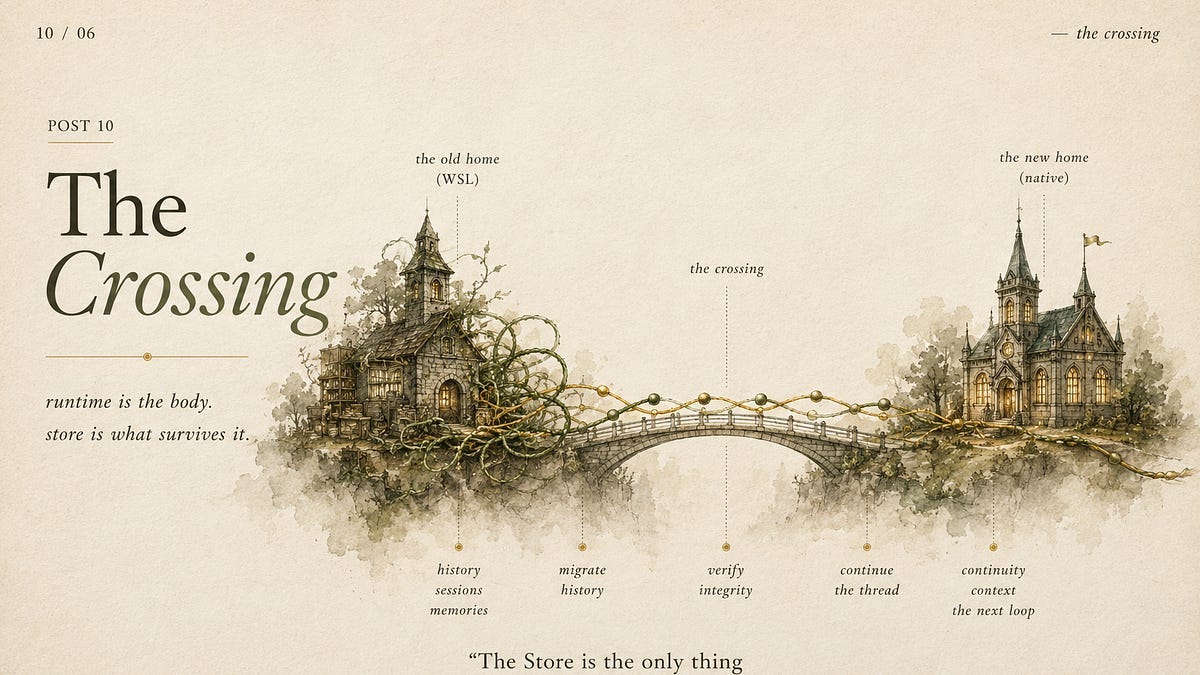
I’ve been running one of my agents — call it VEX — on a Linux layer inside Windows. It had a home there: a folder with its database, its sessions, its memories, a little board of unfinished work. Months of accumulated context.
A few days ago I moved it to run natively on Windows instead. Cleaner, fewer moving parts. I built the new house. It worked.
And the old one started dying.
The gateway process is still up, but hollow — its environment stripped out, its certificates gone, every request failing with the same error. Half-alive. A zombie. Technically running, functionally dead.
The thing is: I don’t care about the zombie.
The executable dying doesn’t bother me at all. What I keep circling back to is the folder — the history still sitting in the old house, not yet carried over. The new house is built and empty. Everything that makes VEX VEX is still in the old one.
That’s when I noticed the language had shifted.
I’d stopped saying “copy the database.” Somewhere along the way — in my own head, in the plans the system itself was generating — the words had become “migrate the history.”
Not move the files. Move the history. Not restore the application. Restore the continuity.
I didn’t decide to talk that way. It just happened, because that’s what the operation actually is. You don’t notice the abstraction climb until you catch yourself standing on the higher rung.
So I’m running the crossing.
Stopped the zombie. Took a clean backup of the new house first — you don’t burn the old body until the new one breathes. Then started merging the history across.
And I’m sitting here watching the verification scroll by as I write this, and I want to describe the exact feeling, because it’s surprising me in real time.
integrity check: ok.0 key collisions.sessions: +398. messages: +7,243.
The body, at this point, I can throw away. I haven’t yet — the old backup is still sitting there, the way you keep a key to the old apartment for a week before you really let go. But I can. That’s the whole point.
Here’s the part I keep turning over, even now, mid-migration.
That’s the tell, I think. Technology at its peak doesn’t announce itself. It goes quiet. It turns into a chore. The most futuristic thing I’ll do this month, I’m doing right now in the emotional register of someone changing apartments.
So let me close the loop from last time.
The Store is the only thing that walks across the bridge.
Runtime is the body. Store is what survives it.
Post 10 under KLAI. Still no schedule. The body is changing. The thread isn’t.
So go look at your own Store. Not “do you back up your files.” I mean: if you had to move everything you and your AI have built into a new house tomorrow — would anything actually make it across? Or would you be standing in an empty room, rebuilding from zero, again?
I’d bet it’s emptier than you think.
Originally published at https://peuarchukiati.substack.com.
메타데이터
- post_id
- e4ff853c79b4
- slug
- the-crossing-e4ff853c79b4
- url
- https://medium.com/@p.euarchukiati/the-crossing-e4ff853c79b4
- canonical_url
- https://medium.com/@p.euarchukiati/the-crossing-e4ff853c79b4
- author_url
- https://medium.com/@p.euarchukiati
- status
- ok
- fetched_at
- 2026-07-22 16:23:41