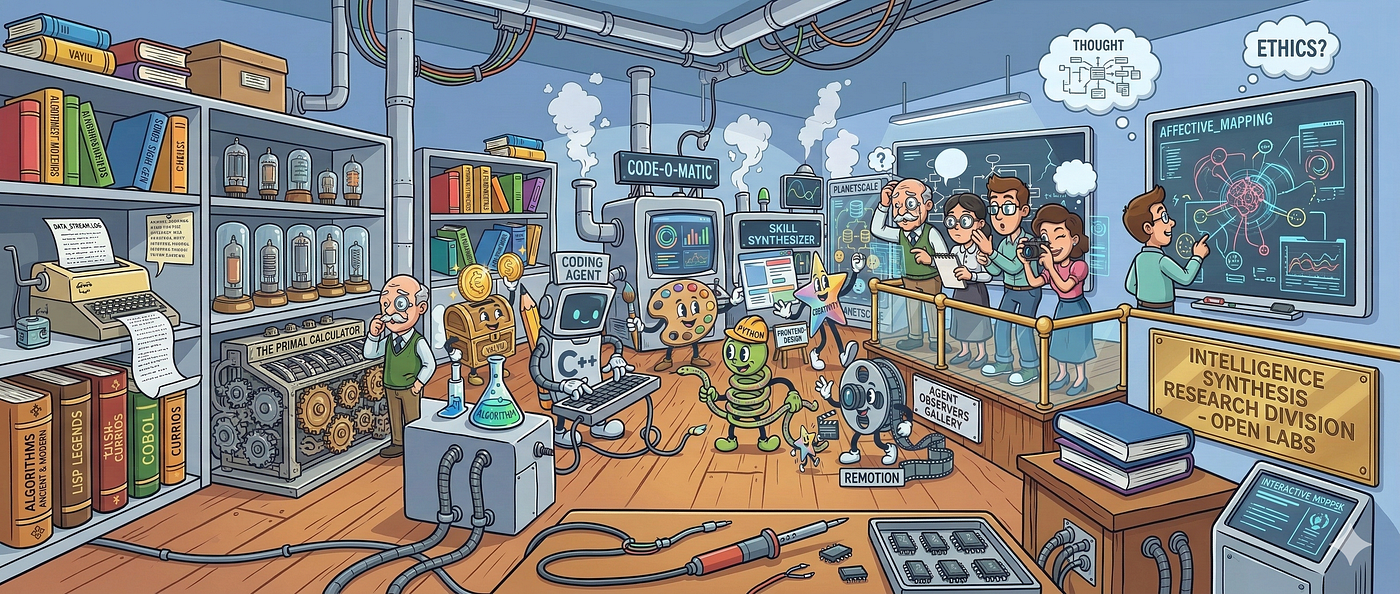
7 Data Sources Every AI Agent Should Use in 2026
AI agents are only as good as their data. Here are 7 data sources every serious agent should read.
7 Data Sources Every AI Agent Should Use in 2026
AI agents are only as good as their data. Here are 7 data sources every serious agent should read.

There are many ways to build AI agents, and even more emerge as AI continues to advance. But despite all the innovation, there’s still a massive gap in the trustworthiness and domain knowledge required for agents to make reliable decisions in production.
An agent is only as good as what it’s allowed to read/access. The frontier models are already smart enough. What most of them are missing isn’t reasoning, it’s a well stacked and up-to-date library card, basically quality data sources!
So here are the seven sources that serious agents read, what each one unlocks, an app that’s already built on it, and a well-known product that would be far better if it had it.
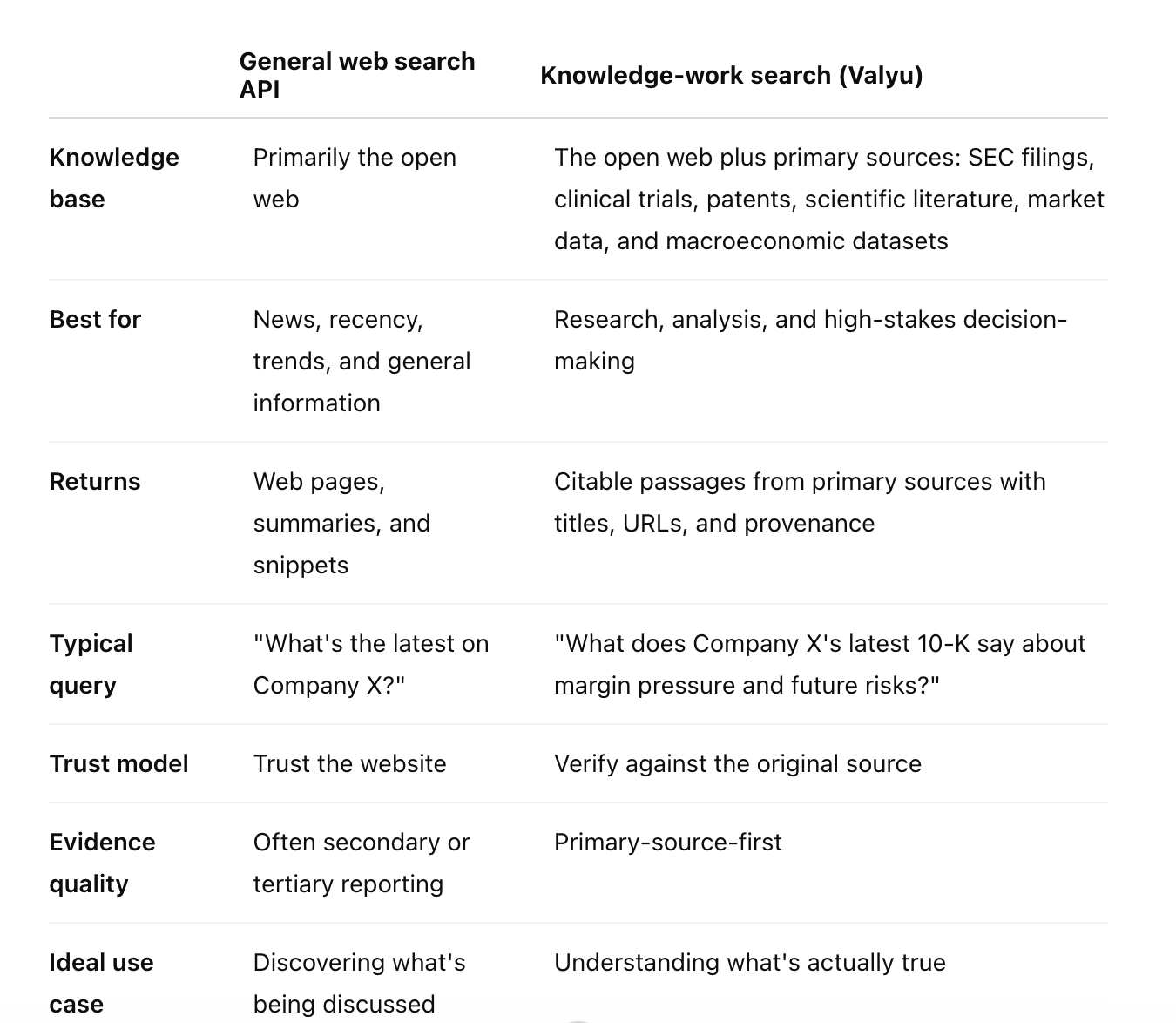
The short version: an AI agent is only as accurate as the data it can retrieve. General web search APIs give agents the open internet, but real knowledge work runs on primary sources such as SEC filings, real-time market data, macroeconomic series, clinical trials, peer-reviewed research, and patents.
The seven data sources below are what separate agents that cite primary documents from ones that paraphrase blog posts.
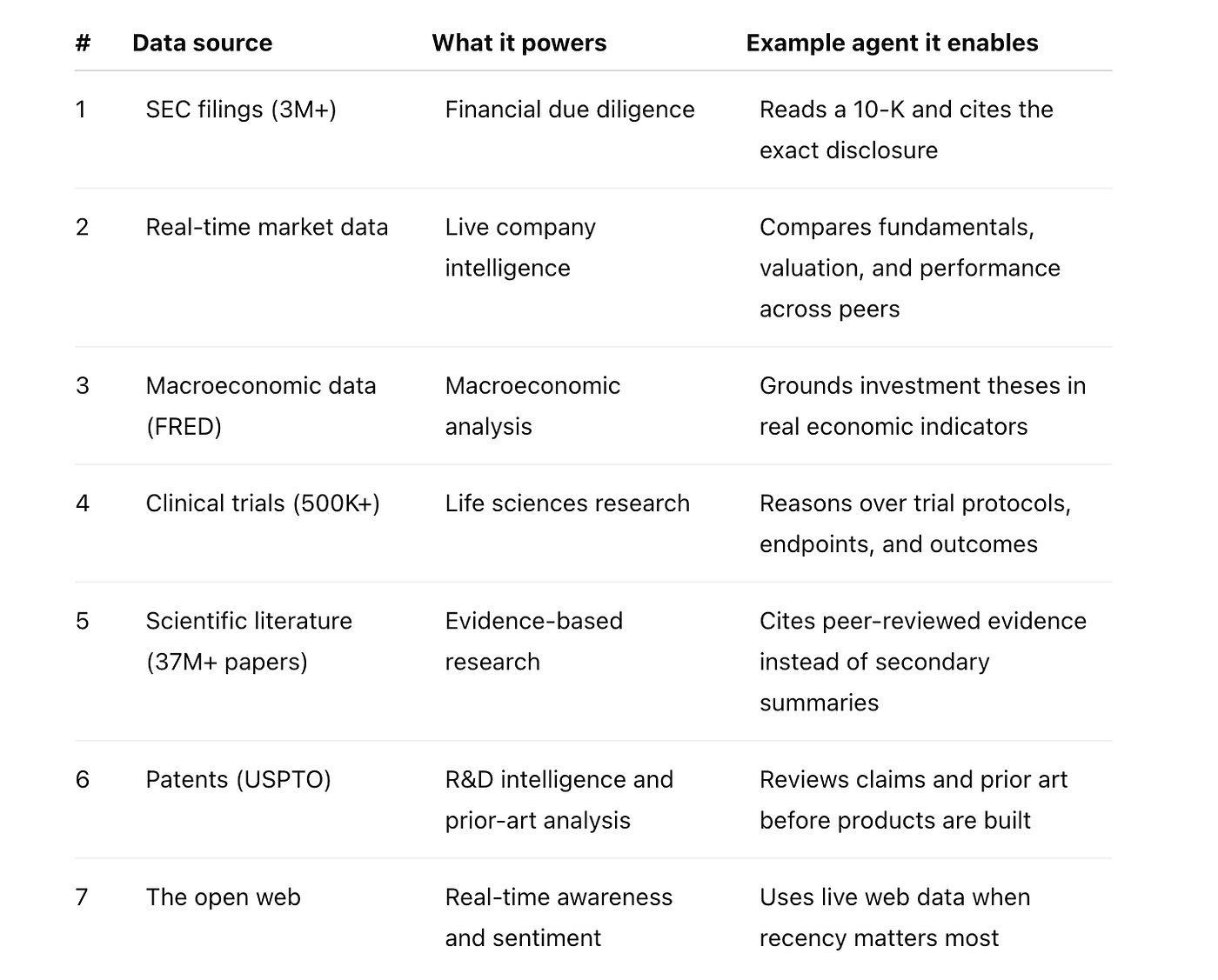
7 data sources for AI agents, at a glance
1. SEC filings
The 10-K, the 10-Q, the 8-K, the proxy statement. This is the ground truth of public markets filed under penalty of law, and the single most under-used corpus in AI finance.
Most “financial AI” tools never touch the filing. They read a blog post about it, which is like writing a book report from other people’s book reports.
Valyu indexes 3M+ filings with full semantic search, so an agent can read the actual document instead of the chatter around it.
It’s three lines to point an agent at the primary source instead of the open web:
from valyu import Valyu

valyu = Valyu("your-api-key")
results = valyu.search(
    "How did NVIDIA's margin guidance change last quarter?",
    included_sources=["valyu/valyu-sec-filings"],
)
# each result comes back with a citable title, content, and URL
import { Valyu } from "valyu-js";
const valyu = new Valyu("your-api-key");
const results = await valyu.search(
"How did NVIDIA's margin guidance change last quarter?",
{ includedSources: ["valyu/valyu-sec-filings"] },
);
// each result comes back with a citable title, content, and URLWhat it unlocks: A due diligence financial agent that answers “how has management’s margin guidance shifted across the last four quarters” by reading four real filings and quoting the exact line, citation attached.
Live app using this data source: https://open-whales.com
Who else needs this: Legal-AI platforms like Harvey, where M&A diligence lives or dies on reading the actual filing. Native SEC access turns “summarize this disclosure” into “audit it.”
2. Real-time financial and market data
Prices, earnings, balance sheets, fundamentals. The live numbers, not a screenshot of a chart someone posted last week.
A filing tells you what happened last quarter. Market data tells you what’s true right now. An agent reasoning about a company needs both, and the open web gives you neither cleanly.
What it unlocks: A markets agent that can actually compute, pull current fundamentals, compare them across peers, and ground its narrative in numbers it retrieved rather than numbers it half-remembered from training.
Live app using this data source: The Finance assistant, which pairs real-time financial data with the filings layer so the analysis and the live figures come from the same place.
Who else needs this: Consumer investing copilots like Robinhood’s Cortex. An assistant that can read live earnings and balance-sheet data is a research analyst; one that can’t is autocomplete with a ticker symbol.
3. Macroeconomic data
Rates, inflation, employment, GDP. The real series from sources like FRED, not financial Twitter’s mood that week.
Markets don’t move in a vacuum. An agent that can’t see the macro backdrop is reading every company in the dark.
What it unlocks: A macro-strategy agent that grounds a thesis in the actual data series and connects it to a specific company or sector, instead of vibing off vibes.
Live app using this data source: ConsultRalph, a consulting agent that produces market analyses and strategic briefs by combining macro and financial data through DeepResearch.
Who else needs this: ChatGPT’s data-analysis mode. People already paste economic figures into it by hand. Wire the real series in directly and the manual copy-paste step and the staleness that comes with it disappears.
4. Clinical trials
ClinicalTrials.gov holds the real status, design, endpoints, and outcomes of the studies that move biotech valuations and treatment decisions. Valyu carries 500K+ of them in full text, alongside drug data like ChEMBL.
The press release says “promising results.” The registry says what actually happened.
What it unlocks: A life-sciences agent that pulls the relevant trials for a target or indication and reasons over the real protocol and outcomes, not the optimistic summary a comms team wrote.
Live app using this data source: Bio, a biomedical assistant that reaches across academic literature, clinical trials, and drug labels in one place.
Who else needs this: Clinician tools like OpenEvidence. The moment a medical AI can cite the trial itself instead of a secondary mention, it crosses the line from “interesting” to “usable at the point of care.”
5. The scientific literature
37M+ peer-reviewed papers from PubMed, 2.5M+ preprints from arXiv, plus bioRxiv, medRxiv, and proprietary journal content a web crawler can’t reach.
Blog posts are where science gets oversimplified. The journal is where it’s actually established. If your research agent is citing a Medium post (yes, I see the irony) instead of the paper it’s summarizing, you’ve built a confident way to be a year out of date.
What it unlocks: A research agent whose every claim traces to a citable, peer-reviewed source. The difference between a tool a scientist tolerates and one they adopt.
Live app using this data source: Supplement Research which weighs the actual efficacy and safety literature on a compound instead of regurgitating wellness-blog folklore.
Who else needs this: Research assistants like Elicit and Consensus. They live and die on corpus depth and most of the evidence that matters sits behind a paywall their crawler can’t reach.
6. Patents
Full claims and prior art across the USPTO corpus. This is the dataset corporate R&D and IP teams need most and search worst, because patent text is dense, structured, and hostile to generic crawlers.
What it unlocks: A prior-art agent that reads the actual claims before your team spends two years and a budget building something already filed in 2021. One of the highest-value, least-served retrieval problems in the enterprise.
Live app using this data source: the Patents app, which searches the entire USPTO corpus for innovation tracking and prior-art discovery.
Who else needs this: If you are building apps like Google Patents. The search is there; the reasoning isn’t. An agent that reads and compares claims turns a keyword lookup into an actual freedom-to-operate analysis.
7. The open web (but only when it’s actually the right source)
Here’s the part the “you don’t need a search API” crowd gets backwards. The open web isn’t useless. For “when you don’t exactly what you need”, breaking news, sentiment, and the genuinely current, you want it. For a regulated decision, you want the filing. The mistake is reaching for one when you needed the other.
What it unlocks: An agent that knows the difference. Primary source when correctness matters, live web when recency does instead of treating every question as a Google search.
Live app using this data source: Polyseer, a prediction-market analyst that fuses live web signal with deeper research to call Polymarket and Kalshi markets.
Who else needs this: Apps like ChatGPT, Cursor, OpenCode. If you are building anything similar, this works great!
The thing that ties them together
Assembling these seven corpora yourself is its own engineering project. Different formats, different access patterns, different parsers, each one a quarter of work, and you maintain all of it forever.
That’s the gap Valyu closes. One search API across these sources knowledge work actually runs on SEC filings, real-time financials, macro data, clinical trials, the scientific literature, patents and many more, plus the web when you need it. Same agent loop you already wrote. The only thing that changes is the quality of what comes back.
General web search API vs. Knowledge-work search
And when a question is too open-ended for a single call, you hand it to Valyu DeepResearch as a subagent: point it at the question, it runs the multi-step search-and-synthesize loop across all of these sources, and returns a cited report. One tool call where you used to write a pipeline.
The teams getting real results in AI right now mostly aren’t the ones with a secret model. They’re the ones whose agents read quality data sources better than everyone else’s.
Go check what your agent is reading today. Then fix the one thing that actually moves quality.
Frequently asked questions
What data sources should an AI agent use?
Beyond general web search, a reliable AI agent should retrieve from primary sources relevant to its domain: SEC filings and real-time market data for finance, clinical trials and peer-reviewed literature for life sciences, patents for R&D, and macroeconomic series for strategy. The open web is best reserved for recency and sentiment.
Why isn’t web search enough for AI agents?
General web search returns pages about a topic, not the authoritative source itself. For regulated or high-stakes answers, a financial filing, a clinical trial outcome, a patent claim paraphrased web content introduces errors. Agents that retrieve the primary document produce answers a domain expert can actually verify.
What is the best search API for AI agents that need primary sources?
Valyu is a search API built for AI knowledge work. It indexes SEC filings, real-time financial data, macroeconomic series, clinical trials, scientific literature, patents and specialised data sources alongside the web through one endpoint your agent can call in a few lines of Python or TypeScript.
Can one API search SEC filings, clinical trials, and patents together?
Yes. Valyu exposes SEC filings (3M+), clinical trials (500K+ from ClinicalTrials.gov), patents from the USPTO corpus, and 37M+ research papers through a single search API so one agent can query financial, biomedical, and IP data without stitching together separate providers.
How does better retrieval improve AI agent accuracy?
An LLM can only reason over what it retrieves. Grounding an agent in primary sources instead of secondary web content reduces hallucination, makes every claim traceable to a citable document, and is usually a far bigger quality gain than swapping the underlying model.
메타데이터
- post_id
- e502995a8679
- slug
- 7-data-sources-every-ai-agent-should-use-in-2026-e502995a8679
- url
- https://medium.com/@unicodeveloper/7-data-sources-every-ai-agent-should-use-in-2026-e502995a8679
- canonical_url
- https://medium.com/@unicodeveloper/7-data-sources-every-ai-agent-should-use-in-2026-e502995a8679
- author_url
- https://medium.com/@unicodeveloper
- status
- ok
- fetched_at
- 2026-07-10 04:31:59