How to maintain your training while travelling for business
Business travel can disrupt even the most consistent training routine. Long flights, back-to-back meetings, hotel living and limited…
How to maintain your training while travelling for business
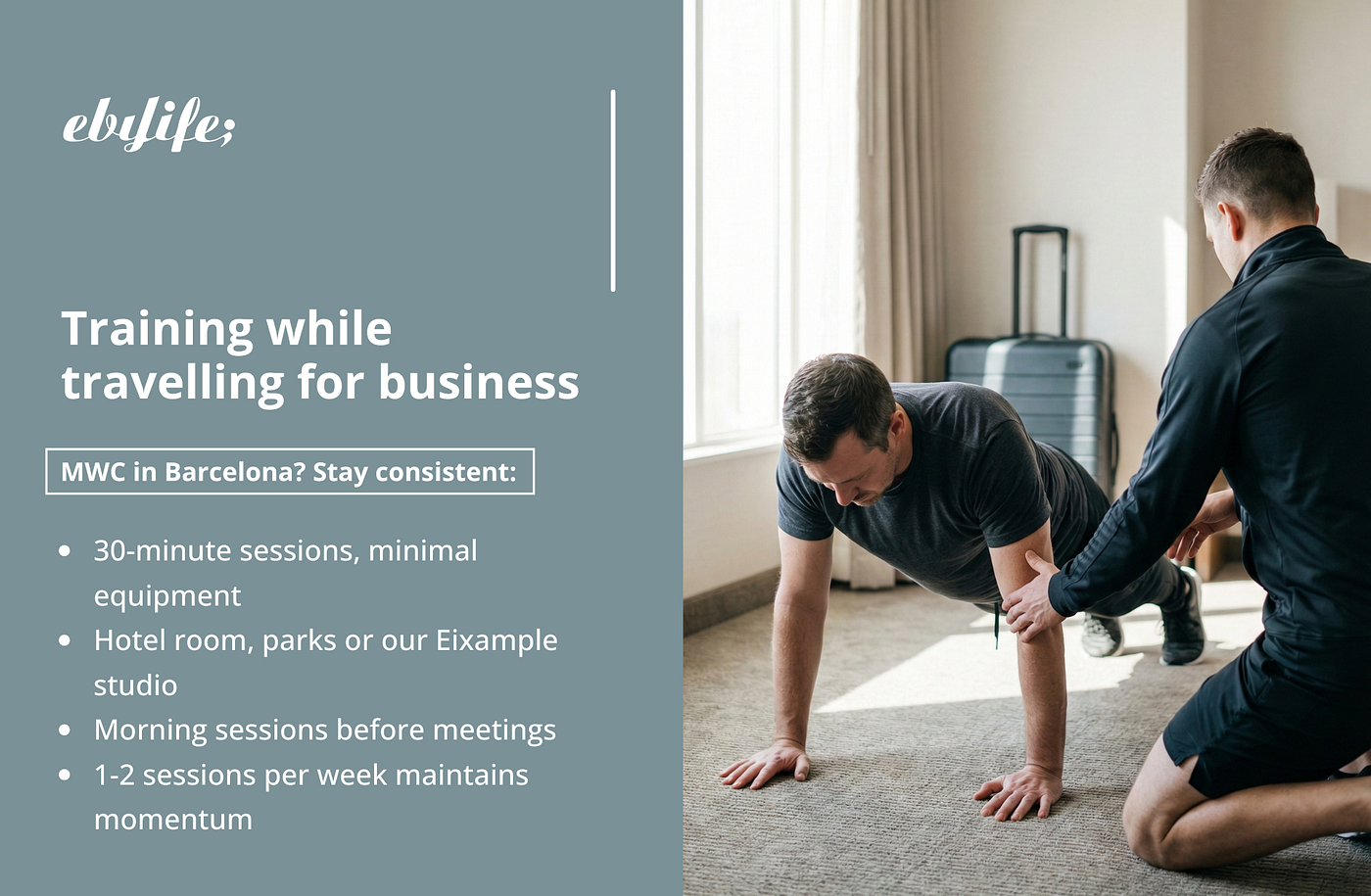
Business travel can disrupt even the most consistent training routine. Long flights, back-to-back meetings, hotel living and limited downtime make it easy to abandon exercise entirely. Most professionals do exactly that. They tell themselves they will restart when they get home.
The problem is that skipping a full week of training has consequences. Momentum stalls. Energy drops. Returning feels harder than it should.
I have worked with hundreds of English-speaking professionals in Barcelona who travel regularly for business. The ones who maintain 1–2 sessions per week during travel consistently outperform those who stop and restart. The difference is not discipline. It is strategy.
Why skipping entirely costs more than you think
Your body adapts to training over weeks and months. Consistent sessions develop strength, improve energy levels and support better sleep. When you stop abruptly, even for a week, your body begins to lose that momentum.
The physical cost is one thing. The psychological cost is worse. Restarting after a break requires more mental effort than maintaining a reduced schedule. Most people who skip a full travel week find it takes two to three weeks to rebuild the habit.
Maintaining even 1–2 shorter sessions during a busy travel period can preserve your progress. You do not need a full training week. You need enough to keep moving forward.
Reduce session length, not frequency
A focused 30-minute session can be just as beneficial as a longer workout when planned right. The key is exercise selection. Compound movements like squats, press-ups, rows and lunges work multiple muscle groups simultaneously. This efficiency means a short session still delivers meaningful training stimulus.
Structure matters more than duration. A well-programmed 30-minute session with appropriate intensity and rest periods can maintain your strength levels through a busy week. Random exercises for an hour cannot.
For most travelling professionals, two 30-minute sessions across a week is enough to maintain what you have developed.
Use what is available
A hotel room provides enough space for effective bodyweight training. Press-ups, squats, lunges, planks and single-leg work require no equipment and can challenge any fitness level when programmed correctly.
Most business hotels offer basic gym facilities. Even a limited selection of dumbbells and a bench can support a focused strength session.
If the weather and location allow, parks and outdoor spaces offer excellent alternatives. Barcelona’s seafront and green spaces provide natural training environments that can make a session feel less like obligation and more like a reset.
The point is not finding the perfect training environment. It is removing the excuse that you cannot train without one.
Schedule sessions early
Morning training before meetings ensures minimal excuses later. This is the single most effective strategy I recommend to travelling clients.
Waiting until evening means competing with dinners, networking events, stress and fatigue. By the end of a demanding day, the motivation to train has usually disappeared. Something always takes priority.
A 6:30 or 7:00am session before your first meeting protects your training from the unpredictability of the rest of the day. It also improves focus and energy levels for the hours that follow.
This applies beyond travel. But during business trips, when your schedule is least within your control, morning sessions become essential rather than optional.
Prioritise consistency over intensity
Travel weeks are not the time to chase personal bests. The goal is maintenance, not progression. Reduce weights if needed. Shorten sessions if necessary. But keep showing up.
1–2 sessions per week during a travel period keeps momentum. You return home ready to progress rather than starting over.
This mindset shift matters. Many professionals view a reduced training week as failure. It is not. It is intelligent adaptation. The ability to adjust your training to match your circumstances is what separates people who stay consistent long-term from those who repeatedly start and stop.
Progressive programming accounts for travel periods. A well-designed training plan includes lighter weeks built around your schedule rather than demanding the same output regardless of context.
The broader pattern
Business travel is not the only thing that can disrupt routines. Family commitments, busy work periods and seasonal changes all create the same challenge. The principle remains the same. Reduce rather than stop. Adapt rather than abandon.
The professionals I work with in Barcelona who achieve lasting results are not the ones with the most time. They are the ones who have learned to maintain consistency through imperfect weeks.
That consistency compounds. Over months, it produces results that sporadic intense efforts never will.
Martin Ebner is head trainer at **Ebylife**, delivering personalised strength training for English-speaking residents in Barcelona. Train at your hotel, our Eixample open-air studio or online.
Chat with a Coach today — WhatsApp **+34 636 597 084**
메타데이터
- post_id
- e50baca48de0
- slug
- how-to-maintain-your-training-while-travelling-for-business-e50baca48de0
- url
- https://medium.com/@ebylife/how-to-maintain-your-training-while-travelling-for-business-e50baca48de0
- canonical_url
- https://medium.com/@ebylife/how-to-maintain-your-training-while-travelling-for-business-e50baca48de0
- author_url
- https://medium.com/@ebylife
- status
- ok
- fetched_at
- 2026-07-10 15:46:15