K2–18b: The Mysterious Ocean World Orbiting a Distant Star
In the vastness of the cosmos, not every discovery immediately captures the imagination of both scientists and dreamers. But K2–18b is an…
K2–18b: The Mysterious Ocean World Orbiting a Distant Star
In the vastness of the cosmos, not every discovery immediately captures the imagination of both scientists and dreamers. But K2–18b is an exception.
Located about 120 light-years away in the constellation Leo, this distant exoplanet has become one of the most talked-about worlds beyond our solar system. First discovered by NASA’s Kepler/K2 mission, and later observed in stunning detail by the James Webb Space Telescope (JWST), K2–18b challenges our understanding of what a habitable world might look like.
A Planet of “In-Between”
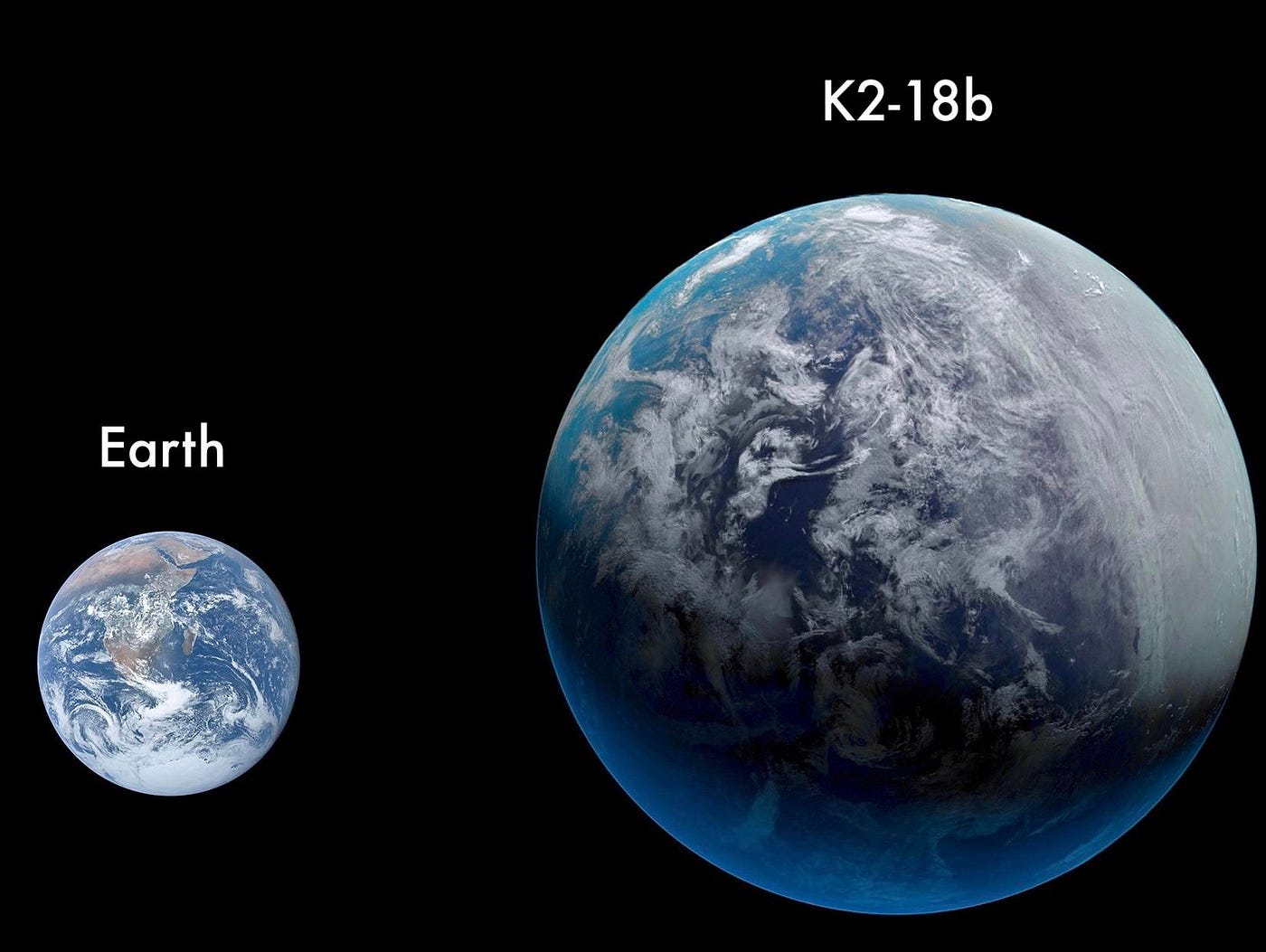
K2–18b is not quite like anything we know. It’s about 8.6 times the mass of Earth — far larger than our home, but smaller than gas giants like Neptune. Astronomers classify it as a “sub-Neptune,” a category of planets that are surprisingly common in our galaxy but absent in our own solar system.
It orbits its star, a cool red dwarf known as K2–18, in a region known as the habitable zone — the sweet spot where temperatures could allow liquid water to exist. And remarkably, it completes an orbit in about 33 Earth days, perfectly aligning periodically with its star and the JWST for critical observations.
A Breath of Alien Air
In 2023, JWST delivered a breakthrough: it detected carbon dioxide (CO₂) and methane (CH₄) in K2–18b’s atmosphere. These gases are often associated with biological activity on Earth, sparking speculation — cautious but hopeful — about the possibility of life.
Even more intriguing was the hint of a water-rich environment beneath a thick hydrogen atmosphere, leading scientists to propose that K2–18b might be an ocean world — a planet covered by a deep, global ocean. In scientific terms, such planets are called Hycean planets: hybrid oceanic and hydrogen-atmosphere worlds.
Could life survive under such alien conditions? We don’t know yet — but K2–18b shows that life-friendly environments could look very different from Earth.
The Bigger Picture
K2–18b reminds us that the universe is far more diverse and imaginative than we sometimes expect. It challenges the idea that life can only thrive on Earth-like planets, opening up entirely new possibilities in the search for extraterrestrial life.
With every 33-day orbit and every new observation, K2–18b whispers a powerful message: The story of life in the universe may be stranger, wider, and more beautiful than we ever imagined.
And this story has only just begun.
메타데이터
- post_id
- e511f36a9780
- slug
- k2-18b-the-mysterious-ocean-world-orbiting-a-distant-star-e511f36a9780
- url
- https://medium.com/@rudra15083/k2-18b-the-mysterious-ocean-world-orbiting-a-distant-star-e511f36a9780
- canonical_url
- https://medium.com/@rudra15083/k2-18b-the-mysterious-ocean-world-orbiting-a-distant-star-e511f36a9780
- author_url
- https://medium.com/@rudra15083
- status
- ok
- fetched_at
- 2026-07-20 04:10:56