A Short Trip to See the Northern Gannets at Troup Head
A clifftop nature reserve near Banff in Aberdeenshire, Scotland
A Short Trip to See the Northern Gannets at Troup Head
A clifftop nature reserve near Banff in Aberdeenshire, Scotland
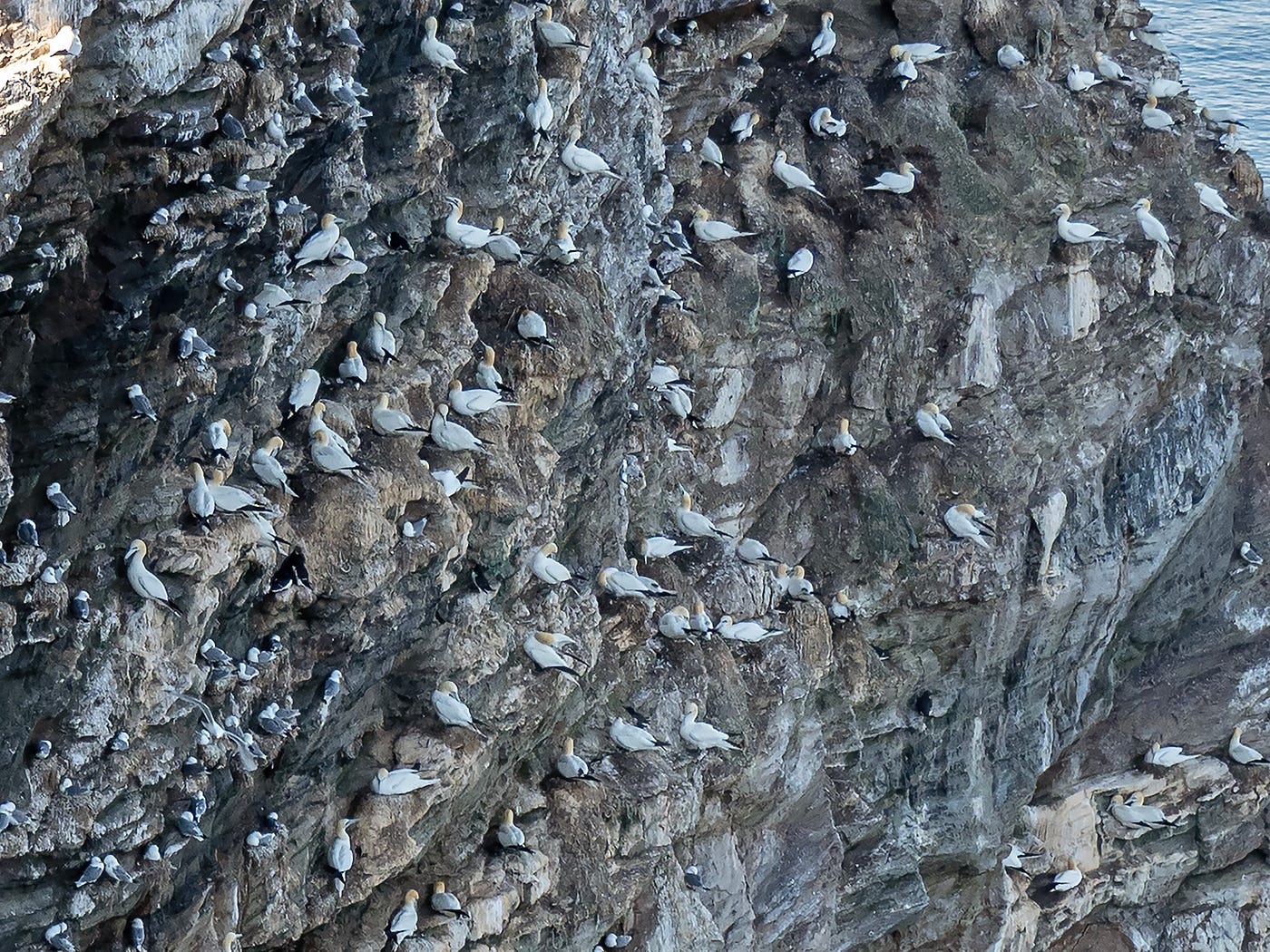
Nesting gannets at Troup Head, Aberdeenshire, Scotland (All photos by Author)
On what turned out to be the hottest day of the year so far, Matt and I had a short visit to the RSPB (Royal Society for the Protection of Birds) Troup Head nature reserve in northern Scotland.
Having been regular visitors to the seabird colony at Bempton Cliffs on the Yorkshire coast for many years, we were delighted to find that Scotland’s only large mainland gannet colony is just a few miles from our new home. Troup Head is located on a spectacularly wild and remote section of the north Aberdeenshire coast. We were keen to check out the reserve, and could not have picked a nicer morning.
Arriving in the car park, the contrast with Bempton Cliffs was immediately obvious. Here there is no visitor center, no shop or cafe, and just a very small parking area. Large crowds are obviously not expected — which is fine by us.
We set off along a grassy path surrounded by farmland and accompanied by the songs of many skylarks.

Skylark on a fence post

Flowering Tormentil (Potentilla erecta)

Common hogweed (Heracleum sphondylium)
Approaching the cliff top we enjoyed the view of the wonderfully blue sea and sky. It is not always like this in northern Scotland!

Approaching the clifftop
On reaching the cliff edge another contrast with Bempton Cliffs was apparent. Here there are no viewing platforms and no fences protecting you from the sheer drops. On this beautiful calm day this was not a problem, but on a wild and windy day common sense would definitely be required!

The view down
There was a sudden change from the sounds of singing skylarks and yellowhammers to the sounds (and smells) of the seabird colony. To our right was a fantastic view along the cliffs eastward. Scanning with binoculars revealed many kittiwakes, fulmars, guillemots and razorbills perched on the various cliff faces.

View of the cliffs to the east

Rugged cliffs

A lovely fulmar nest
However, we had come to see the gannets, and so we headed west. Easy steps took us to the top of Troup Head, where the views in all directions were magnificent.

The view east from Troup Head

The view west from Troup Head
The path continued over the headland to descend on the other side, and as we proceeded more and more gannets came into view. Suddenly views of the nesting colonies opened up, with birds perched on every available spot. Many of the birds were paired, with others probably waiting for their partners to return from hunting trips.

Gannets nesting on the cliffs
Gannets are hefty birds, with wingspans up to 180 cm. Their nesting ledges always look impossibly small and precarious. It is remarkable that the eggs and young chicks can stay safe on the exposed cliffs in the frequently wild, wet and windy coastal weather.
In the photo below you can see the scant nesting material below two of the birds. It would not provide much protection in a storm!

Nesting on the edge
On the day we visited it was not wild and windy weather that was the problem, but the heat. Many birds were holding their beaks ajar and panting by flickering their throats as a way of keeping cool, like the one shown below.

Keeping cool
The gannets seemed to be totally unconcerned by the close presence of people walking past (and the frequent camera lenses being pointed in their direction). As we were walking past a small hidden gully the head below suddenly popped up right in front of us, and casually watched as we walked by, with no attempt to fly off.

Close encounter
The seabird colony at Troup Head is much smaller than the one at Bempton Cliffs, and the reserve does not have the same facilities or infrastructure. But the lack of crowds, remote location, untouched nature and magnificent scenery are what give the reserve its charm. We will definitely return to explore more of this special place.

Rocky bay seen from the clifftop
You can read more about Troup Head at the RSPB’s web page:
Originally published at https://adcimages.substack.com.
메타데이터
- post_id
- e519b0e871ee
- slug
- a-short-trip-to-see-the-northern-gannets-at-troup-head-e519b0e871ee
- url
- https://medium.com/picturethis/a-short-trip-to-see-the-northern-gannets-at-troup-head-e519b0e871ee
- canonical_url
- https://medium.com/picturethis/a-short-trip-to-see-the-northern-gannets-at-troup-head-e519b0e871ee
- author_url
- https://medium.com/@angeladawn.cottingham
- status
- ok
- fetched_at
- 2026-07-09 16:18:44