I’ve Been Working Out for 45 Years — These Findings Still Blindsided Me
What no one tells you about working out as you age
I’ve Been Working Out for 45 Years — These Findings Still Blindsided Me
What no one tells you about working out as you age

Photo from Canva
After spending nearly five decades in the fitness world as a trainer and fitness writer, I thought I’d seen and heard it all.
I’ve interviewed hundreds of health and fitness experts, worked one-on-one with people, achieved four training certifications — and even ran an online site for women over 50 (Ageless After 50) — in a never-ending quest to uncover the latest, most innovative information.
But fitness science never stops evolving, and it’s not long before something else catches my attention that I’d not known about.
It’s why I wrote two other stories on Medium (links below this story) about how workouts affect us as we age, and felt it was time for another set of fitness truth bombs no one talks about.
I dug deep to find five little-known facts most people have never heard of that could change how you work out or treat yourself as you age.
These were all news to me, so I thought you may benefit from hearing them, too.
Let’s get into it.
Your feet become a hidden weak link
A 67-year-old gym friend told me he noticed his knee only hurt him on days when he wore a particular style of workout shoe. “They were supposed to be good for lifting, but my knees hurt worse when I wore them,” he told me.
Surprisingly, changes to his feet may also be part of the problem.
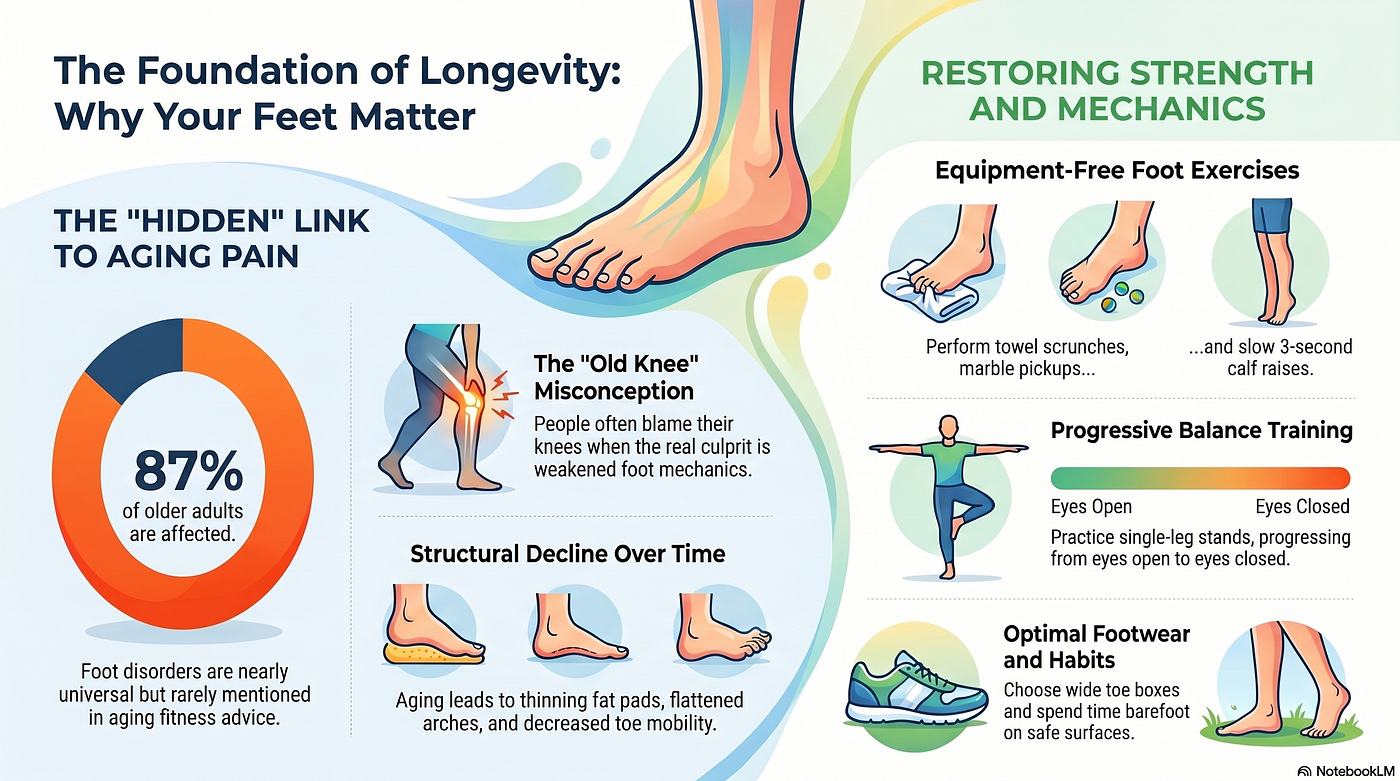
Foot disorders affect up to 87% of older adults. Yet foot strength, sensation, and structure almost never come up in aging fitness advice.
As we age, our foot fat pads thin, arches flatten, toe mobility decreases, and the muscles of the feet weaken. These changes affect walking mechanics, balance, hip alignment, stability during lifting, and yes — even knee pain. People often blame their “old knees” when the real culprit is actually their feet.
Keep feet strong with exercises that require no equipment: towel scrunches (scrunch a towel on the floor with toes, 10x each foot), marble pickups (pick up marbles with toes), slow calf raises (3 seconds up, 3 down), single-leg balance stands progressing from eyes open to eyes closed.
Spending some time barefoot on safe surfaces at home may help activate foot muscles. And opt for footwear with a wider toe box that allows toes to spread naturally and avoid narrow shoes that compress them.
Heat hits you harder
Here in Arizona, it’s often 85 degrees by 7:00 a.m. in the summer and can reach 110 by the afternoon. Younger people are warned against outdoor workouts on the hottest days, but aging raises the risks even more.
Changes in the body’s ability to regulate its internal thermostat — called thermoregulation — are not only impaired in menopausal women, but it becomes dysregulated and fires inappropriately. This causes sweating or flushing during exercise at intensities or temperatures that shouldn’t trigger that response. At the same time, the system is losing its capacity to cool efficiently through normal pathways.
For men, studies show that older men had a 23% lower sweat rate than young men at the same exercise workload. It’s not just about sweating less. The mechanism for activating the sweating response has been dismantled. So drinking more water doesn’t fix it. An older adult’s cardiovascular system doesn’t adapt as easily, and heat stroke tends to escalate faster with less warning.
Time your workouts for early morning and drink about 16 ounces of water before going out in the heat. By the time you feel thirsty, you’re already behind.
Sleeping longer isn’t always better for muscle health
This disruption goes beyond the workout itself.
The slow-wave sleep decline with age means less growth hormone released nightly — that’s the repair window you’re losing. The counterintuitive finding: sleeping more than eight hours in older adults has been associated with worse muscle outcomes, and is associated with about double the risk of age-related muscle loss, or sarcopenia.
This is likely because it reflects fragmented or lower-quality sleep rather than better recovery.
Elevated cortisol from disrupted sleep actively breaks down muscle tissue. Extra time in bed just means more light sleep — more time in the stages where growth hormone isn’t being released. So the sleep you’re getting is producing less of the hormone that drives repair.
Aim for seven to eight hours of quality sleep, not maximizing time spent in bed. Resistance training, avoiding alcohol before bed, and keeping consistent sleep-wake timing may help improve sleep.
Your tendons age faster than your muscles
A 79-year-old friend of mine at the gym recently tore his biceps tendon while lifting heavy weights and requires surgery to fix it. I asked him why he hoisted so much weight, and he smiled and said, “I’m a Marine!”
Marine or not, he had been accumulating microscopic damage over the years. This process looks and feels completely normal until it’s overloaded. Then, one sudden effort exceeds the tendon’s capacity — and it snaps.
Protecting your tendons involves lifting weights, but it’s not about “going heavy.” The focus should be on the eccentric contractions (the slow lowering phase of any movement), where adaptation happens.
Use a 3–4 second lowering phase of the weight, maintaining a deliberate and controlled motion. Gradually add more weight as strength builds, but never more than 10% in a week.
Side note: Antibiotics, including ciprofloxacin and levofloxacin, carry an FDA black box warning for tendon rupture risk that most patients are not told about. Ask your doctor if either of these is prescribed for you.
The same workout you did easily now wipes you out
I had a personal interest in finding out why I felt great during my workout but crashed and burned a couple of hours later. I reluctantly accept that I’m getting older, but the energy drop made me wonder if this was normal.
Turns out, it is.
Research says it’s not a fitness decline, but three biological mechanisms that aren’t a factor when you were younger.
The extra energy drain doesn’t come from the muscles themselves so much as the higher cellular cost of sustaining the work.
In other words, the same 45-minute strength session that drew on 40% of your available reserves at age 35 may be drawing on 70% of them at 65 — even at the same intensity, same exercises, and the same weights.
You don’t feel it during the workout because the immediate energy supply of adrenaline and glycogen is adequate. You feel the effect later when the reserves are more depleted than you expected.
In addition, exercise triggers an inflammatory response — one that signals muscle repair and normally resolves within 24–48 hours. In older adults, this same acute response fires on top of an already-elevated inflammatory baseline. The result: a less regulated inflammatory environment post-workout. This helps explain why the post-workout crash often hits one to three hours later.
The solution isn’t to do less — it’s eating immediately after. Post-workout protein of 20–40 grams within 30–60 minutes helps reduce the crash. The good news is this crash gets smaller over time for older adults who train consistently, which is a sign your body’s adapting.
Working out after 50 the same way you did in your 30s is a recipe for injury, regardless of whether you were a Marine or elite athlete earlier in life. Your body doesn’t care if you feel younger. It’s about understanding how to work out in a way that allows you to remain active, strong, and independent for as long as possible.
If you found this helpful, check out these two earlier stories in the series:
Sign up here to receive our free weekly newsletter featuring the best of Crow’s Feet: Life As We Age.
메타데이터
- post_id
- e521f24ab80d
- slug
- ive-been-working-out-for-45-years-these-findings-still-blindsided-me-e521f24ab80d
- url
- https://medium.com/crows-feet/ive-been-working-out-for-45-years-these-findings-still-blindsided-me-e521f24ab80d
- canonical_url
- https://medium.com/crows-feet/ive-been-working-out-for-45-years-these-findings-still-blindsided-me-e521f24ab80d
- author_url
- https://medium.com/@linda_86854
- status
- ok
- fetched_at
- 2026-06-09 14:34:10