Ignite the Power of Co-creation & Collective Creativity
Ava Han, August 27, 2024
Ignite the Power of Co-creation & Collective Creativity
Ava Han, August 27, 2024
I’ve been thinking about the good powers we have, as User Experience Strategists & Researchers. One such power lies in the collective creativity that is often fueled by our craft and inspiration to co-create with others.
WHY SHOULD WE CARE?
In this age of uncertainty, the experiences and products we help create and build are becoming more integrated. Yet, research teams are increasingly more decentralized.
According to the 2023 study by User Interview about the field of User Research, more than 50% of research practices are decentralized, a significant increase from 44% the year before. And we saw half of the researchers were directly or indirectly affected by layoffs, highlighting that we are more vulnerable when not together.
We’ve successfully built our UXR brands, not too distantly different from the diplomats. Our research teams embody leadership qualities of empathy, adaptability, strong communication, and analytical thinking, to name a few. But I wonder if it’s forgotten that, more than anything else, user experience researchers are change agents.
“So, it often starts with insights” — CEO, Airbnb
Good designs often start with deep understanding of the problem space. To identify what problems are worth solving, we must truly understand the user needs and what is meaningful to them. Research plays a critical role in problem framing, design iterations, testing, and helping inform product decisions. All disciplines in user-centered experience and innovation can benefit from Research.
Yet, we frequently need to justify what we do and the value we bring to the table. We seem to have lost momentum and we’re being pulled into different directions. We’re spread thin.

Created with Stable Diffusion XL
It’s time to reimagine the field of UX Research.
We must redefine our ways of working, toward leveraging the Good Power of Collective Creativity among all disciplines that matter, across Research, Design, Product, and Business.
HOW DID WE GET HERE?
In the last decades, we’ve built an impressive set of Research toolkit. The methods we use are growing more rapidly than ever, propelled by potential applications of AI. Being T-shaped or V-shaped no longer ensures us a competitive candidate, as it seems today.

Created with Stable Diffusion XL
We see a new breed of UX generalists — the “jellyfish.” They can flex their “muscles”, at a moment of notice, conducting usability testing, doing design discovery, facilitating Design Thinking, creating design concepts, wire-framing, and having tough conversations with stakeholders…
The skills we expect to see in UXR, Design, and Product increasingly overlap, and the boundaries between what each discipline does are more blurred than ever.
Today, democratization of research is no longer a debate; it’s a necessity. My previous Research team built a Usability Academy to train non-researchers how to conduct usability testing. It allowed us to focus on strategic research, where we believed brought the most value to the organization. We built an internal “Design Thinking Lab” to evangelize and train stakeholders on user-centric approach to strategy and problem solving.
To accelerate learning more broadly, we implemented Rapid Research and Field-Testing programs to empower Design, Product, and Business in collecting user feedback with greater speed and iteration.
With more non-researchers involved in usability testing, Research no longer has sole control over the topic and methodology of all research conducted within the organization.
To prevent ill-informed Design decisions, it is imperative to establish research governance and ensure consistent adherence to best practices and processes.
We continue to debate the ratio. What is the optimal ratio of Research to Design? How about Design to Product? The overlapping skill sets and the perceptions that we could achieve if we could hire more additional jellyfish are heavily shaping the dynamics and ways of working amongst disciplines.
Let’s reframe our thinking —
· How might we enhance collaboration across Research, Design, Product, and Business, irrespective of how big or small the teams are?
· How might we better foster co-creation and tap into the collective creativity that different user-centered disciplines can bring together?
CO-CREATE, WITH WHOM?
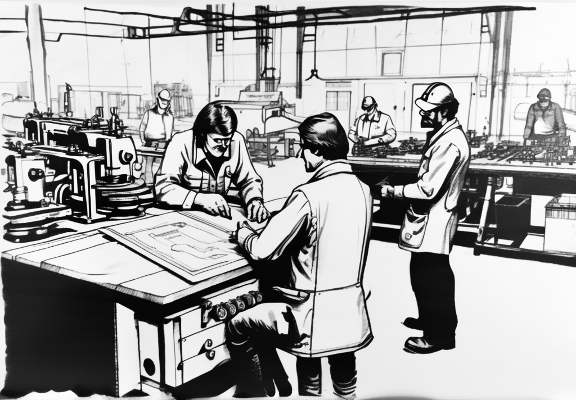
Created Stable Diffusion XL
First, we must co-create with the users. Participatory design is not a new concept. The shift from research participants to partners of design took place in Northern Europe during the labor union moments in the 1970s. This historical context took away the power of technology experts, including industrial designers and researchers at that time. Workers were made part of the process of designing and building complex systems and tools, with technologists, at the workplace. Participatory designing was born. We must continue to co-create with users and do so contextually when we can.
At Walmart, “we believe the key to unlocking transformation lies in the creativity and innovation of our associates” — Donna Morris[1].
Our people Research team conducted co-creation workshops with field associates at stores. The team wanted to better understand what associates need from digital tools. Insights generated from the paper prototypes that associates built helped inform potential product solutions.
Second, we must partner with business leaders, early on in innovation the process. I strongly believe that if we wait to research what product features to build, it’d be too late. The remarkable shift from a product-centric view to building personalized experiences and mass customization was spear-headed by the marketers after all. Be the strategic partners to the business by equipping them with insights and articulated stories of WHY something is the right thing to do for both the business and for the user. Here is where we can begin to calculate the ROI of research.
Third, we must join forces with Design. In this much divided world that we live in today, navigating all the uncertainties and changes around us is a constant challenge. Rather than defining for the users, more designers are adopting a participatory approach to architect the container of the experience and let the users fill in the rest.
UXR can investigate and test the boundaries by conducting iterative user research, along with Design and Product. We must help shape what could be meaningful experiences, have the users react to them, and co-create as a cross-functional team with Design. More than ever, Design and UXR ought to work together, closely. Silos must be busted.
“The designer should build the container or shape the boundaries and the user should fill in the rest…” Brock Dishart
Fourth, we must co-imagine with Foresight Thinkers, to build a future world that that is inclusive, loving, and what we want to live in.
CO-BUILD A PATH FORWARD
The time has come to co-build our path forward. What are the things UXRs must consider and do to empower our Collective Creativity?
Deepen our expertise. When the CEO of Airbnb was asked about team and design skills, he said —
“We try to go very deep with expertise. Not only we have a design function, we have a workshop group, we have a dozen people focus on the app, we have a studio that is going through a lot of the specific implementations…”
I advocate the same for User Experience Research and Strategy. Go deep and be more specific about what we do and the expertise we offer. Have specialized roles even though they may not be traditionally considered as UXR, for example, Facilitation and Service Design to boost our Power of Collective Creativity. Facilitators are superheroes and Service Designers are silo-busters. The value they can bring to the co-creation process, Design Thinking, and Foresight warrants them a special seat at the table.
Do not categorically combine Facilitation with Design Thinking, Service Design with System Thinking. Each of these specialties requires rigorous education and training.
We must welcome designers who are interested in Research to our team. Create a Research Designer position to transform insights into visual articulations of future better user experiences. Better bridge Research and Design.
Form a centralized insight entity. Stand together with other research and Data teams who can have more direct access to the complementary data and participant pools. Do not position UXR as a service provider. There are many “side effects” of UXRs being a cost center that other disciplines use for free. During financial down turns, services are often deprioritized, under the disguise of saving costs. It does not matter how high-performing the teams are.
Create a searchable insight library to centralize learning and data insights that all disciplines can leverage, across products, domains, and business functions. Build a forest of common knowledge that regenerates with new research and insights. Foster unified understandings of the user needs and aspirations.
Building skills as a team. Instead of considering our skills and roles individually, we must approach building research craft collectively, as a team. Structuring a jellyfish-shaped research team with diverse specialties. An important factor to consider is that as we are deepening team expertise, we must not distribute our people. Only by staying centralized and through partnerships, we can have the flexibilities to move and scale our influence, in harmony, with other disciplines. Ratio is of a lesser concern if we stay together.
“Design should not be a service organization. Design challenges technology. Technology inspires art. It is a perfect harmony from the very beginning. Tell people the story — you benefit from ME.” — Brian Chesky.
Co-create with AI. A fifth of researchers are currently using AI in their research; an additional 38% plan to incorporate AI in the future (User Interview).
“AI won’t replace us, but the people who use AI will.” — Ioana Teleanu
AI will never replace the human creativity, but AI can offer benefits serving as a smart partner or an assistant. A fifth of researchers are currently using AI in their research; an additional 38% plan to incorporate AI in the future (User Interview).
While AI shows great potentials in assisting Research, we must apply critical thinking and co-create with it to achieve the intended outcome we want.
Design thinking workshops. A popular method that my previous research team offered is Design Thinking. We used GenAi to create fun icebreakers at the beginning of workshops to encourage collaboration and team creative. After the workshops, our research team used an internal GenAi tool to quickly conduct thematic analysis and create concise summaries for themes generated. They then applied critical thinking to see if the outcomes were accurate.
Prompts and scenarios for testing. Recently, our team experimented using GenAi to create testing scenarios for an unmoderated testing. We applied relevant behavior economics principles as parameters when writing prompts for AI. The AI-assisted method allowed us to complete research and share learning with stakeholders in three days.
Quantitative research. In addition, our team used the tool in finding Excel formulas and writing codes in R for quantitative analysis, enabling us to complete tasks faster.
In sum, I urge our UXR community to co-create with Design, Product, Business Leaders, AI, and most importantly the users for more meaningful experience in the next decade. This is a critical moment in the history of our discipline. Be the trail blazers for your teams and for each other in co-building a better world around us.
So next time when people or robots ask — what you do? Proudly say it —
“I co-create, with YOU.”
(The content of this article was first presented at the UX360 Research Global Summit in 2024.)
[1] https://www.linkedin.com/pulse/empowering-associates-creating-better-work-through-new-donna-morris/?trackingId=1fsiGnlmQTq3nMhzpUp65g%3D%3D
메타데이터
- post_id
- e52a41e6e5ce
- slug
- ignite-the-power-of-co-creation-collective-creativity-e52a41e6e5ce
- url
- https://medium.com/@huahannah8/ignite-the-power-of-co-creation-collective-creativity-e52a41e6e5ce
- canonical_url
- https://medium.com/@huahannah8/ignite-the-power-of-co-creation-collective-creativity-e52a41e6e5ce
- author_url
- https://medium.com/@huahannah8
- status
- ok
- fetched_at
- 2026-07-25 03:20:30



