The 4 Fatal Mistakes New Medical Writers Make (and How to Avoid Them)
The first medical article I ever reviewed taught me something I wasn’t expecting.
The 4 Fatal Mistakes New Medical Writers Make (and How to Avoid Them)
The first medical article I ever reviewed taught me something I wasn’t expecting.
The grammar was solid. The spelling was flawless. Every medical term was used correctly.
It was also painfully difficult to read.
About three paragraphs in, I realized the problem wasn’t the writer’s ability. It was the process behind the writing. The article had clearly been written from the top down, with very little thought given to the reader, the structure, or even the purpose of the piece.
I’ve seen versions of that same mistake ever since.
People often assume medical writing is simply writing with more scientific vocabulary. It isn’t. Good health communication sits at the intersection of science and storytelling. It asks you to understand the evidence while never forgetting that a real person is reading your words.
That person may be trying to understand a new diagnosis. They may be caring for an aging parent. They may have spent hours searching online because they can’t make sense of conflicting advice.
When you look at it that way, the responsibility feels different.
If you’re thinking about becoming a medical writer, there are a few mistakes worth avoiding from the very beginning. They’re common because nobody talks about them, yet they’re often the reason promising writers struggle long before they ever land their first client.

The introduction isn’t where you prove you’re smart
One habit seems almost universal among beginners.
They open with a definition.
“Hypertension is…”
“Diabetes is…”
“Osteoarthritis is…”
There’s nothing technically wrong with that approach. It’s simply forgettable.
Readers rarely arrive because they want a definition. They arrive because something has interrupted their lives. Maybe they’re worried. Maybe they’re confused. Maybe they’re trying to understand something their clinician explained in ten minutes.
The opening paragraph should acknowledge that reality.
Some of the strongest medical articles I’ve read don’t begin with medicine at all. They begin with a question someone is already asking, a misconception that deserves correcting, or an observation that immediately tells the reader, “This article understands why I’m here.”
Once you’ve earned that attention, explaining the science becomes much easier.
Accuracy matters, but connection comes first.
Writing starts with reading
One of the quickest ways to spot an inexperienced medical writer is to look at the order in which they work.
Many open a blank document first.
Experienced writers usually don’t.
Before the first paragraph exists, they’ve already spent time gathering studies, comparing recommendations, checking publication dates, and asking whether one source simply repeated another without adding new evidence.
Medicine changes constantly. Clinical guidelines evolve. New trials challenge old assumptions. Statistics that looked current two years ago may already be outdated.
That’s why research isn’t a box you tick halfway through writing. It’s the foundation the entire article rests on.
I’ve found that good research has another benefit people rarely mention.
It makes writing easier.
Instead of stopping every few minutes to check a fact or second-guess a claim, you already know where your evidence is. Your attention stays on explaining the topic rather than chasing information across dozens of browser tabs.
Readers can usually sense when a writer knows the material well. The writing feels calmer. More confident. Less eager to impress.

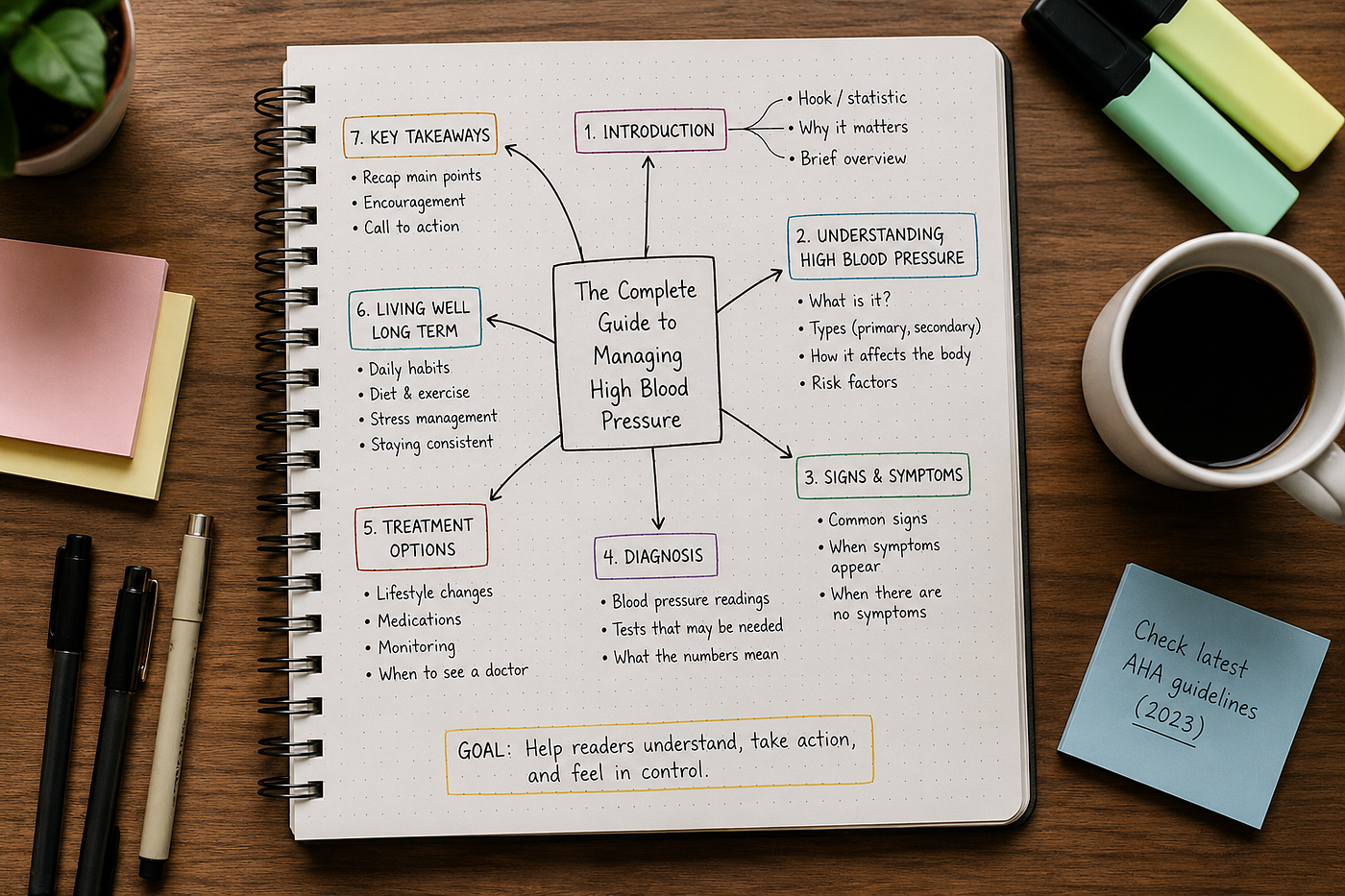
An outline saves more time than it costs
I used to think outlining slowed me down.
Then I looked back at my early drafts.
I’d introduce one idea, wander into another, repeat myself without realizing it, and somehow reach the conclusion having forgotten to answer the question I started with.
The outline wasn’t the extra step.
Skipping it was.
Medical topics already contain enough complexity. The structure shouldn’t add more.
A simple framework helps you decide what belongs in the article and, just as importantly, what doesn’t. That’s harder than most people expect.
Every interesting fact doesn’t deserve a paragraph.
Every study doesn’t need to be mentioned.
Every tangent pulls the reader a little farther from the reason they opened the article in the first place.
A good outline quietly keeps everything moving in one direction.
Readers may never notice it consciously, but they’ll notice the effect. The article feels easier to follow. Each section builds naturally on the last. Nothing feels forced because the thinking happened before the drafting.
Know who you’re talking to
This might be the most overlooked part of medical writing.
Not every article is written for the same reader.
Someone living with chronic migraines doesn’t need the same explanation a neurologist expects.
A nursing student doesn’t read like a parent whose child has just received a diagnosis.
The science may stay the same, but the language, pacing, examples, and depth all change.
I’ve seen articles drown ordinary readers in terminology that could have been translated into plain English with almost no loss of accuracy.
I’ve also seen articles simplify complex evidence so much that the nuance disappears entirely.
Neither serves the audience.
The best medical writers constantly ask themselves one question.
What does this reader need from me?
Not what do I know.
Not what can I explain.
What does this specific person need to understand before they close this page?
That question changes everything.
It changes the examples you choose. It changes the metaphors you avoid. It even changes the length of your sentences.
Good medical writing isn’t about showing readers how much you know.
It’s about making sure they leave knowing more than they did five minutes ago.

Build a system instead of relying on inspiration
For a long time, I treated every article like a completely new project.
New document.
New outline.
New research notes.
New structure.
It worked, but it was exhausting.
Eventually I realized experienced writers weren’t necessarily faster because they wrote better. They were faster because they stopped rebuilding the process every single time.
They had templates for research.
Frameworks for outlining.
Checklists for editing.
Systems for translating technical language into something people could actually understand.
That realization eventually led me to build my own collection of writing templates and planning documents. What started as a way to organize my workflow became something I found myself returning to again and again because it removed the guesswork.
After enough conversations with aspiring health writers facing the same challenges, I packaged those resources into my Medical Writing Toolkit on Gumroad.
It isn’t a shortcut to becoming a great writer.
Nothing is.
What it does offer is a practical starting point. Instead of wondering how to organize your research, structure an article, or adapt your writing for different audiences, you begin with frameworks that have already solved those problems.
That leaves you free to focus on what matters most: producing accurate, engaging health content that people genuinely trust.
Writing about health is a privilege.
People invite your words into some of the most uncertain moments of their lives. They read your articles before appointments, after diagnoses, and during long nights spent looking for answers.
That’s worth taking seriously.
If you’re just starting out, don’t worry about sounding like every established medical writer you admire. Focus on building a process that’s reliable. Learn how to research thoroughly. Plan before you draft. Keep your audience at the center of every decision.
The writing itself will improve with practice.
If you’d like a head start, I’ve shared the exact templates and planning frameworks that helped me move away from blank-page anxiety and toward a more consistent workflow. You can find the Medical Writing Toolkit on Gumroad, download it, and adapt it to your own style.
Your readers won’t remember every sentence you write.
They will remember whether your writing helped them understand something that once felt confusing. That’s the standard worth aiming for.
메타데이터
- post_id
- e52bdd124f83
- slug
- the-4-fatal-mistakes-new-medical-writers-make-and-how-to-avoid-them-e52bdd124f83
- url
- https://medium.com/@ifiokene/the-4-fatal-mistakes-new-medical-writers-make-and-how-to-avoid-them-e52bdd124f83
- canonical_url
- https://medium.com/@ifiokene/the-4-fatal-mistakes-new-medical-writers-make-and-how-to-avoid-them-e52bdd124f83
- author_url
- https://medium.com/@ifiokene
- status
- ok
- fetched_at
- 2026-07-24 12:20:12