Vibe Testing with TestMu AI — The New LambdaTest Experience
There’s a new way software is getting built. You’ve probably felt it.
Vibe Testing with TestMu AI — The New LambdaTest Experience
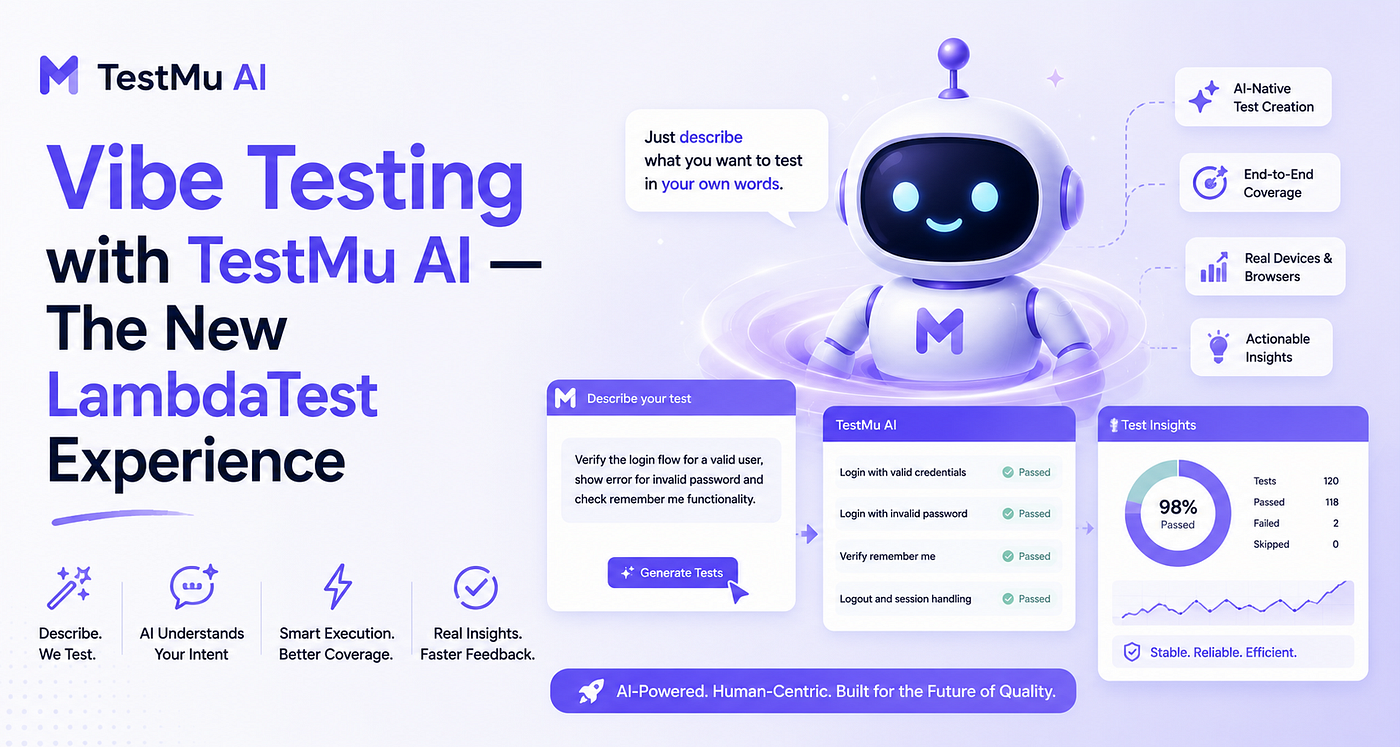
There’s a new way software is getting built. You’ve probably felt it.
A developer describes what they want — in plain English, to an AI assistant — and working code comes back. A founder ships an entire MVP over a weekend with nothing but prompts and iteration. An engineer builds a feature by vibe: describe the outcome, refine the output, ship when it feels right.
This is vibe coding. And it’s not a fringe trend anymore. It’s how a growing number of software gets built in 2026.
The tools for vibe coding are mature. The tools for vibe testing — making sure what you vibe-coded actually works before your users find out it doesn’t — are just arriving.
TestMu AI (formerly LambdaTest) is where that experience lives now.
What Is Vibe Testing?
Vibe coding has a testing problem. When you build fast using AI assistance, you’re generating more code than any one developer can read and reason about carefully. The traditional response — “slow down and write comprehensive tests manually” — runs directly counter to the speed that makes vibe coding valuable in the first place.
Vibe testing is the answer. It’s testing at the speed of thought — describing what should work, having an agent write and run the tests, getting results fast enough to act on before the momentum breaks.
It’s not about cutting corners on quality. It’s about scaling quality validation to match the pace of AI-assisted development.
TestMu AI built KaneAI for exactly this: a GenAI-native testing agent that turns a natural language description of your feature into runnable, maintainable test cases — without slowing down the build cycle.
KaneAI: Testing at the Speed of Thought
KaneAI is the core testing agent inside TestMu AI. It’s the world’s first GenAI-native end-to-end software testing agent. You tell it what you want to verify, and it does the rest.
Here’s what that looks like in a vibe testing workflow:
The old flow:
- Build feature
- Hand off to QA
- QA writes test plan
- QA authors test scripts
- Tests run
- Bugs filed
- Fixes made
- Cycle repeats
The vibe testing flow:
- Build feature
- Describe what it should do to KaneAI: “Verify that a new user can sign up with an email, complete onboarding, and land on the dashboard”
- KaneAI authors the test cases
- Tests run on TestMu AI’s cloud grid across Chrome, Firefox, and Safari simultaneously
- Results, videos, and root cause analysis arrive in your dashboard
- Ship or fix — your call, with actual signal
The loop collapses from days to minutes. The quality bar doesn’t drop — it moves alongside the velocity.
The TestMu AI Experience: What Changed from LambdaTest
TestMu AI is the evolution of LambdaTest — same company, same team, same infrastructure, now built for the agentic AI era.
If you used LambdaTest before, nothing breaks. Your Selenium, Playwright, Cypress, and Appium scripts run exactly as they did. Your test history, your team accounts, your CI/CD integrations — all intact. The domain redirects automatically. This isn’t a migration. It’s an upgrade.
What changed is the ceiling.
The LambdaTest experience was: connect your test framework, run tests in the cloud, get results. That was a meaningful improvement over local testing. But it was still you writing every test, you interpreting every failure, you fixing every broken selector.
The TestMu AI experience adds an agent layer. You still control your testing strategy. You still make the release decisions. But the agent handles the authoring, the maintenance, the triage, and the analysis. The platform goes from infrastructure-for-your-tests to a collaborator in your quality engineering process.
Who Vibe Testing Is For
The vibe testing model resonates differently across different parts of the software ecosystem, but the groups getting the most from it share a common profile: they’re moving fast and need quality validation that keeps up.
Indie builders and solo founders shipping AI-native products: you’ve built something real, but you haven’t had the bandwidth to write a comprehensive test suite. KaneAI lets you describe your critical flows in plain language and get test coverage without a QE team.
AI engineering teams building chatbots, voicebots, and autonomous agents: your product is an AI that produces variable outputs. You need Agent-to-Agent Testing — AI agents that test your AI product, covering conversation flows, edge cases, and adversarial inputs at a scale that manual testing can’t reach.
Fast-moving product teams with established QE practices: you have a test suite, you have automation, but maintenance overhead is eating your QE team’s capacity. Layering KaneAI and the Auto Healing Agent on top of your existing Playwright or Cypress tests reduces that overhead without requiring a full rewrite.
Developers who ship features directly: increasingly, individual developers are responsible for test coverage on the features they build. KaneAI makes it possible for a developer to author meaningful test cases without learning a testing framework — describe the behavior, review the output, ship with coverage.
Real Device Cloud for Real-World Confidence
Vibe testing isn’t just about speed — it’s about confidence. The tests have to run on what users actually use.
TestMu AI’s Real Device Cloud gives you 10,000+ real iOS and Android devices to test on. Not emulators. Real Samsung Galaxy, iPhone, and Android devices running real operating system versions, with real network conditions.
When you describe a flow to KaneAI and it generates a mobile test, that test can run on a real device — the same hardware your user has. The bugs it catches are bugs your users would have found.
This is particularly important for vibe-coded apps. When you’ve moved fast and built a lot, the surface area for device-specific bugs is larger than you might think. A flow that works beautifully in Chrome on a MacBook might behave differently on a Samsung Galaxy on a slower network. Real Device Cloud is where you find out before your users do.
The HyperExecute Speed Multiplier
If vibe testing is about moving fast, HyperExecute is the engine that makes it possible at scale.
HyperExecute is TestMu AI’s blazing-fast automation testing cloud. It distributes your test suite across multiple machines running concurrently, using intelligent orchestration to minimize total execution time. Tests that would take 40 minutes on a sequential runner, or 15 minutes on a standard parallel grid, run in under 10 minutes on HyperExecute.
For a vibe tester in the middle of an iteration cycle, this matters enormously. A 10-minute feedback loop lets you ship three or four more iterations before lunch. A 40-minute loop means waiting around, losing context, and building on uncertain ground.
HyperExecute doesn’t change how you write your tests or configure your framework. You point it at your test suite and it handles the distribution. The speed gain is immediate.
MCP Server: Agents in Your IDE
For teams using AI coding assistants and IDE-native workflows, TestMu AI’s MCP Server brings testing directly into where you build.
The TestMu AI MCP Server connects AI agents in your IDE to the TestMu AI platform through a unified MCP (Model Context Protocol) interface. Instead of context-switching to a dashboard, your AI assistant can trigger test runs, retrieve results, and surface failures directly in your development environment.
It’s a small change in workflow that has a large impact on momentum. When test results come to you instead of requiring you to go find them, the feedback loop tightens further. Vibe coding and vibe testing start to feel like one continuous motion.
The SmartUI Layer: Visual Confidence
Vibe-coded apps often evolve their UI rapidly. Components get restructured, layouts shift, new design elements get added. SmartUI, TestMu AI’s Visual Testing Agent, tracks these changes and flags unexpected regressions automatically.
When KaneAI runs a test suite and SmartUI is enabled, every visual comparison runs in parallel. If a component renders differently than it did on the last approved run, SmartUI flags it. The AI-native image comparison filters out rendering noise — minor font antialiasing differences, subpixel variations — and surfaces the regressions that actually matter.
For a vibe coder iterating rapidly on UI, this is the safety net that catches what functional tests miss.
Continuity: What Doesn’t Change
One thing worth being direct about: if you’re a LambdaTest user, you don’t have to do anything to experience TestMu AI. Your account is your account. Your scripts are your scripts. Your pipelines keep running.
The rebrand happened on January 12, 2026. Lambda (λ) and Mu (μ) are consecutive Greek letters — it’s evolution, not a break. The domain redirects, the infrastructure is identical, and the same team is behind it.
What you’re gaining is access to a platform that now treats AI agents as first-class citizens: KaneAI for test authoring, Agent-to-Agent Testing for AI products, Auto Healing for maintenance, Root Cause Analysis for triage, SmartUI for visual regression. All of it on the same cloud grid you already trust.
Start Vibe Testing
The workflow is simple. Sign in at accounts.lambdatest.com with your existing credentials or create a new account. Connect your framework — Playwright, Cypress, Selenium, Appium, anything — and run your first cloud test. Then try describing a test scenario to KaneAI in plain language and see what it produces.
The shift from automation to agentic testing doesn’t require a migration plan. It requires trying the agent once and seeing what changes.
TestMu AI. Built for the speed you’re already moving at. Explore the platform at testmuai.com.
메타데이터
- post_id
- e52d4056ca44
- slug
- vibe-testing-with-testmu-ai-the-new-lambdatest-experience-e52d4056ca44
- url
- https://medium.com/@tanveer.insights/vibe-testing-with-testmu-ai-the-new-lambdatest-experience-e52d4056ca44
- canonical_url
- https://medium.com/@tanveer.insights/vibe-testing-with-testmu-ai-the-new-lambdatest-experience-e52d4056ca44
- author_url
- https://medium.com/@tanveer.insights
- status
- ok
- fetched_at
- 2026-06-09 15:37:30



