The Loyal Royalists: The Tory Movement in Revolutionary America
Not all colonists were revolutionaries — including Benjamin Franklin’s own son, William
The Loyal Royalists: The Tory Movement in Revolutionary America
Not all colonists were revolutionaries — including Benjamin Franklin’s own son, William

“The Battle of Bunker’s Hill” by John Trumbull, 1786 (source: Yale University Art Gallery)
Onstage at Lantern Theater Company now through June 7, 2026, Lloyd Suh’s *Franklinland* takes as its subject one of early America’s most famous patriots, Benjamin Franklin. But he’s not the only title Franklin — William Franklin, his son, is an equal player in the story. While Benjamin was a revolutionary, his son was the opposite: a committed Loyalist working tirelessly for the British crown. Who were the Tories, and what happened to them during and after the War of Independence?
In 1607, Great Britain established its first successful colony at Jamestown, Virginia. William Penn founded Philadelphia 75 years later. Less than a century later in 1706, Benjamin Franklin was born in Massachusetts, a colony hundreds of miles to the north, to a Puritan father who moved to the New World to escape religious persecution in Britain. For the first 158 years (including the first six decades of Franklin’s life), the colonies were more or less content as they were: subject to the British crown, with a degree of independent governance.
That changed in 1765 with the passage of the Stamp Act. Two years earlier, Britain won the French and Indian War, with France ceding its territories in eastern North America to Britain. But despite the victory, the war was costly, and Britain began to look for revenue sources to defray the expense. The Stamp Act was an act of British Parliament decreeing that many paper products in the American colonies — legal documents, newspapers, playing cards, and more — must be printed on paper with a stamp from Britain. That stamp raised the price of paper, making this the first direct tax on the colonists, who resisted it fiercely.

1909 illustration by Henry Marriott Paget of British troops escorting stamped paper to New York City Hall amidst protests of the Stamp Act (source: Wikipedia)
Resistance was especially strong in Boston. A new round of taxes called the Townshend duties were passed, and Bostonians fought them so hard that British forces occupied the city in 1768. In 1770, the Boston Massacre left five colonists dead at the hands of British troops, and in 1774 Britain’s occupation of Massachusetts intensified with the Coercive Acts, also called the Intolerable Acts of the Americas, which closed ports and installed troops in taverns in the state. Britain had hoped that this show of force would quell revolutionary inclinations in the colonies. Instead, though, it only fanned the flames as other colonies rallied to Massachusetts’ side. By 1775, the revolution had begun, with Lexington and Concord in Massachusetts becoming the site of the first battle of the Revolutionary War.
But while the revolutionary effort was broadly popular, it was not universal. Historians estimate that 15% to 20% of white colonists remained loyal to Great Britain and opposed efforts toward independence. There were many reasons for this, but the primary ones were financial and temperamental. Colonists with direct business ties to Great Britain were more likely than others to be Tories, as independence would disrupt their business. Older colonists sometimes felt a more direct connection with England and considered revolution morally wrong. Others rejected the violence of revolution and became Loyalists either as opposition to Patriot violence or as a stopgap until independence could be reached peacefully and by broad consent. While these were the primary reasons white colonists became Loyalists, there were also Black Loyalists — often in response to promises from Great Britain that they would be freed from enslavement if they fought for the British.
But while Great Britain assumed Loyalists would rush to the side of the Redcoats militarily, that kind of civilian support did not materialize. Patriots, who vastly outnumbered Tories, restricted Loyalist organization and punished those who were outspoken for the Loyalist cause with things like property confiscation and public humiliation. While some colonists joined up to fight on the British side or formed their own Tory militias, Loyalists often remained undercover and passive unless there were British forces in the immediate vicinity. Royal officials were expelled from their posts, and those actively working to support the British cause were often imprisoned. In cities the British controlled, like New York, Loyalist colonists spoke their minds more clearly. But in more rural areas — which, in colonial times, were up to 90% of the land — they stayed quiet.

“Reception of the American Loyalists by Great Britain in the Year 1783” by Benjamin West, depicting Britannia taking in exiled Loyalists (source: Wikipedia)
After the war, some of these Loyalists self-exiled to other British holdings, including areas in the Caribbean, Nova Scotia, and even back to England itself. About 2% of the white population self-exiled in this way, especially those who were newer colonists with fewer ties to the new United States. But the vast majority remained. After a few years, many of those who left returned and became American citizens. Many anti-Tory laws, passed to punish those who supported Britain’s forces, were repealed in 1783, and those who were punished with fines or land confiscation often appealed and were forgiven. Not everyone came back, though, including the son of one of America’s most important patriots: William Franklin, illegitimate son of Benjamin and an unknown woman.
As a young man, William showed some of Franklin’s early urge for independence — just like his father, he ran away as a teen, but Franklin caught him and brought him home. William then joined the army (this time, with Franklin’s blessing) and fought in King George’s War, the third of the four French and Indian Wars. In 1747, at the age of about 17, he was promoted to captain. After that war, he returned to Philadelphia and the home of his father, where he often accompanied and assisted his father through his science experiments and diplomatic trips abroad, including a fateful trip to London in 1759, during which time William became a lawyer; fathered his own illegitimate son, William Temple, whom he placed in foster care; and met and married Elizabeth Downes, who was visiting London from Barbados.
In 1763, William was honored with an appointment as the Royal Governor of New Jersey. This was a major promotion; governors were typically gentlemen, not illegitimate sons of colonists who earned their fortunes in trades. But William proved capable and popular. He improved infrastructure, secured crop subsidies, encouraged the growth of higher education, pardoned women who were convicted of adultery, and maintained relatively supportive relations with the indigenous tribes — particularly the Lenape and the Oneida, recognizing their rights to the land and establishing the first reservation. But as a Loyalist, his motives were distrusted among those who were pro-Revolution, and his reputation fell as revolutionary fervor grew. But damage to his popularity would not dissuade him from his devotion to the Loyalist cause. When Benjamin Franklin returned to America and attempted to persuade William to switch to the revolutionary side, they argued so loudly it woke neighbors. William was steadfast — he assured the British crown that “no attachments or connections shall ever make me swerve from the duty of my station.”

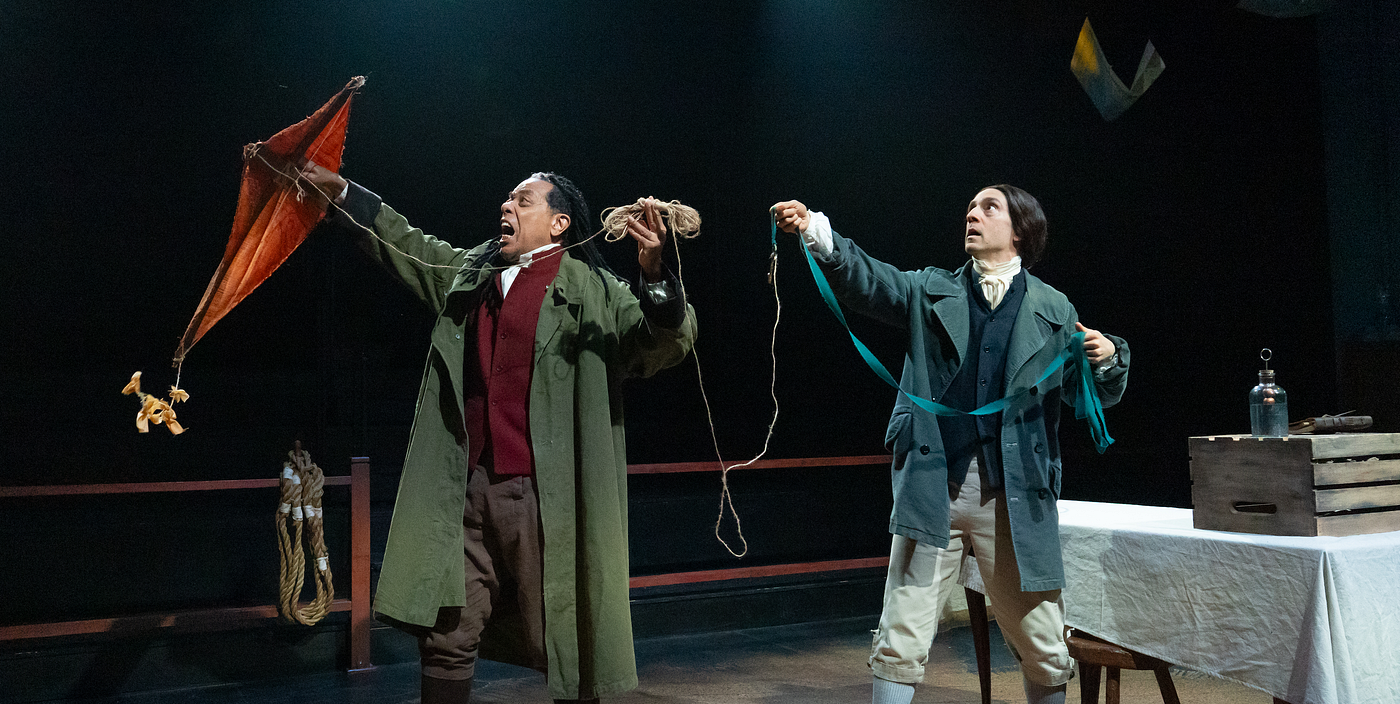
Dave Johnson and Frank X as William and Benjamin Franklin in the Lantern’s FRANKLINLAND (Photo by Mark Garvin)
When William was arrested in 1776 by American forces, he attempted escape. When he was paroled, he collaborated with the British forces in support of their war effort, resulting in his rearrest and imprisonment in solitary confinement. His wife fell ill and died while he was jailed, an echo of his own father’s absence from his wife Deborah’s sick bed. Upon his release, William self-exiled to England, where he lived the rest of his life as something of a Loyalist hero. His bond with his father was irretrievably broken. Despite several attempts on William’s side to reconcile, Franklin remained silent, preferring instead to raise and support William’s son Temple, who replaced William as Franklin’s confidant and collaborator. They reunited just once, nine years after their final meeting in the U.S., and then remained estranged until Franklin’s death, whereupon he left William nothing but a parcel of land in Nova Scotia — the inspiration for the play’s *Franklinland*, which Lloyd Suh devised to make sense of this strange bequest to a disgraced son.
More great reading: See other recent articles and interviews on the Lantern Searchlight blog
Lantern Theater Company’s production of *Franklinland* by Lloyd Suh is onstage May 7 through June 7, 2026, at St. Stephen’s Theater. Visit our website for tickets and information.
메타데이터
- post_id
- e52fd20bbd02
- slug
- the-loyal-royalists-the-tory-movement-in-revolutionary-america-e52fd20bbd02
- url
- https://medium.com/lantern-theater-company-searchlight/the-loyal-royalists-the-tory-movement-in-revolutionary-america-e52fd20bbd02
- canonical_url
- https://medium.com/lantern-theater-company-searchlight/the-loyal-royalists-the-tory-movement-in-revolutionary-america-e52fd20bbd02
- author_url
- https://medium.com/@lanterntheater
- status
- ok
- fetched_at
- 2026-06-09 15:37:30