Who Built The Sphinx?
This is an age-old question that does not have an answer to it. The traditional explanation, by Egyptologists and those who agree with…
Who Built The Sphinx?
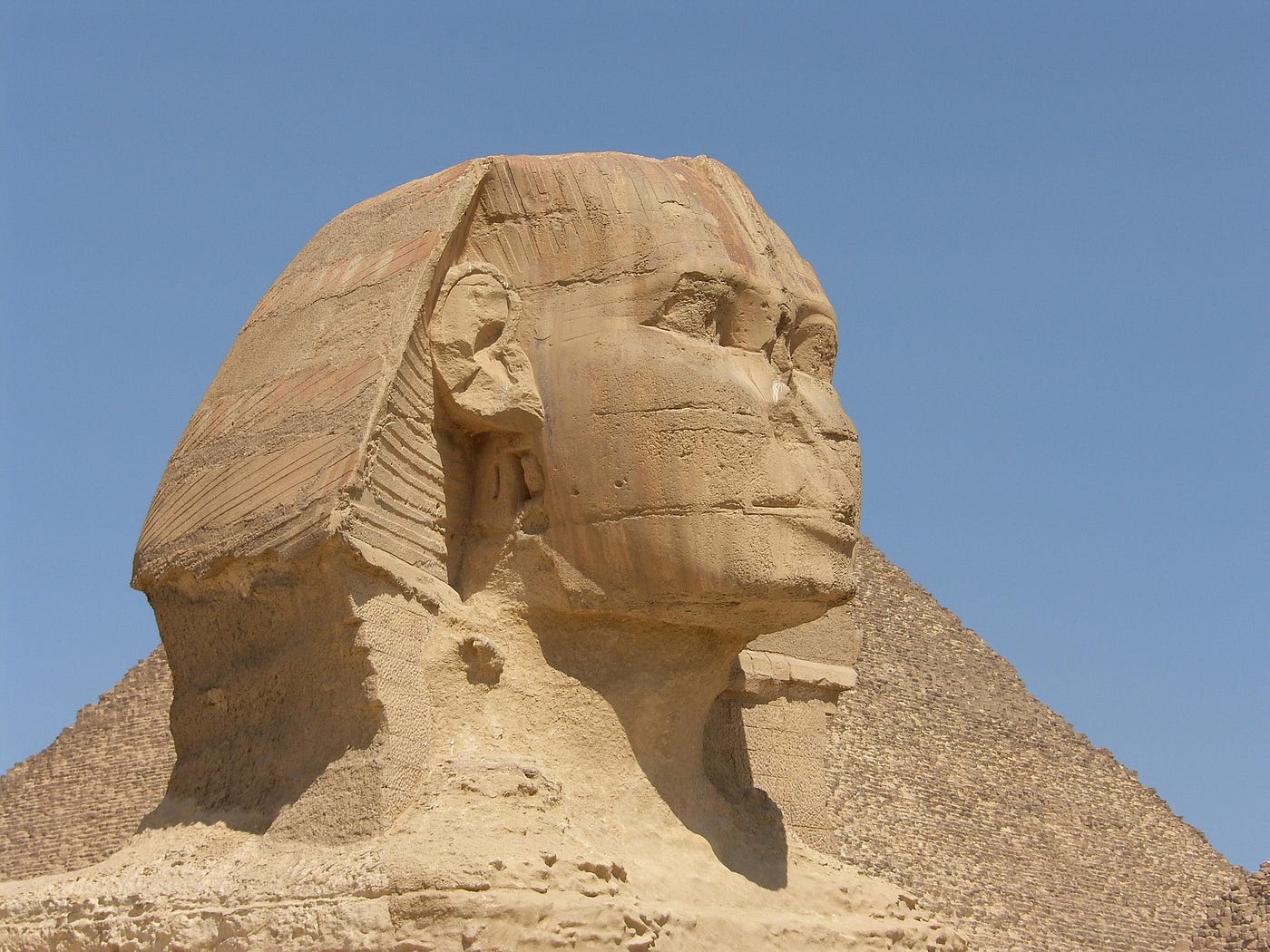
Photo by Lyad
This is an age-old question that does not have an answer to it. The traditional explanation, by Egyptologists and those who agree with them, is that Khafre built it in his lifetime:
We are willing to agree that Khaefre may have redesigned the Sphinx to mirror his personal image, but we will not accept the idea that he had it built. It is hard to determine who built it because ancient records do not survive, providing honest information.
Even if ancient records survive detailing its construction and design, it would be hard to take the ancient Egyptian’s word for it. Their reputation for falsifying their history undermines their credibility.
It would be hard to believe that the ancient Egyptian records were honest and accurate. The fact of the last line of that quote leaves the construction up for all types of speculation, including the most recent study that places it in deep, dark, very ancient history:
According to a study presented at the International Conference of Geoarchaeology and Archaeomineralogy held in Sofia titled: GEOLOGICAL ASPECT OF THE PROBLEM OF DATING THE GREAT EGYPTIAN SPHINX CONSTRUCTION, the enigmatic and mysterious Sphinx of Egypt is around 800,000 years old.(Ibid)
That theory is worse than what the ancient Egyptians did, as there is absolutely no credible and legitimate method that could possibly verify that date. There is no constructive way to discuss that theory at this time.
Ancient records do provide some mentioning of the Sphinx, however, they do not contain any record of its building, just that it was there at the time of the ancient writers:
Later Egyptian records: Another Egyptian text often cited is the Inventory Stela (sometimes called the “Stela of Khufu’s Daughter”), likely from the much later 26th Dynasty (Saite period, c. 670–525 BC). It purports to record that Khufu (Khafre’s father) found the Sphinx already buried in sand and carried out repairs to honour it. The stela even claims Khufu built a temple next to the Sphinx. If the claim is accepted at face value, it implies that the Sphinx predates Khufu, which contradicts the Khafre attribution.
Later writers, like Pliny the Elder (1st century AD), did mention the Sphinx but only as a marvel; Pliny repeats a folk belief that it was a tomb of a king named “Harmachis” (a Hellenised form of Hor-em-akhet) — indicating that even in antiquity its true history was obscure. These classical anecdotes neither confirm nor refute Khafre’s involvement; they mainly underscore that the Sphinx’s origin was a mystery even to later Egyptians and Greeks, reinforcing the importance of archaeological evidence to identify its builder. ( source)
What we wonder about is why Egyptologists would claim the Inventory Stele to be a fake:
However, Egyptologists overwhelmingly consider the Inventory Stela to be pseudo-historical — a later fabrication or allegory, not a factual Old Kingdom record. Its style of hieroglyphic writing and the deities mentioned point to a first-millennium BC creation-likely an attempt by Saite priests to legitimise local cults by backdating them to the Old Kingdom. Even Gaston Maspero (a 19th-century Egyptologist) speculated the Inventory Stela might copy an authentic 4th Dynasty document, but this theory is viewed with strong scepticism today.(Ibid)
We do not fully accept that explanation, not because we want the Stele to be accurate, but because that is too pat an answer. Given that writing styles can be found in any era, this explanation seems more of an excuse to keep the accepted narrative supported.
We have read Schoch, listened to John Anthony West, as well as other scholars on this topic, and we do not think it was a masterpiece created by Khafre.
Other Egyptologists, and scholars, professors, and historians from outside the field, have claimed the Sphinx is much older than the 4th-Dynasty date mainstream Egyptology continually insists on. The claims of some of these writers, such as Zechariah Sitchin and Erich von Daniken, have long been discredited by scholarship in the field, and those of more recent writers on the subject are routinely ignored or claimed to be irrelevant or incorrect. (Ibid)
We have not read Sitchin, but we have read Daniken and dismissed his ideas long ago. However, the closed minds of Egyptologists lead us to believe that they do not want to see an older date, as it would undermine the view of Egypt and its history among modern Egyptians.
It is possible that there is no conspiracy here, just an attempt to keep the patriotism the Ancient Egyptians wanted in future generations, flowing and building today.
Except for the deep ancient date, the idea that the Sphinx was submerged has been shared by many more modern scholars. Schoch is one of them. it is very possible for the Sphinx to have been built and then submerged as sea water did cover the land, just not over 1 million years ago.
If the Sphinx is in fact, 800,000 years old as the geological study suggest, who built the enigmatic monument nearly one million years ago? Are we looking at evidence that points to the existence of an unknown civilization to history? Is it possible that an advanced ancient civilization inhabited the Giza Plateau in the distant past, before the ‘creation’ of the ancient Egyptian civilization? And if this culture did develop on the shores of today’s River Nile… Is it possible that other advanced civilization developed elsewhere on our planet hundreds of thousands of years ago? (source)
The problem with these questions is not who built them or whether there were other advanced civilizations existing at that time. The problem is, where did this knowledge go, and why did people have to start over at square one again?
The theory does not make sense, for it has no real mechanism to destroy those supposed civilizations and their knowledge. Why weren’t subsequent civilizations traveling to the stars if advanced societies could construct the Sphinx so long ago?
Time in our history where mainstream scholars suggest people were still living in caves. Obviously, there is something wrong with our views on history and prehistory. (Ibid)
It is not our views on both history and prehistory that are the problem here. The lack of real, credible, legitimate, physical evidence is. It is unrealistic to think that the Sphinx and other physical evidence could last for almost 1 million years.
The only “written” evidence that exists from ancient times about the Sphinx is that of Greek historian and geographer Herodotus, who does not mention that the pharaohs of the fourth dynasty (Khufu, Khafre, and Menkaure) were the builders of the Sphinx, nor the Pyramids of Giza. (Ibid)
These words contradict another resource concerning Herodotus and his Egyptian experience:
We will accept the latter quote on this topic as it is supported by other academic papers:
The paper/study on the 800,000-year-old age seems to be playing fast and loose with history for whatever reason the researchers may have had.
The only reason we would quote or give that statement any time is that Cayce was probably actually talking about the global biblical flood, but being the unbeliever that he was, he used Atlantis instead.
There is no reason to deny the idea that ancient people who knew of the global biblical flood would change the story as their unbelief and deception grew. Atlantis is a replacement for the pre-flood world.
We would and do accept a pre-flood construction for the Sphinx. That is the only era that makes sense for construction. The age of the Sphinx would be in the range of 4000 to 8000 years old and not older.
Who built the Sphinx? The people in the pre-flood world occupied what we know now as Egypt.
Originally published at http://theoarch.wordpress.com on April 6, 2026.
메타데이터
- post_id
- e53e0affddec
- slug
- who-built-the-sphinx-e53e0affddec
- url
- https://medium.com/@archie55/who-built-the-sphinx-e53e0affddec
- canonical_url
- https://medium.com/@archie55/who-built-the-sphinx-e53e0affddec
- author_url
- https://medium.com/@archie55
- status
- ok
- fetched_at
- 2026-07-14 09:34:12