How talking to 10 customers over two (2) weeks unlocked $2M for a Fortune 500 co
How a structured approach to customer interviews turned assumptions into evidence—and evidence into a completely different product strategy
Customer interviews 101
A couple of weeks, 10 conversations, and $2M in projected savings
Third in a series of four (4) articles
In parts 1 and 2 of this series, I explained why customer interviews matter and how to do them well. Here in the third part, we’ll get into an example around what happened when you do them — and the return on investment (ROI) we generated for a specific client who we’ll call Acme Co.
Not quite the right problem, but confidently held
I was at an agency in 2017 and we were gearing up to work with Acme, a Fortune 500 healthcare financing company. They were 100% certain they understood their main problem. They had a solution nearly ready.
They had databases of customer survey results and years of focus group findings. Marketing personas too — complete with stock photos and articulate backstories across the entire customer journey in stages. And a customer success team that was H-O-T-T-O-G-O.
Their belief was straightforward: affordability of the medical/dental procedure(s) was the problem.
Their next product feature was all but set in their mind: extend payment terms from 12 months to 24/36 months. Stretch it out, make it more affordable on a monthly basis. Problem solved.
I should also say that Acme wasn’t hunting for insight — they were hunting for confirmation. They wanted to check a box.
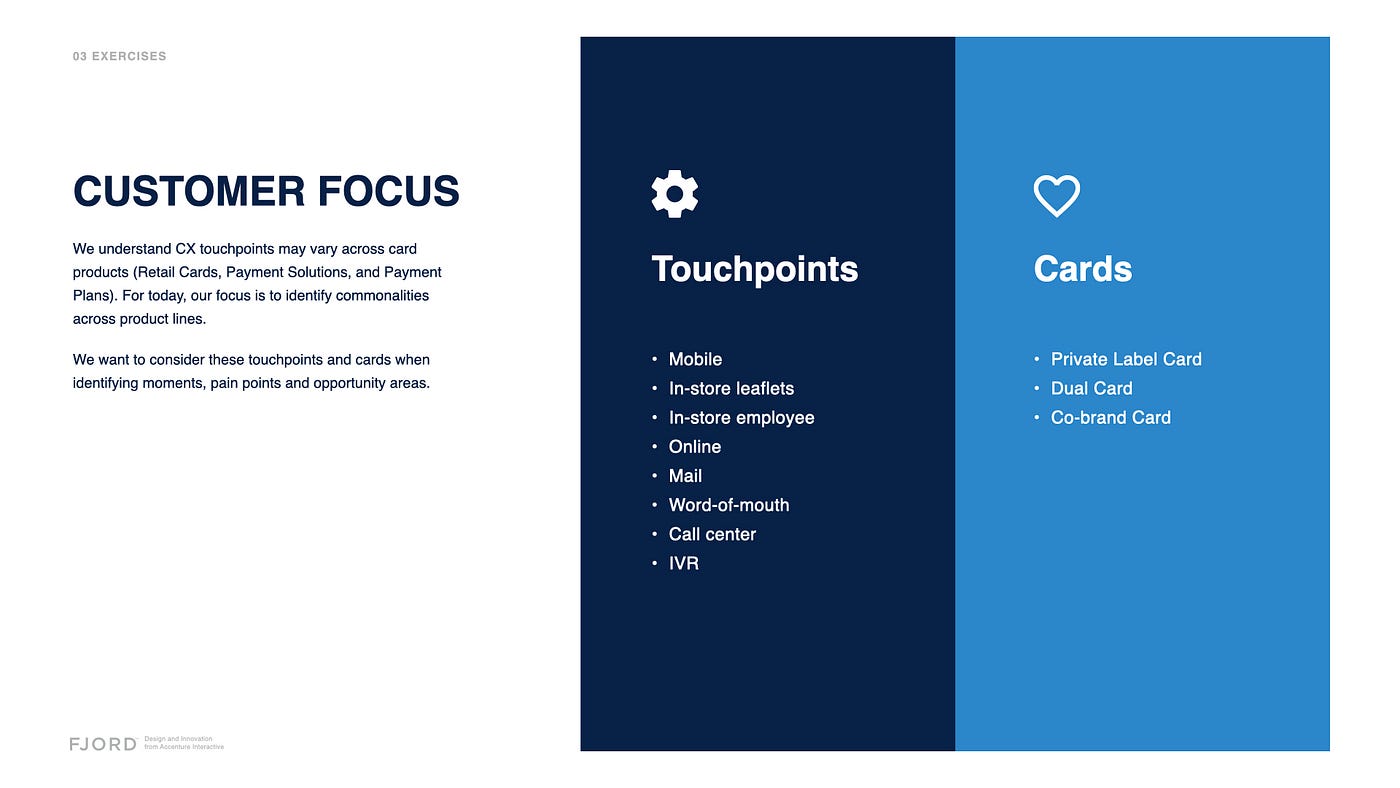
The starting scope: eight (8) touchpoints and three (3) card types across all product lines and every stage of the customer journey. We mapped customer moments, pain points, and opportunities across the system — not just a single product or channel in isolation.
But when we talked to 10 customers over a couple of weeks, everything they believed turned out to be not quite right. Because according to their customers, that wasn’t the problem at all.
Data rich, but insight poor
This situation isn’t unique to Acme. So many organizations invest in expensive market research, build elaborate personas, but still can’t build products people love. Why? Because demographic data can’t tell you why people make decisions. And most interviews are done incorrectly; people asking leading questions built on the quicksand of their own limiting beliefs.
Sure, survey data told them who their customers were and focus groups told them what customers would say in a controlled room with strangers. But none of that revealed the friction that actually stopped people from hitting “apply.”
Building trust before digging for truth
We started with two (2) back-to-back workshop sessions to uncover the client team’s context. We needed to understand their mindset, active projects, priorities, etc.
This matters. If you walk into a company and immediately tell them everything they believe is incorrect, they will dig in and fight whatever you say. No matter how true. Nobody likes a know-it-all, especially when you’re right. That’s even worse, as Dave Gray says. But listening can take the edge off, demonstrating that you understand their work and respect what they know, which can make them more open to uncomfortable truths.
After the workshop sessions, we did 10 customer interviews over two (2) weeks. Ironclad user research stuff: talk to humans, listen to their stories, look for patterns, make changes accordingly. That’s what we did in 2017. It’s also the foundation of the Bullseye Customer Sprint methodology I use now — same practice, same goal, now with a slightly different structure thanks to Google Ventures (GV).
What we heard
The second woman I interviewed was sitting in her car waiting for the check cashing store to open. I remember she asked whether the gift card incentive we were offering was $15 or $50. That was grocery money, she said.
Valerie (not her real name) wasn’t avoiding the service because she couldn’t afford it. In fact, she had used healthcare financing before and qualified easily. The barrier wasn’t what was in or wasn’t in her bank account — it was the opacity in the process.
As we walked through the user flow, our questions brought out what the client’s surveys had never captured:
- The timing gap: she needed her due date to be exactly when her paycheck cleared but before money vanished to other bills.
- Credit risk: she was working to improve her credit score; would a “pull” for an application destroy months of progress? Was it a hard pull? A soft pull?
- Dignity tax: she didn’t want to experience “desk shame” — having to admit to the provider’s staff that she couldn’t pay upfront.
- Whose best interest: without a clear timeline or transparent approval steps, she couldn’t tell if this was a smart financial move or something else.
She described the experience as walking in the dark. It seemed as though she knew where she wanted to go, but she couldn’t see the specific path.
(Not) surprisingly, 7/10 customers we interviewed described variations of similar things. The other three (3)? They mentioned how the monthly payment amounts were important, but the uncertainty was right there too.
Yes, affordability mattered but Acme had missed something much earlier: uncertainty about the process kept people from ever getting to the budget/money question.
The gap nobody saw
The company had been working on a secondary problem, not the primary problem that was blocking people from even getting there. They’d been focused on making payments more affordable — extending terms, reducing monthly amounts — when customers first needed clarity about the process.
People weren’t avoiding the service because they couldn’t pay. They were avoiding it because they didn’t know where to begin or how long it would take.
When you talk to a human being sitting in their car waiting for the check cashing outlet to open, asking whether you were paying $15 or $50, you understand their reality in a way no persona can capture.
From insight to action
Here’s where Valerie’s specific struggles became the framework that drove the entire redesign.
We used a structured approach that forced specificity:
- Identify customer moments (what’s actually happening)
- Surface pain points (where it breaks down)
- Define opportunities (what could shift)
- Share findings with the team
This framework prevented us from chasing abstract problems and kept insights grounded in real customer behavior — particularly hers.
For Valerie, who couldn’t get her due date changed to the 16th or 17th to match her paycheck? That became a product requirement: let customers choose their payment date based on their own needs. The confusion about approval timeline? That became upfront communication: “You’ll hear back in 24 hours or less.” The shame about explaining financial status? That was product and design table stakes: bring dignity back to the process.
With these 10 conversations as evidence — and these stories (Valerie’s was but one) as the through-line — we made specific recommendations for Acme:
- Streamline the application workflow
- Create crystal-clear customer timelines showing exactly what happens and when
- Reveal what’s happening behind the scenes with the approval process and next steps
Each recommendation flowed directly from what we heard. Not from theory. Not from what we thought customers needed. From what Valerie and six (6) others actually told us.
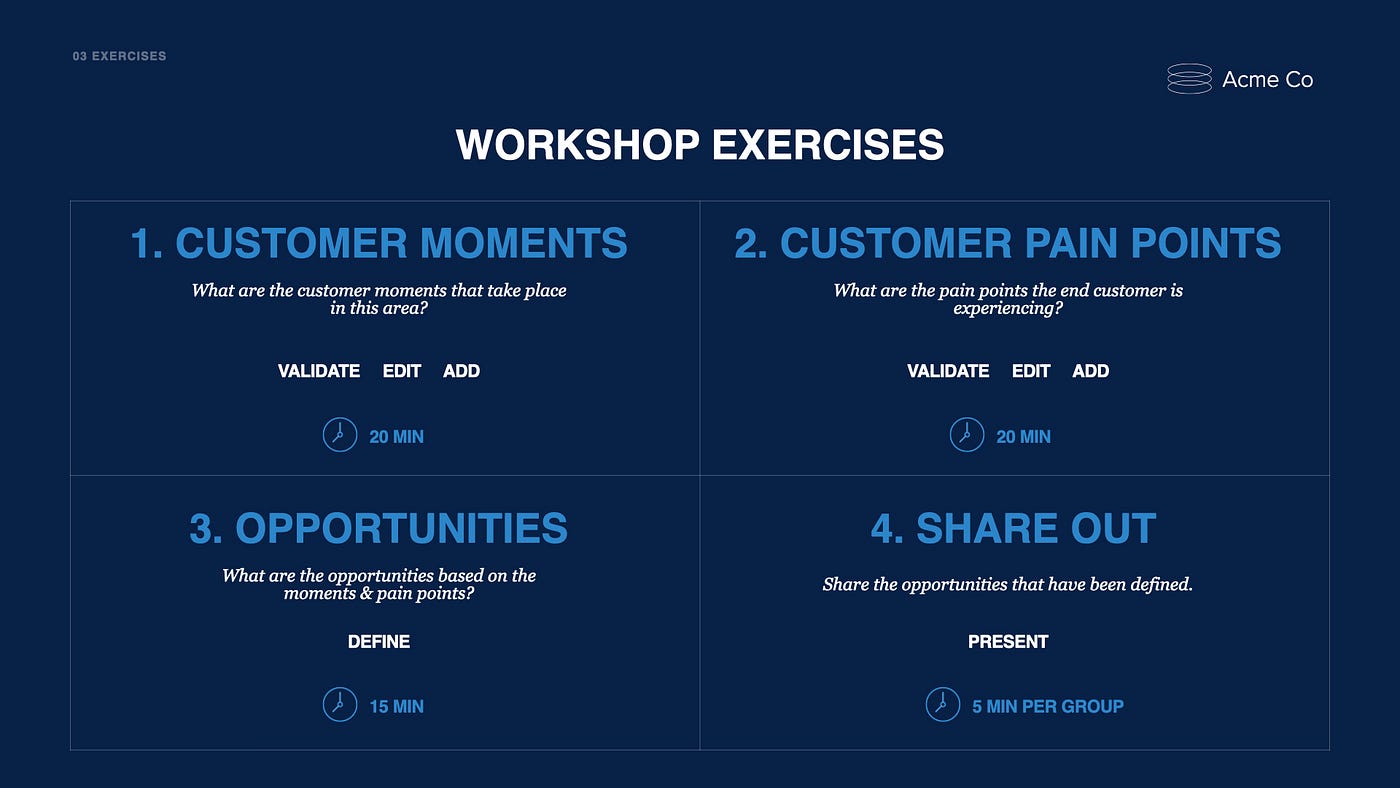
The structured approach: four (4) exercises that force specificity. Identify customer moments (what’s actually happening), surface pain points (where it breaks down), define opportunities (what could shift), and share findings with the team. This framework prevented us from chasing abstract problems and kept insights grounded in real customer behavior.
The projected impact: an estimated 10% increase in service signups, based on the percentage of qualified applicants who were abandoning at the approval stage. For a segment worth over $20M annually, that translated to about $2M in retained revenue — all from insights gathered in less than a few days of interviews.
And if Acme had continued that cadence with 4-5 interviews every month, they’d have met or exceeded Teresa Torres’ recommendation of weekly customer conversations over the course of a year. That ongoing practice would’ve kept them connected to how customer reality was shifting, rather than operating on assumptions that calcified into “what we know about our customers.”
And 10 conversations is just the start. But the real win? Making interviews a weekly ritual so you’re never too far away from your customers.
The only thing constant in life is change. Your customers won’t stay the same, neither will their needs, goals, wants, or pains. If you’re not keeping up with this, your product could be a solution in search of a problem that’s already been solved.
If you’re not talking to customers, you’ll ship features no one asked for. You’ll de-prioritize fixes people are desperate for. You’ll confidently defend outmoded decisions. And you’ll do it all while genuinely believing you understand what your customers need.
That’s the trap. Not ignorance — confidence built on expired information.
Weekly interviews don’t guarantee you’ll get everything right. But they do guarantee you’ll never be that far wrong. They keep you close enough to catch your assumptions before they calcify into strategy.
The ROI nobody talks about
For Acme, $2M was an obvious metric. But there were other returns that don’t necessarily show up in a financial model:
- Team alignment around customer needs — before the interviews, different departments had different theories about the problem. Product thought it was a specific thing. Marketing thought it was another. Customer success had their own perspective. After hearing from the same kind of 10 customers, there was a general alignment.
- Confident decision-making backed by evidence — when you’ve talked to customers directly, you make choices differently. You’re not guessing or arguing about opinions. You’re citing what you heard, you’re citing evidence.
- Reduced wasted effort on solutions to the wrong problems — the company had been planning to invest heavily in extending payment terms — development resources, financial model changes, new lender partnerships — all to solve a problem customers kind of had, but not the main one.
These almost never show up in an ROI calculation, but they’re often the biggest return of all.
What this teaches about assumptions
Companies don’t fail to do customer research because they don’t care about customers. They fail because they feel confident that they already understand.
Acme had so much data, they jokingly called their data lake a double Baikal (after the deepest lake in the world, in Siberia). They had surveys, focus groups, and personas. They had smart people with deep industry experience. All folding in on what they already believed.
But all that existing knowledge created a kind of certainty that prevented them from seeing what was actually happening.
The demographic data told them who was using the service and who wasn’t. The survey data told them customers were “concerned about affordability.” The focus groups reinforced what they already believed.
None of it revealed that the real barrier was uncertainty about the process.
That insight only emerged through direct conversation. Through asking open questions and following where customers’ stories led. Through talking to someone about their real context, dealing with their actual constraints.
Arbitrage by the numbers
Here’s the ROI calculation for the Acme work that should convince anyone:
- Time invested: about 20 hours of interviewing and synthesis spread over a couple of weeks. That’s 2.5 days of effort.
- Potential annual return: $2M in additional revenue from a 10% increase in service signups.
- The arbitrage: For the cost of 2.5 days of effort, we unlocked $2M in value. That is an easy decision for even the most risk averse CEO would take.
But more than the number itself, think about what 2.5 days actually means in context. That’s half a work week to discover that everything you believed about your customers’ biggest barrier was off course. Then, to redirect the strategy toward solving the actual problem. To unlock, in this case, millions in retained revenue.
How many half-week investments can you make in your business that generate that kind of return?
What you can do with this
You don’t need a Fortune 500 budget or an agency team to replicate this approach.
Here’s the minimum effective version:
- Schedule 10 conversations. Split them into a few sections — it helps to have a break between or you’ll lose the thread from the first ones.
- Start with their stories, make it about them: “Walk me through the last time you [encountered this problem / made a decision / solved something like this].” Then, follow their story. Don’t lead. Don’t pitch. Seek to understand their reality.
- Look for what surprises you. Pay attention to moments when what they’re saying contradicts what you assumed. That’s where insights live.
- Synthesize immediately. Right after each conversation, capture: What surprised us? What confirmed what we believed? What should we change based on this?
- Compare all 10. A single person telling you something is interesting. 5–7 people revealing the same underlying pattern through different stories is evidence you can act on.
In this case, Acme didn’t need sophisticated research methods or massive sample sizes. They needed 10 conversations and the willingness to let those conversations challenge what they thought they knew.
Granted, we did a lot more than 10 customer interviews — including context-setting workshops, stakeholder and retail partners interviews, and high-level business case — but it was really those customer interviews that shifted the tide and unlocked the $2M value.
In the last part of this series, I’ll show you how we used this same principle (generally) at Sesame to launch a new two-sided healthcare marketplace in three (3) months with even fewer resources. You’ll see exactly how we recruited participants, what questions we asked, and how we turned insights into product decisions without drowning in process.
If you missed the earlier parts:
- In part 1, I explained why customer interviews matter and how teams drift from reality
- In part 2, I shared the lightweight framework that makes customer interviews practical
Thanks for reading.
My name is Skipper Chong Warson and I run How This Works co — a product strategy and design practice that helps teams like yours do customer interviews on the regular, not as a one-off.
How might customer interviews transform your product path and the decisions you make? Let’s chat about it. **Book a free 25-minute call with me.**
Citations:
- Teresa Torres — “Continuous Discovery Habits” (2021)
- The Bullseye Customer Sprint methodology in Learn More Faster from Google Ventures (GV)
- Rob Fitzpatrick — “The Mom Test: How to Talk to Customers and Learn If Your Business is a Good Idea When Everyone is Lying to You” (2013)
- Erika Hall — “Just Enough Research” (2013, second edition 2019)
메타데이터
- post_id
- e544716640fd
- slug
- how-talking-to-10-customers-over-two-2-weeks-unlocked-2m-for-a-fortune-500-co-e544716640fd
- url
- https://medium.com/how-this-works-co/how-talking-to-10-customers-over-two-2-weeks-unlocked-2m-for-a-fortune-500-co-e544716640fd
- canonical_url
- https://medium.com/how-this-works-co/how-talking-to-10-customers-over-two-2-weeks-unlocked-2m-for-a-fortune-500-co-e544716640fd
- author_url
- https://medium.com/@skipperchongwarson
- status
- ok
- fetched_at
- 2026-07-29 08:51:35