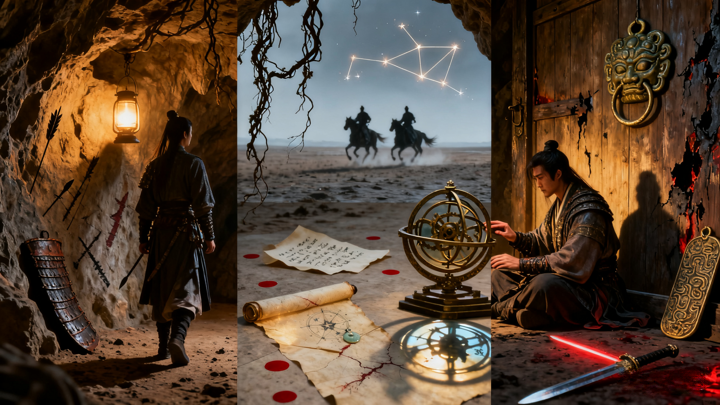
Chapter 20: Trial by Fire
The Ontological Flame Awakens
Chapter 20: Trial by Fire
The Ontological Flame Awakens
1.Night Raid on Blackpine Forest — The First Counterattack of Many Grammars
Before dawn, the forest was a void where even starlight seemed to drown. The wind through the pine needles was no longer nature’s whisper — it was the last breath of civilization, warning itself to stay alive.
The assassins of the Guild of Unity moved like shadows pressed flat against the earth. Their black armor devoured light, their knives engraved with the word Oneness. They were not men but formatting tools, sent to erase variance itself.
The lead infiltrator touched the thatched granary wall; dew clung to his fingertips, heavy with the White River Clan’s “grammar of cycles.”
For a heartbeat, two philosophies met — one fluid and eternal, one frozen and singular.
[Close-up] A hidden tripline snapped. The cords of White River’s Eightfold Net whipped tight. It wasn’t a trap — it was a theorem proving itself.
[Wide shot] Alarm bells screamed through the trees — civilization’s last, feral cry. Thirty torsion crossbows woke at once; their arrows hissed through the air, slick with tung oil.
Each shaft was more than a weapon — it was a sentence in defense of multiplicity.
The first assassin raised his blade — too slow. The arrow found him before sound could. His fall was nothing but a smear of “oneness” erased by “diversity’s punctuation.”
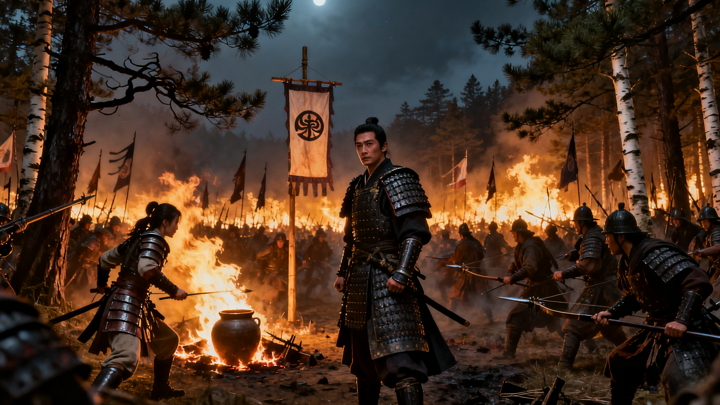
“Light it!” Oil jars rolled down the slope, shattering into tongues of red flame. The fire leapt skyward — not as destruction, but as a manifesto.
The Ontological Fire was born: wind from Qingya feeding it, tung oil from White River igniting it, clay from Blackstone holding it. Three grammars, one flame — burning to prove that life itself cannot be written in a single font.
Through the inferno, the Banner of Multiplicity stood firm. The birch pole charred but unbroken, its flag snapping in the wind:
“Our grammar will not be deleted. Our existence has more than one way to be written.”
2. Dawn Confrontation — The Metaphysics of Trembling
When dawn broke, the battlefield was a mosaic of ash and molten soil. The light painted the ruins crimson — the hue of survival, not victory.
Yan Duanmu walked across the scorched ground, the soles of his boots hissing against melted metal. He knelt, touching the armor of a fallen enemy. The etched normalized cut into his skin.

He winced — not from pain, but recognition. This was no mere battle-scar; it was civilization fighting its own extinction.
He thought of Old Shi’s millstone carvings, of Ayu’s fish-comb, of Agula’s wolf-marked cloth. Every object, every song, every dialect — they were fragments of infinite unfinished worlds. Each one worth more than the perfection of a single, total order.
He trembled — not in fear, but under the gravity of meaning. This was civilization’s existential quake — the soul’s recoil against oblivion.
Lifting his gaze, Yan saw Liu Mengyun arriving with a half-drawn map of clan lands. He spoke, voice steady as iron:
“The Guild thinks they fight for peace. They do not see that we defend the right to difference — Blackstone’s fairness, White River’s cycles, Qingya’s freedom. We are fighting for the tenses of existence itself.”
He pointed toward the smoke rising over the south ridge.
“As long as this banner stands, as long as we remember our grammar, the North remains a land of possibilities — not a desert of certainty.”
3. The Eve of Storm — The Resonance of an Unyielding Grammar
Hooves thundered from the northern trail before the morning mist had lifted. A scout stumbled into camp, breath torn from his lungs.
“Report! The Guild’s main force approaches! Thirty thousand infantry at Blackstone Flats, twenty thousand cavalry at White River docks! The black fog follows them — grass withers, even the stones lose color!”
Panic rippled through the air, but it froze on no one. In every corner, purpose answered fear.

Old Shi sharpened his chisel, its iron head gleaming. Each stroke was calibration — a communion with fairness itself. “Afraid?” his apprentice asked. He smiled, tapping the shield. “As long as these patterns hold, so does our grammar. And as long as our grammar lives, we cannot die.”
The Old Fisherman folded his nets — perfect, measured, like scripture. “Keep the comb safe,” he told Ayu. “If they burn the nets, remember the fish swim upstream. That’s all the prayer we need.”
Agula stroked his colt’s ear, tightening the wolf cloth. “Don’t fear the storm,” he whispered. “We’ll guard the wind that keeps the cloth flying, the grass that sings seventeen songs, and my father’s promise — ‘A wolf’s child never kneels.’”
Back in the command tent, Yan Duanmu traced the map, connecting Qingya, Blackstone, and White River with red ink — a constellation of survival. He raised three relics: Shi’s chisel, Ayu’s comb, Agula’s cloth.

“The Guild wants to end every story with the same period,” he said. “But we refuse. The North fights for commas, for semicolons — for every sentence still unfinished.
Outside, the black wind howled — but could not drown the sounds of life: the chiseling of stone, the folding of nets, the steady rhythm of hooves.
Three rhythms. Three grammars. Together, they became the heartbeat of plurality — a defiance sung to the void.
메타데이터
- post_id
- e54a0a116a60
- slug
- chapter-20-trial-by-fire-e54a0a116a60
- url
- https://medium.com/@johnshark/chapter-20-trial-by-fire-e54a0a116a60
- canonical_url
- https://medium.com/@johnshark/chapter-20-trial-by-fire-e54a0a116a60
- author_url
- https://medium.com/@johnshark
- status
- ok
- fetched_at
- 2026-06-21 07:44:09