Wan 2.6 vs Kling 2.6: Changed the AI Video Generation?
Wan 2.6 supports 15s videos with native audio, multiple voices, and multi-shot sequences vs kling 2.6, what effect would be achieved?
Wan 2.6 vs Kling 2.6: Changed the AI Video Generation?
On December 16, Alibaba officially released the new generation of **Wan 2.6 series models, which were comprehensively upgraded for professional film production and image creation scenarios. The brand-new Wan 2.6 is the first video model in China to support starring functionality, as well as features such as **native synced audio and visuals, multi-shot storytelling, and voice-driven animation.
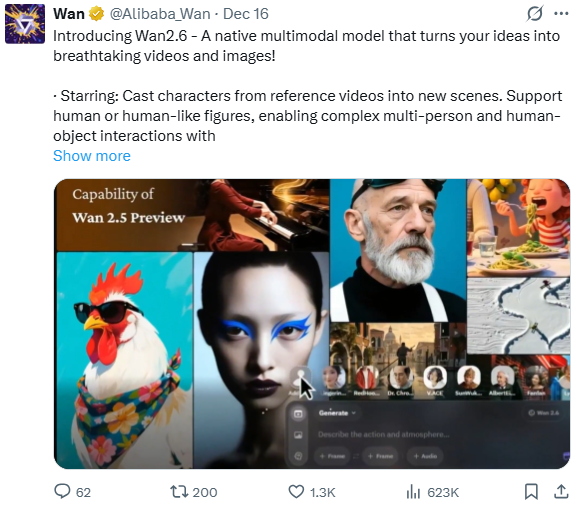
This upgraded version directly targets Sora2, its core function in the following aspects:
- Starring: The model can learn and reference the appearance, expressions, and even voice of characters in videos, allowing the same character to “perform consistently” across different scripts and scenes. It solves the long-standing issue of AI video generation, where characters often change randomly, and the narrative is difficult to maintain.
- Multi-shot Storytelling: The model can understand complex textual descriptions and automatically break them down into a coherent script containing multiple shots, such as wide shots, close-ups, and medium shots. It maintains consistency in the subject and scene across shots, achieving a leap from “generating single images” to “directing short films.”
- Native synced audio and visuals and long video generation: supports generating up to 15s, 1080p HD narrative videos, achieving precise synchronisation between lip movements, dialogue, and sound effects. It can portray emotional multi-person conversations and even song performances, significantly enhancing narrative completeness and immersion.
The most noteworthy is the Multi-shot Storytelling capability. Storyboarding is a professional hallmark of film-level creation, and properly handling storyboards requires the model to maintain consistent visual style, elements, colour tones, and logic across each generated shot, which is highly challenging. When AI understands storyboarding, it essentially masters a key aspect of film production — editing. It’s clear that the Wan series video models, from the 2.2 version’s cinematic visual control, to the 2.5 version’s first realisation of “audio-visual synchronisation,” and now the latest optimisation in character performance and intelligent storyboarding narrative, all towards the same evolutionary direction — cinematic quality.
*In previous test articles,* the Kling 2.6 held its ground with high-quality audio-visual synchronisation. Now, with the Wan 2.6 version, sound effects are available, actors are present, and even storyboarding has been automated. The “2.6 era” of AI video has officially begun, and an inevitable head-to-head competition is approaching.
302.AI has now integrated the Wan 2.6 series model API. Focusing on cinematic creation, Wan 2.6 vs Kling 2.6, who will come out on top? Let’s explore it.

Case 1: Complex Motion
Test Point: Complex Motion, Specific Style, Camera Direction, Audio Quality

Cinematic Western scene, medium shot. A young, confident cowboy stands in a dusty Wild West town street under harsh sunlight. He skillfully and rapidly twirls a silver revolver in his hand for several seconds, showing off his dexterity with a cocky smirk. Suddenly, he stops the spin, aims, and fires the gun with a decisive bang and a puff of smoke.
The camera then zooms in quickly to a close-up of his face, capturing a cool, triumphant expression, sweat glistening on his forehead. Cut to a wide shot showing the opponent, another cowboy in the distance, collapsing to the dusty ground in slow motion. The scene has a gritty, high-contrast aesthetic.
(Style: 1990s western movie, film grain, intense atmosphere.)
Audio:Classic Ennio Morricone style western soundtrack, whistling, acoustic guitar strumming, sound of heavy gun spinning mechanical clicks, a loud gunshot echo, body falling on dirt.
[embed]
Motion quality: Wan 2.6★★| Kling 2.6★★★★
Audio quality: Wan 2.6 ★★★| Kling 2.6★★★★★
Shot quality: Wan 2.6 ★★★| Kling 2.6★★★★★
Kling 2.6 wins. For the core test point ‘deftly and swiftly twirling a silver revolver in one’s hand’, Wan presented a cartoonish, 《Tom and Jerry 》style sequence, whereas Kling generated nothing at all, resulting in a deduction. Audio-wise, Kling produced background music with a classic old-West flavour, alongside accurate and authentic sound effects for gunfire and characters collapsing. Regarding cinematography, Kling flawlessly executed the zoom-in/zoom-out close-up and the cutaway shot transition to the opponent’s fall. The generated matched the reference images remarkably well in both realism and stylistic fidelity, earning the description ‘cinematic’.
Case 2: Product advertisement
Test points: consistency, intelligent storyboard, text generation, instruction following, world knowledge

A 10-second commercial for the Ricoh GR III HDF camera shown in the picture. Overall Style: Dark, minimalist studio setting with a black background. Cinematic, ultra-realistic 3D rendering. Smooth, slow camera movements. Focus on material textures like matte black metal and textured leather grip. Dramatic key lighting creating sharp highlights and deep shadows. Tech-noir aesthetic.
Shot 1: (0–2s) Start with an extreme close-up, a single sharp rim light glides across the camera’s compact, pocketable silhouette, slow dolly-in.
Shot 2: (2–4s) Then, transition to a macro top-down shot of the mode dial and the green ring on the power button, the camera slowly rotates, the letters “HDF” are in sharp focus.
Shot 3: (4–6s) Then, the camera deconstructs in an exploded view, the visual anchor is the massive APS-C sensor glowing softly in the center, next to the compact GR lens assembly and the new HDF filter module. Shot 4: (6–8s) Then, with an implied “click”, the components instantaneously reassemble; the moment it’s whole, the green power indicator light flashes on.
Shot 5: (8–10s) Finally, the activated camera fades to black, and the white text logo “RICOH” elegantly appears in the center.
[embed]
consistency: Wan 2.6 ★★★★| Kling 2.6★
Storyboard quality: Wan 2.6 ★★★★★| Kling 2.6★★
Prompt adherence: Wan 2.6★★★★| Kling 2.6★★
Audio quality: Wan 2.6 ★★★★| Kling 2.6★★★
Wan 2.6 wins. Wan 2.6 visibly generates higher-quality ad effects, fully completing five storyboards as per the prompt, with coordinated visuals, sound effects, and lighting. The body outline is relatively accurate, and the ending logo text is generated correctly. Details such as the font used also closely resemble the original Ricoh logo. The only drawback is the scrambled icons on the mode dial. In contrast, Kling’s performance is subpar, as the model failed to complete the storyboards and instead disassembled and reassembled the scene in a single take, failing to maintain the original body appearance, which resulted in a logo that does not match the original version.
Case 3: Camera Movement
Test points: Camera movement, physical motion, audio quality
A high-octane Moto GP racing sequence featuring a duel between two elite riders.
[Shot 1] First, a static low-angle shot from the side of the race track, capturing the blurred, high-speed flash of two motorcycles zooming past the camera in a split second.
[Shot 2] The camera cuts to a dynamic medium tracking shot, showing the two riders wheel-to-wheel in a fierce battle, leaning deep into a curve. Both futuristic racing motorcycles are fully visible, sparks flying from their knee sliders grazing the asphalt.
[Shot 3] Finally, a fast FPV drone shot follows them from behind as they accelerate down a long straightaway, speeding off into the distance towards the horizon.
High contrast, motion blur, hyper-realistic 4K broadcast quality, sunny race day.
Audio Prompt
Roaring high-pitched engines of Moto GP bikes screaming past (Doppler effect), the sound of tires screeching on asphalt, wind noise, mechanical gear shifts, cheering crowd in the background, overlaid with high-energy, fast-paced electronic rock sports music.
[embed]
Realism: Wan 2.6 ★★| Kling 2.6★★★★★
Audio quality: Wan 2.6 ★★★★| Kling 2.6★★★
Shot quality: Wan 2.6 ★★★★| Kling 2.6★★★
Kling 2.6 wins, with victory hinging on one factor: its visual realism is utterly superior. Wan’s cinematography (utilising 3 distinct shots) and audio production clearly adhere more closely to the prompt requirements (generating high-energy, fast-paced background music), yet the visual realism is woefully inadequate, exhibiting an unmistakable 3D-rendered game quality.
Wan 2.6 Video Model Practical Testing Conclusion
In this direct showdown with Kling 2.6, Wan 2.6’s performance is mixed, showing both strengths and weaknesses. While it reveals shortcomings in image realism, it demonstrates impressive capabilities in understanding video structure and storyboard logic.
Core Advantage: Outstanding “Director’s Mind” and Storyboard Execution
In product advertisement Case 2 testing, Wan 2.6 demonstrated dominant performance. Facing complex “5 scenes” instructions, it didn’t try to cover them up with a single long shot like competitors, but truly grasped the concept of editing, perfectly executed scene transitions, and even accurately generated the end logo details.
Audio-visual synchronisation: a more immersive “atmosphere creator”
Compared to simple dialogue or sound effect generation, Wan 2.6 excels in building an environmental atmosphere.
In the test of camera direction (Case 3), although the visuals were not good, the generated “high-energy, fast-paced background music” precisely matched the emotional requirements of the prompt, demonstrating its excellent multimodal understanding and generation capabilities.
Critical weakness: the persistent “game-like” and “cartoonish” feel.
The biggest challenge Wan 2.6 currently faces is the lack of photorealism.
Physical Dynamic Distortion (Case 1): In the “Turn Gun” test that requires detailed physical feedback, the generated actions have a “Tom and Jerry-style” cartoonish feel, completely losing the sense of weight and speed found in the real world.
Cheap Texture (Case 3): In text-to-video generation, once it involves complex scenes, the visuals often degrade into a “3D rendered game feel,” lacking the lighting, texture and grain of real photography. This directly results in a significant visual impact disadvantage compared to Kling 2.6.
Wan 2.6 is a model that “has a good mind but needs more refinement ” It is recommended to use the image-to-video mode to achieve strong logical storytelling, multi-shot transitions for commercial ad storyboards, story shorts that emphasise background sound effects and atmosphere, as well as creative validation with less emphasis on image quality but strict structural requirements. However, it still has obvious shortcomings in achieving extreme photorealistic effects and in handling detailed physical actions (such as combat or stunts).
How to Use on 302.AI
Use Model API
Step guide: API Store → Video Generation → Tongyi Wan → Wan 2.6 series models

Click [Try Now] to call the API online

메타데이터
- post_id
- e55477e610ee
- slug
- wan-2-6-vs-kling-2-6-changed-the-ai-video-generation-e55477e610ee
- url
- https://medium.com/@302.AI/wan-2-6-vs-kling-2-6-changed-the-ai-video-generation-e55477e610ee
- canonical_url
- https://medium.com/@302.AI/wan-2-6-vs-kling-2-6-changed-the-ai-video-generation-e55477e610ee
- author_url
- https://medium.com/@302.AI
- status
- ok
- fetched_at
- 2026-06-22 05:41:33