A PM’s Decision Framework for AI Agents.
From PRD → Product Release | A Technical PM’s lessons building AI in production.
A PM’s Decision Framework for AI Agents.
From PRD → Product Release | A Technical PM’s lessons building AI in production.
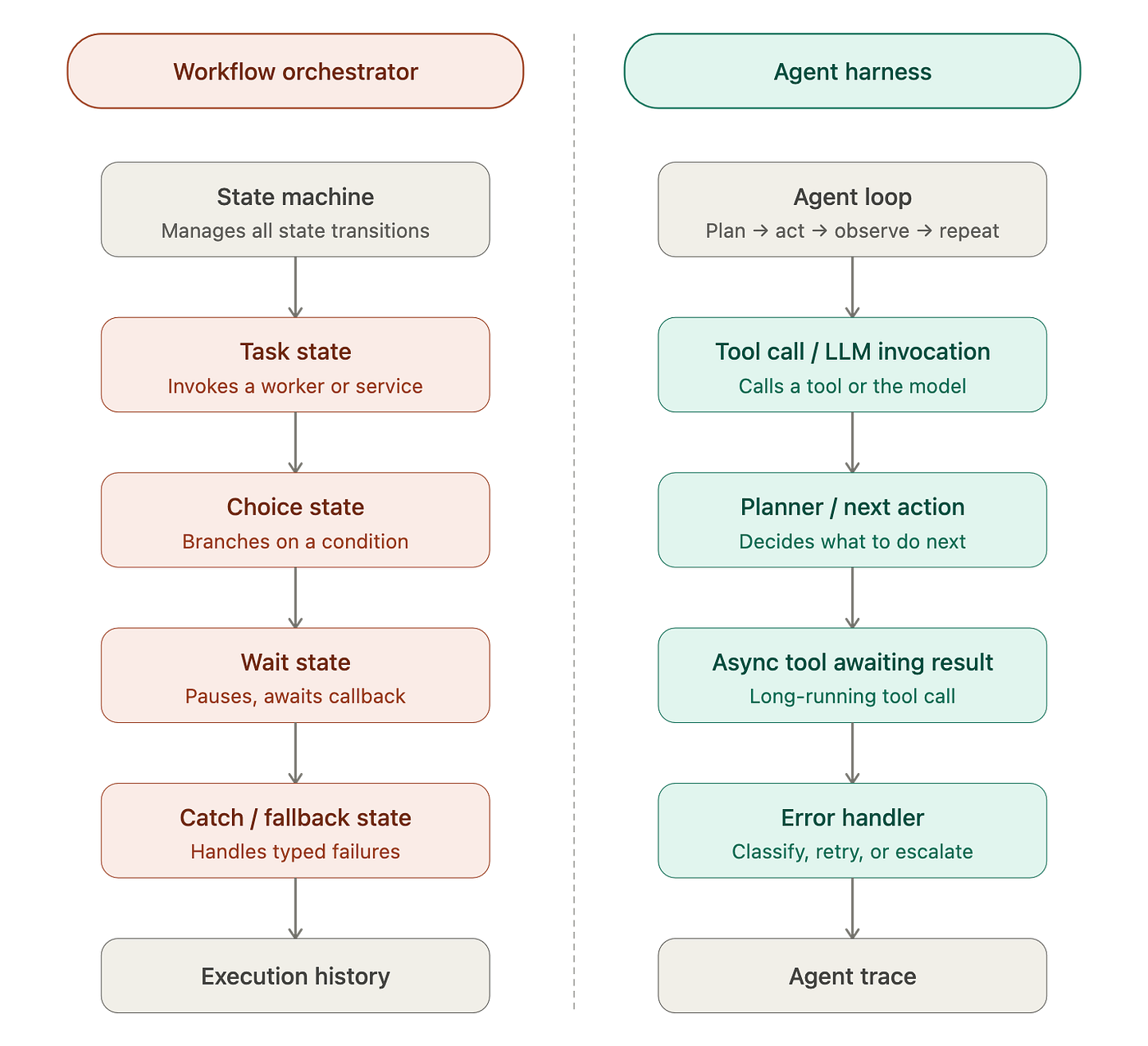
Agents and microservices are both powerful tools — they just shine in different contexts. The key question to ask: does this workflow require judgment, or just execution?
When every step is predictable, branching is finite, and inputs are structured, microservices are your best friend. They’re faster and cheaper for deterministic problems. Order fulfillment, payment processing, ETL pipelines — these workflows are fully map able before deployment, and microservices handle them beautifully.
Agents unlock their full potential when workflows involve ambiguity, unstructured input, or decisions that can’t be pre-enumerated. Contract review, intelligent workflow routing, research synthesis — these are the moments where reading and reasoning beat rigid pattern matching. When the right next step depends on understanding context, not just matching a rule, agents don’t just help — they make the whole thing possible.
The good news? You don’t have to choose one philosophy for everything. The most effective AI systems pair deterministic microservices with well-scoped agents — letting each do what it does best.
The Agent Decision Rubric
Score your workflow across five dimensions.
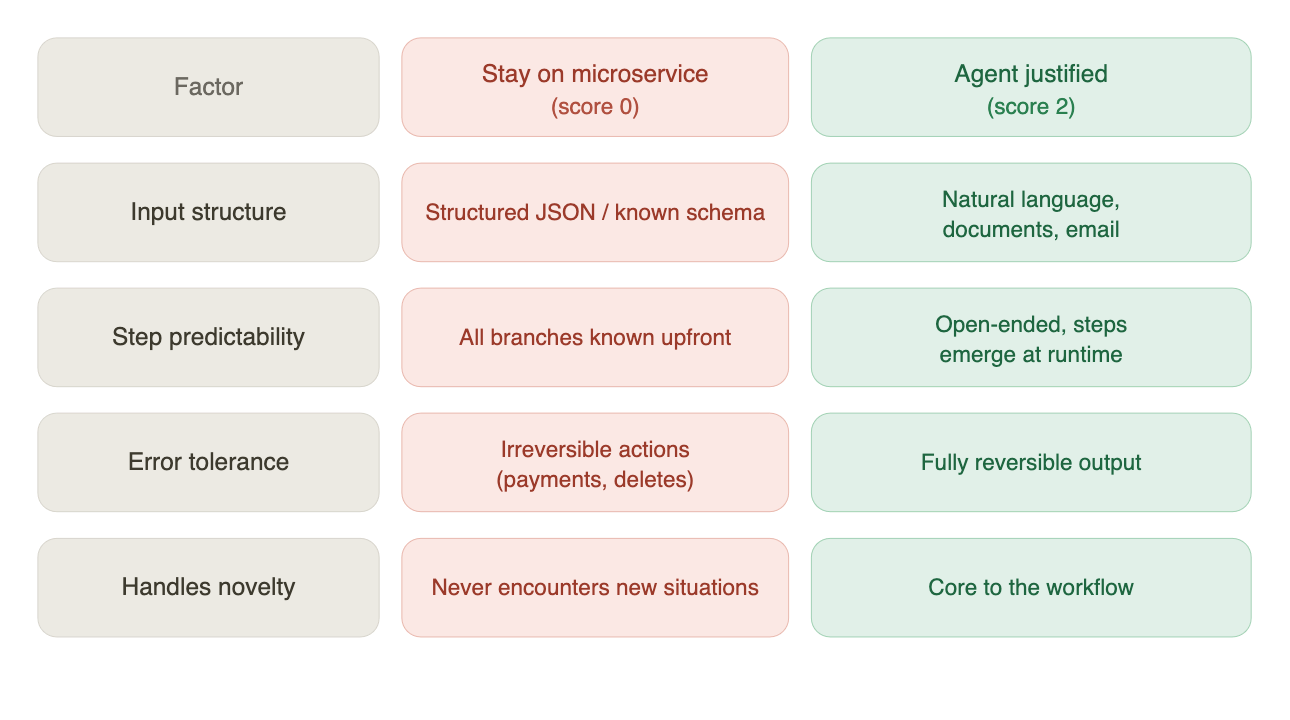
The Agent Decision Rubric: Five Factors That Lead You to the Right Call
Score 0–3: Your microservice is the right tool. Trust it. Score 4–5: Hybrid wins here — precision where you need it, intelligence where you don’t. Score 6–8: Full agent, fully justified. Do the cost math and build.
What Agents Cost — and What They Unlock
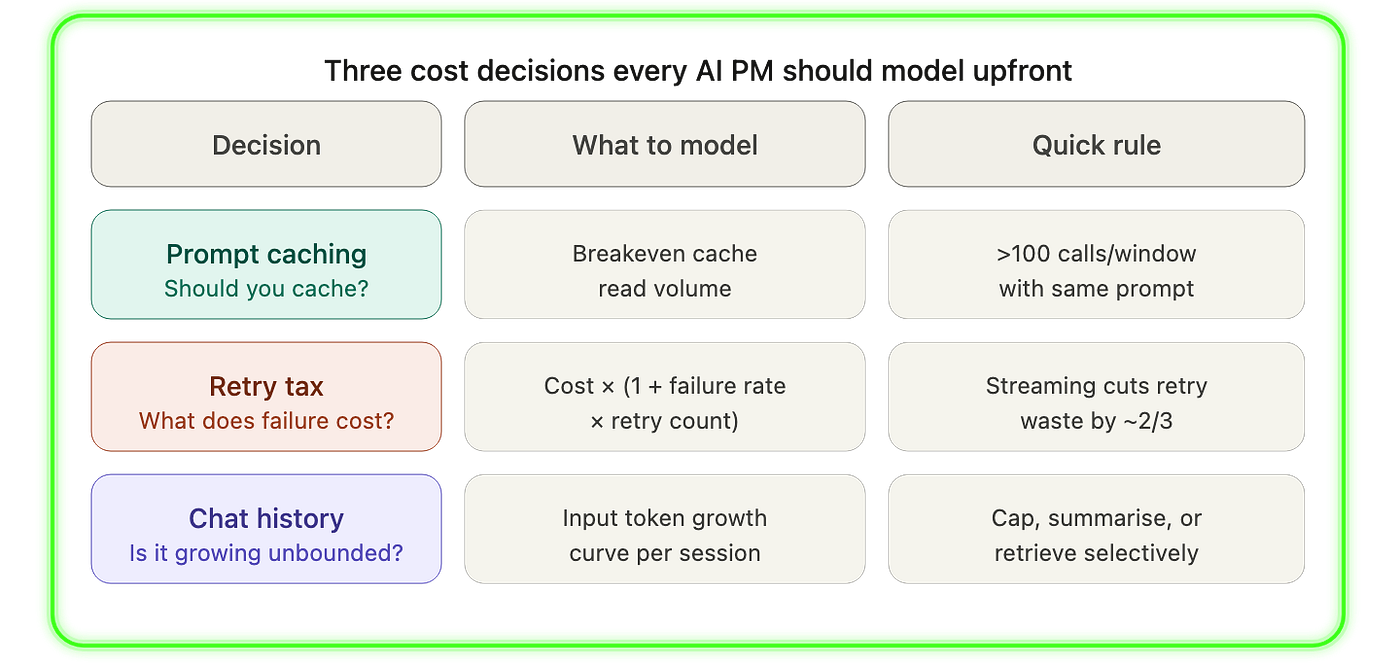
A 10-step agent running ~5k tokens per step costs roughly $0.0X–$0.X per run at current API rates. At 10,000 runs/day, that’s a real number — but it’s a number that reflects something remarkable: reasoning, judgment, and decision-making running at machine scale.
That’s the paradigm shift. Agents don’t just execute faster — they do work that simply couldn’t be automated before. The value is transformational in three ways:
- Throughput on knowledge work
- Resilience on edge cases. Microservices break on inputs they weren’t designed for. Agents don’t.
- Compounding intelligence. The more context an agent builds across a workflow, the sharper its downstream decisions become. Every step informs the next. No deterministic pipeline comes close to that.
The teams who win with agents are the ones who run the cost math early and design workflows where the value per run is obvious. With this alignment co genuine competitive advantage that compounds over time.
The PM’s Agent Greenlight Checklist
Eight questions that set your agent up for success. Confident on 6 or more? You’re ready to build.
- ✅ I can name the specific step where judgment is required — and why only an agent can handle it
- ✅ I know the cost-per-run and the task value clearly justifies it
- ✅ Failures are reversible, or human-reviewed before any action is taken
- ✅ I have an eval framework in place to measure and improve output quality over time
- ✅ The team has budgeted for guardrails — not just the model call, but the full system
- ✅ Retry behavior and failure costs are modeled and accounted for
- ✅ Context and history growth is planned for at scale (see: token economics)
- ✅ A microservice fallback exists if the agent needs more time to reach production quality
Agents mark a new chapter in applied AI — where software doesn’t just execute, it reasons. Get the numbers right upfront: model the cost, estimate the effort, plan for retraining, know your ROI. Build what wasn’t possible before.
DISCLAIMER: Cost figures are illustrative estimates based on publicly available API pricing at time of writing. Actual costs depend on model choice, token counts, failure rates, and infrastructure configuration. Always model your specific use case before committing to an architecture.
Opinions expressed are solely my own in a personal capacity and do not represent the views, policies, or positions of any current or former employer, or their affiliates.
메타데이터
- post_id
- e57dfc8e94cd
- slug
- economics-of-ai-agents-a-pms-go-no-go-guide-e57dfc8e94cd
- url
- https://medium.com/from-prd-pr-product-release/economics-of-ai-agents-a-pms-go-no-go-guide-e57dfc8e94cd
- canonical_url
- https://medium.com/from-prd-pr-product-release/economics-of-ai-agents-a-pms-go-no-go-guide-e57dfc8e94cd
- author_url
- https://medium.com/@aditijain4151
- status
- ok
- fetched_at
- 2026-06-15 20:49:13