Statistically Improbable
And strangely lucky
Statistically Improbable
There was one detail in your essay that kept distracting me.
Not Jung. Not Descartes. Not even the seven books. Not Freud (i hate him)
The Americano.
I know this is probably the least intellectual response anyone has ever had to a discussion involving Carl Jung, but I was genuinely impressed.
I have never understood how people drink coffee. I’ve asked countless people over the years. Somehow, the answers never reached me.
I don’t mean that metaphorically. I mean physically.
Every attempt I’ve made has ended with the same conclusion:
Perhaps some tastes require a level of maturity that never arrived for me.
Coffee and I remain in a long-standing disagreement.
So naturally, my first reaction to your thoughtful reflections on consciousness, personality, and philosophy was:
“Wow, he drinks Americano voluntarily.”
Oh by the way, I should correct one small detail.
I wasn’t running. I was walking.
Though, in my defense, I do consider myself a rather committed fast walker.
About MBTI, I should probably begin with a confession.
I should admit that seeing the “T” gave me a brief moment of silence. Not dramatically, of course. Just enough for me to stare at the sentence for a suspiciously long time.
The funny thing is that I used to be an INTJ.
At least according to every personality test I encountered when I was younger.
The first one said INTJ. The second one agreed.
Then one day another website confidently informed me that I was actually an INFJ.
Since then, every test has remained remarkably loyal to that conclusion. Which is unsurprising, really.
I think I am, at heart, an embarrassingly enthusiastic feeler.
Whether that says something meaningful about personality or simply about the consistency of internet questionnaires remains unclear.
Still, MBTI mattered to me once. More than I usually admit.
I even went through a brief phase of learning cognitive functions. For a while, I became the sort of person who tried to guess someone’s MBTI after fifteen minutes of conversation.
Sometimes successfully. Sometimes with remarkable confidence and absolutely no accuracy.
I was guessing yours would be INTJ. Or perhaps ENTP.
As it turns out, I was wrong.
Though I was quite confident you were an N. I simply refused to believe I could spend this much time discussing with an S.
Still, INTP was not among my predictions.
Which means I now have to reconsider several assumptions. Including the comforting belief that I was the emotional one in this conversation.
INTP is supposedly the most logical personality type. At least according to the internet, which has never once exaggerated anything.
So perhaps I should be more careful.
The next time I arrive carrying feelings, poetry, and an entirely untested theory, I may have to submit supporting evidence.
Anyway, the reason why it mattered is not because I believed sixteen categories could successfully organize millions of people.
That always sounded slightly ridiculous. What mattered was something much smaller.
Relief.
For most of my childhood, I carried a quiet suspicion that there was something fundamentally strange about me.
In the way a person notices that everyone else seems to understand a conversation whose rules were never properly explained to them.
Perhaps it was middle-child syndrome.
Though I suspect middle children deserve a better defense attorney than that.
Whatever it was, I spent years trying to understand why I often felt slightly out of step with the people around me, and because of that, I became fascinated by anything that promised recognition.
Characters in films. Poems. Songs. Books. Personality theories. Love languages. More recently, neurodivergence.
Not because I wanted labels. But because I wanted evidence.
Evidence that other people had stood in the same place and asked the same questions.
That I was not the only person looking at the world from whatever peculiar angle I happened to occupy.
MBTI arrived during one of those searches, 2017. And for a little while, it helped.
Not because it explained me completely. No system could.
But because it introduced me to a comforting possibility:
Perhaps I was not different in the way I feared. Perhaps I was simply one variation among many.
Different, yes.
But surrounded by other forms of difference too, and strangely enough, that felt less lonely.
I hope you don’t find me confusing. Though perhaps “confusing” is an unfair accusation.
People are confusing.
Now that I think about it, perhaps I should address the accusation in your title.
The clairvoyant allegation.
Unfortunately, this is not the first time it has been made. Over the years, several of my friends have independently reached the deeply concerning conclusion that I might possess prophetic abilities.
I have attached the evidence below.
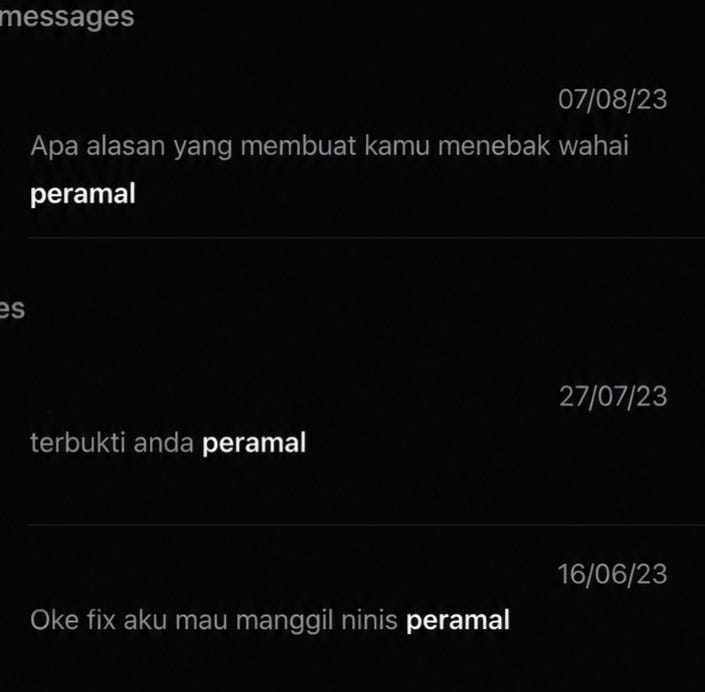

For legal reasons, I would like to state that I reject these claims entirely.
My defense remains very simple:
I am not a clairvoyant.
I simply have a longstanding habit of connecting dots that may or may not belong together.
The distinction feels important (?)
Speaking of things that appear brighter than they hould…
I think your wandering light was Venus, judging by its brightness. Which amused me more than it probably should have.
Venus is supposedly the planet of love. At least that is what Mitski informed me in one of the songs I listened to far too many times, and I have trusted her ever since.
Though what fascinates me most about Venus is not the mythology. It is the fact that beneath all that brightness lies a rather violent history.
The planet we associate with beauty is, in many ways, a survivor.
Perhaps beautiful things are not always untouched things. Perhaps some of them shine because they survived.
Oh, another confession:
I don’t think you realize how much I enjoyed your last essay.
For the first time in a while, I wasn’t reading an essay.
I was reading a person
And strangely enough, that felt rarer. I found myself absurdly grateful for that. There was something comforting about seeing the ordinary shape of your day.
The parts that exist when nobody is discussing philosophy. The parts that happen between the essays.
They felt real.
And perhaps that is a strange thing to say to someone I’ve mostly known through words.
But it is true.
For someone I met through ideas, you felt surprisingly human in that essay. I mean that as a compliment.
There is one question I keep hesitating to ask.
Out of the nineteen essays you’ve written…,do you think any of them were secretly addressed to me?
Or perhaps only fragments. A paragraph here. A sentence there.
You don’t have to answer.
I suspect the uncertainty may be part of the charm.
Still, I find myself wondering.
And if someday we do end up sharing a chessboard, I should warn you in advance:
You have dramatically overestimated my abilities. Though I admit it’s comforting to know that my greatest chess strategy appears to be distraction.
You wrote that perhaps walking without a map is not really about getting lost. Perhaps it’s about giving the world enough time to surprise you.
I liked that line.
Because if you had asked me a year ago whether I would spend my evenings discussing constellations, Jung, Venus, chess, personality theories, and the occasional Americano with a law student from East Java, I would have laughed.
And yet, here we are.
Which feels statistically improbable. And strangely lucky.
I suppose some constellations take a while to reveal themselves.

메타데이터
- post_id
- e58ff423c67f
- slug
- statistically-improbable-e58ff423c67f
- url
- https://medium.com/@pseucathartic/statistically-improbable-e58ff423c67f
- canonical_url
- https://medium.com/@pseucathartic/statistically-improbable-e58ff423c67f
- author_url
- https://medium.com/@pseucathartic
- status
- ok
- fetched_at
- 2026-07-09 21:48:21


