DNA Technology
What is DNA Technology?
DNA Technology
What is DNA Technology?
DNA technology is the study of sequencing, analysis, and cutting and pasting of genetic material deoxyribonucleic acid (DNA) from one species to another. The common forms of DNA technology may include DNA sequencing, polymerase chain reaction, DNA cloning, and recombinant DNA (rDNA) technology.
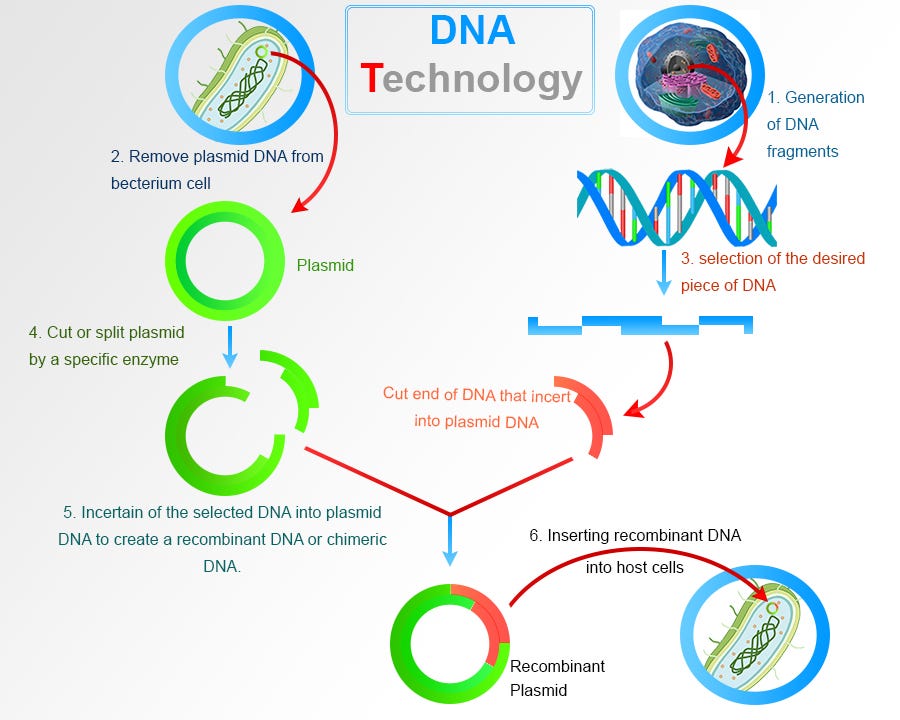
DNA is the genetic material of the living organism which contains the information that contributes to various characteristic features of living organism. Therefore, DNA technology is an important field of biotechnology for analyzing the human genome, discovering new genes, and identifying genetic material that causes disease. In modern biotechnology, DNA analysis is a very useful and sensitive tool for analyzing genetic materials.
Applications of DNA Technology
DNA technology is an important field of biotechnology that is used widely in medicine, agriculture, enviourment, and various gene-related research purposes. The most common uses of DNA technology are
- DNA technology is an important tool that can be used to detect the presence of HIV in a person.
- In gene therapy, such type of technology is used for the correction of the gene defects that give rise to heredity diseases in human beings.
- In clinical diagnosis, it is used to diagnose genetic disorders like Huntington’s disease.
- rDNA technology is an extremely important research tool in biotechnology that allows scientists to manipulate deoxyribonucleic acid fragments in order to study them in their laboratory.
- In agriculture and food technology, rDNA is widely used for the production of agriculture-based genetically modified organisms (GMOs) and enzymes.
- DNA technology is widely used in the field of medicine for the production of insulin, vaccines, and harmless proteins for better human health.
Recombinant DNA Technology
Recombinant DNA (rDNA) technology is a part of biotechnology used for the production of recombinant DNA molecules in the laboratory by genetic recombination or molecular cloning of genetic material obtained from multiple sources.
Recombinant DNA molecules are possible because the nucleotide sequence of DNA molecules differs from one organism to another. It creates special sequences of DNA that would not be found in the genome of a special organism. We can create many bacteria through recombinant techniques that are capable of synthesizing various medically useful substances such as human insulin, human growth hormone, alpha interferon, hepatitis B vaccine, etc.
Recombinant DNA technology provides wide advantages for scientists in researching human diseases and creating new organisms for developing new medicines, proteins, vaccines, and hormones for human health. It also helps to create new environmentally friendly bacteria that can reduce pollution and clean up waste from the environment.
Invention of recombinant DNA technology
The invention of recombinant DNA technology was obtained through the work of American biochemists Stanley N. Cohen, Herbert W. Boyer, and Paul Berg. The first step of DNA recombination was proposed in the early 1970s by Paul Berg in which he combined DNA from two different viruses to form a recombinant DNA molecule.
In the next step, Boyer and Cohen inserted these recombinant DNA molecules into bacteria. It is now replicated, creating many copies of the recombinant DNA molecule. Prior to the work of these microbiologists — Swiss microbiologist Werner Arber discovered restriction enzymes which provided the path for the invention of recombinant DNA technology.
DNA Cloning
DNA technology is based primarily on two other technologies such as DNA cloning and DNA sequencing. A clone in such type of technology refers to a group of organisms, cells, biomolecules, or other objects arising from a single individual.
Gene cloning strategies related to DNA technology or rDNA technology by the following points,
- Generation of desired DNA fragments: The first step is to isolate the gene which we want to clone. It can be done by isolating the DNA from the cell and cutting desired DNA fragments with specific restriction enzymes.
- Insertion of these DNA fragments in a cloning vector: In the next step, the cloning vector or plasmid (circular DNA molecules that originated from bacteria, viruses, and yeast cells) is also cut with the same restriction enzyme. The desired DNA fragments and cloning vector are then stuck together using the enzyme DNA ligase.
- Introduction of the vector into host cells: The cloning vector which contains desired DNA fragments is then inserted into host cells through the process of transfection.
- Selection and screening of the recipient cells for the recombinant DNA molecule.
Uses of DNA Cloning Techniques
DNA cloning is an important part of DNA technology that helps to improve our foods, medicine, agriculture, biological research, etc. The most common uses of DNA cloning are
- DNA cloning plays an important role in the production of various types of hormones, vitamins, and antibiotics.
- Gene cloning is widely used in the agricultural field for improving the genes of nitrogen-fixation bacteria such as cyanobacteria. By gene cloning technology we can introduce desired genes in cyanobacteria to enhance the productivity of crops. Therefore, it can reduce the use of fertilizers and we get chemical-free food products for our good health.
- DNA cloning is used in gene therapy for the replacement of a faulty gene by the insertion of a healthy gene. Such type of technology can be used for treating leukemia and sickle cell anemia in humans.
- DNA cloning is important for studying genes and their protein for human disease research. Therefore, such technology allows scientists to create genetically modified organisms that can be used to study various gene-related diseases in humans.
DNA Sequencing
DNA sequencing means determining the order of the four bases (adenine, guanine, cytosine, and thiamine) that make up the DNA molecule. The DNA sequence can tell scientists, what kind of genetic information is carried in a particular DNA segment.
Determination of the nucleotide sequence of a DNA molecule is the basic and fundamental requirement of this technology. DNA sequencing is important to understand the functions of genes and basic inherited disorders. DNA cloning and gene manipulation also require knowledge of accurate nucleotide sequences.
DNA chips are a recent development in DNA sequencing that had many successful uses in modern biotechnology. Some common uses of such technology are listed below:
- Identification of a specific gene that is responsible for the development of nervous systems.
- Detection of genes which responsible for inflammatory diseases.
- It can be used for identifying expression of genes in prokaryotic cells.
- It may also used for the detection and screening of single nucleotide polymorphisms.
- Rapid detection of microorganisms for environmental monitoring can be done by DNA chip technology.
References
메타데이터
- post_id
- e597237f497a
- slug
- dna-technology-recombinant-dna-e597237f497a
- url
- https://medium.com/study-chemistry/dna-technology-recombinant-dna-e597237f497a
- canonical_url
- https://medium.com/study-chemistry/dna-technology-recombinant-dna-e597237f497a
- author_url
- https://medium.com/@pandakajal42
- status
- ok
- fetched_at
- 2026-06-23 03:48:11