Polypropylene (PP) Granules Explained: The Complete Buyer’s and Manufacturer’s Guide (2026)
Polypropylene has quietly become one of the most important raw materials in Indian manufacturing. It shows up in bottle caps, automotive…
Polypropylene (PP) Granules Explained: The Complete Buyer’s and Manufacturer’s Guide (2026)
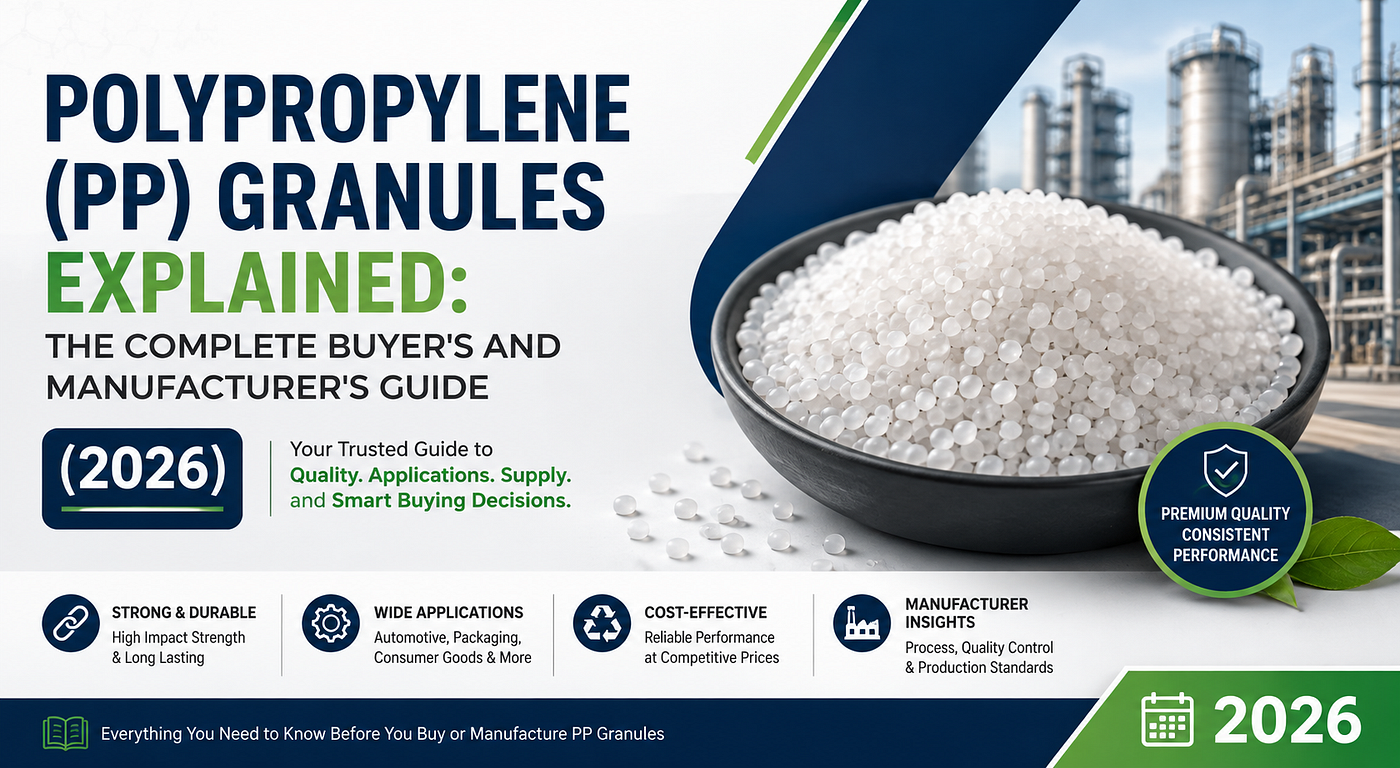
Polypropylene has quietly become one of the most important raw materials in Indian manufacturing. It shows up in bottle caps, automotive dashboards, woven sacks, houseware, packaging film, and thousands of injection-moulded components most people never think twice about. Yet for buyers new to the plastics trade, the terminology — grades, MFI, virgin vs recycled, reprocessed vs reground — can feel like a different language entirely.
This guide walks through what PP granules actually are, how they’re made, where they’re used, and how to source them reliably in India, with pointers to deeper resources along the way for anyone who wants to go further into a specific topic.
What Exactly Are PP Granules?
At the most basic level, PP granules are small pellets of polypropylene resin, produced either directly from petrochemical feedstock or by reprocessing plastic scrap and waste. They’re the raw material that gets fed into injection moulding machines, extruders, and blow-moulding equipment to produce finished plastic goods. If you’re completely new to the material, it’s worth starting with a primer on what PP granules are before diving into grades and applications — it lays out the basic vocabulary the rest of this guide builds on.
Understanding Grades: Not All PP Granules Are the Same
One of the biggest mistakes first-time buyers make is treating “PP granules” as a single, interchangeable product. In reality, the right grade depends entirely on what you’re manufacturing.
A good starting point is understanding how to go about choosing the right PP grade for your product, since colour, impact resistance, and flow characteristics all change depending on whether you’re moulding a consumer product, an automotive component, or packaging film.
Colour and finish matter too. Buyers producing lighter, near-virgin-looking output often specifically look for milky PP granules, which sit in a middle ground between fully recycled and virgin material on both cost and appearance.
A related decision many manufacturers face is whether to use virgin or recycled input at all. A detailed breakdown of virgin vs. recycled PP granules is useful here, covering where each makes sense from a cost and performance standpoint. And since polypropylene is often compared against other commodity plastics during material selection, it’s worth reading up on PP vs HDPE before finalising a spec.
How PP Granules Are Actually Manufactured
Recycled PP granules don’t simply appear from shredded plastic — there’s a defined process involving sorting, washing, shredding, extrusion, and pelletising, each step affecting the final quality of the batch. A walk-through of how recycled PP granules are manufactured is a good reference for anyone trying to understand why quality varies so much between suppliers.
Because quality varies this much, buyers need to know what to check for before committing to a bulk order. A practical checklist on how to check PP granule quality covers the tests — melt flow, ash content, moisture, tensile strength — that separate a dependable supplier from a risky one. Closely related is understanding Melt Flow Index (MFI), a single number that has an outsized effect on how well a batch will process on your specific machine.
Poor-quality or mismatched material is also one of the leading causes of production headaches on the shop floor. If you’ve dealt with warping, short shots, or flash on finished parts, it’s worth reading through common injection moulding defects and their causes — a surprising number of these trace back to the granule batch rather than the machine settings.
On the sustainability side, there’s also a strong operational case for recycled input, not just an environmental one. The advantages of using recycled PP granules go beyond cost savings and touch on supply security and compliance, which are increasingly relevant as extended producer responsibility rules tighten across India.
Where PP Granules Actually Get Used
Polypropylene’s versatility is what makes it so widely adopted. A broad overview of common applications of PP granules shows just how many industries — packaging, houseware, textiles, automotive, electronics — depend on this one polymer family.
The automotive sector deserves special mention, since it’s one of the largest and most demanding consumers of PP. Battery covers, interior trims, and structural components all rely on specific impact- and heat-resistant grades, covered in more detail in PP granules in the automotive industry. For buyers specifically sourcing for automotive component manufacturing, it’s also worth looking at how to identify a best PP granules manufacturer for the automobile industry, since not every supplier can meet automotive-grade consistency requirements.
Injection moulding remains the dominant process for converting PP granules into finished goods, and understanding why the material performs so well in that process is covered in PP granules for injection moulding.
Sourcing PP Granules in India: What to Look For
Once you understand the material, the next challenge is finding a supplier you can actually rely on for repeat bulk orders. This is where geography, documentation, and production capacity start to matter as much as the resin itself.
For manufacturers evaluating the broader Indian supply landscape, a good starting point is this buyer’s guide to PP granules manufacturers in India, which lays out what separates an organised manufacturer from a small-scale trader. Buyers based in or around the capital will find more region-specific detail in the guide to PP granules manufacturers in Delhi NCR, and for those looking even more locally, there’s a focused look at operations in Bawana, Delhi — one of the city’s main organised industrial hubs for plastic reprocessing.
Recycled material specifically comes with its own sourcing considerations, since quality depends heavily on where in the supply chain a “dealer” actually sits — scrap trader, reprocessor, or manufacturer. A detailed guide on choosing a recycled plastic dealer in Delhi breaks down exactly what to verify before placing a bulk order.
Finally, no sourcing decision is complete without understanding pricing dynamics. PP granules price in India walks through the factors — raw material costs, grade, colour, and order volume — that cause quoted prices to vary so widely between suppliers.
Bringing It All Together
Polypropylene granules sit at the intersection of cost, performance, and sustainability in a way few other commodity plastics do. Whether the priority is matching the right grade to a product spec, verifying a supplier’s quality documentation, or simply finding a dependable manufacturer within reasonable delivery distance, the decisions compound — a wrong call on grade selection early on shows up as a defect rate problem three steps later on the shop floor.
For manufacturers and buyers who want to go deeper on any of the topics above, Evonpolymers’ Insights section maintains an ongoing library covering grades, manufacturing processes, quality control, applications, and regional sourcing guides across the Indian PP granules market.
메타데이터
- post_id
- e59ee16a4e02
- slug
- polypropylene-pp-granules-explained-the-complete-buyers-and-manufacturer-s-guide-2026-e59ee16a4e02
- url
- https://medium.com/@ammyjhonsan2854/polypropylene-pp-granules-explained-the-complete-buyers-and-manufacturer-s-guide-2026-e59ee16a4e02
- canonical_url
- https://medium.com/@ammyjhonsan2854/polypropylene-pp-granules-explained-the-complete-buyers-and-manufacturer-s-guide-2026-e59ee16a4e02
- author_url
- https://medium.com/@ammyjhonsan2854
- status
- ok
- fetched_at
- 2026-08-19 06:53:14