RESTful APIs: Consuming and Creating RESTful APIs using Guzzle
Guzzle, a popular PHP HTTP client, simplifies both the consumption and creation of RESTful APIs.
RESTful APIs: Consuming and Creating RESTful APIs using Guzzle
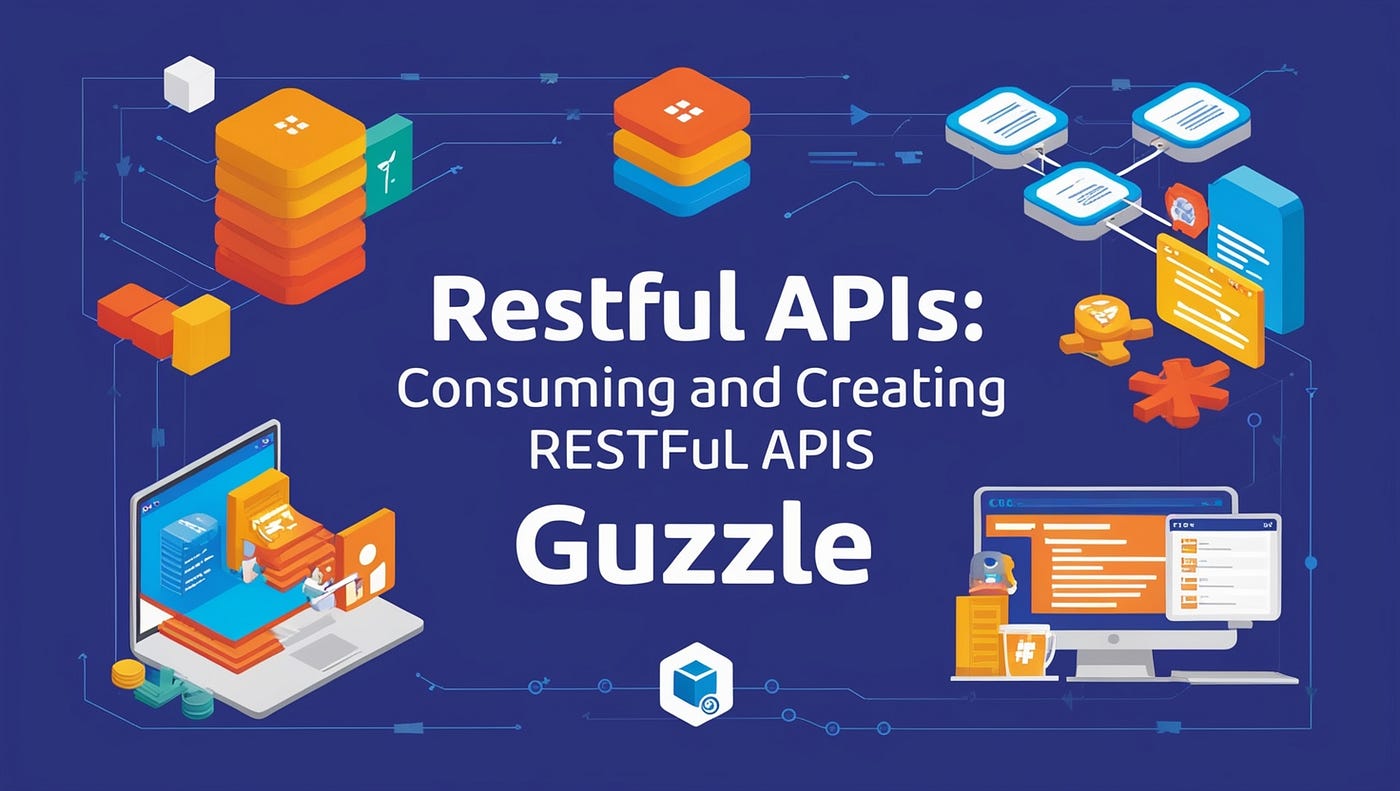
RESTful APIs: Consuming and Creating RESTful APIs using Guzzle
REST (Representational State Transfer) has become the dominant architectural style for web services, offering a standardized and flexible approach to building APIs.
RESTful APIs rely on HTTP methods (GET, POST, PUT, DELETE) to interact with resources, identified by URLs.
Guzzle, a popular PHP HTTP client, simplifies both the consumption and creation of RESTful APIs.
This article delves into using Guzzle for effective API interaction, covering both client-side consumption and server-side creation, accompanied by practical examples.
Part 1️⃣:
Consuming RESTful APIs with Guzzle
Guzzle provides a clean and intuitive interface for making HTTP requests.
Let’s explore common use cases:
1. Making a GET Request 💦
Retrieving data from an API is fundamental.
Here’s how to fetch data from a hypothetical API endpoint /users:
use GuzzleHttp\Client;

$client = new Client();

try {
    $response = $client->request('GET', 'https://api.example.com/users');

    $statusCode = $response->getStatusCode();
    $body = $response->getBody();
    $users = json_decode($body, true); // Decode JSON response

    echo "Status Code: " . $statusCode . "\n";
    print_r($users);

} catch (GuzzleHttp\Exception\GuzzleException $e) {
    echo "Error: " . $e->getMessage();
}
This code snippet initializes a Guzzle client, sends a GET request to the specified URL, handles the response (including status code and body), and decodes the JSON data.
Error handling is crucial, especially when dealing with external services.
[embed]Why PHP is Better Than Other Server-side Languages? medium.com
2. Sending Data with POST 🌺
Creating new resources often involves sending data to the server using a POST request.
Consider adding a new user:
$client = new Client();

try {
    $response = $client->request('POST', 'https://api.example.com/users', [
        'json' => [
            'name' => 'John Doe',
            'email' => 'john.doe@example.com'
        ]
    ]);

    $statusCode = $response->getStatusCode();
    echo "Status Code: " . $statusCode . "\n";
    echo $response->getBody(); // Response might contain the created user's ID

} catch (GuzzleHttp\Exception\GuzzleException $e) {
    echo "Error: " . $e->getMessage();
}
The json option in the request array easily encodes the provided data as JSON.
3. Updating Resources with PUT 🍁
Updating existing resources is typically done with PUT requests.
Here’s how to update user information:
$client = new Client();

try {
    $response = $client->request('PUT', 'https://api.example.com/users/123', [ // Assuming user ID 123
        'json' => [
            'name' => 'Updated Name',
            'email' => 'updated.email@example.com'
        ]
    ]);

    $statusCode = $response->getStatusCode();
    echo "Status Code: " . $statusCode . "\n";
    echo $response->getBody();

} catch (GuzzleHttp\Exception\GuzzleException $e) {
    echo "Error: " . $e->getMessage();
}try {
    $response = $client->request('PUT', 'https://api.example.com/users/123', [ // Assuming user ID 123
        'json' => [
            'name' => 'Updated Name',
            'email' => 'updated.email@example.com'
        ]
    ]);
4. Deleting Resources with DELETE 🍄
Removing resources is done via DELETE requests:
$client = new Client();

try {
    $response = $client->request('DELETE', 'https://api.example.com/users/123'); // User ID 123

    $statusCode = $response->getStatusCode();
    echo "Status Code: " . $statusCode . "\n";
    echo $response->getBody();

} catch (GuzzleHttp\Exception\GuzzleException $e) {
    echo "Error: " . $e->getMessage();
}
5. Handling Headers and Query Parameters
Guzzle allows setting headers and query parameters easily:
$client = new Client();

try {
    $response = $client->request('GET', 'https://api.example.com/products', [
        'headers' => [
            'Authorization' => 'Bearer your_api_token',
            'Accept' => 'application/json'
        ],
        'query' => [
            'category' => 'electronics',
            'limit' => 10
        ]
    ]);

    // ... (handle response)
} catch (GuzzleHttp\Exception\GuzzleException $e) {
    // ... (handle error)
}[embed]Every Developer Should Avoid These PHP Mistakes blog.stackademic.com
Part 2️⃣:
Creating RESTful APIs with a PHP Framework (Example with Slim)

While Guzzle is primarily a client, it can be used alongside PHP frameworks to build RESTful APIs.
🍉This example uses Slim, a micro-framework:
use Slim\App;
use Slim\Http\Request;
use Slim\Http\Response;

require 'vendor/autoload.php';

$app = new App();

// GET /users
$app->get('/users', function (Request $request, Response $response) {
    $users = [
        ['id' => 1, 'name' => 'User 1'],
        ['id' => 2, 'name' => 'User 2']
    ]; // Replace with database retrieval

    return $response->withJson($users);
});

// POST /users
$app->post('/users', function (Request $request, Response $response) {
    $data = $request->getParsedBody();  // Get request body data
    $name = $data['name']; // Access posted data

    // ... (Database insertion logic)

    return $response->withJson(['message' => 'User created', 'name' => $name], 201); // 201 Created status
});

// PUT /users/{id}
$app->put('/users/{id}', function (Request $request, Response $response, $args) {
    $id = $args['id'];
    $data = $request->getParsedBody();

    // ... (Database update logic using $id and $data)

    return $response->withJson(['message' => 'User updated', 'id' => $id]);
});

// DELETE /users/{id}
$app->delete('/users/{id}', function (Request $request, Response $response, $args) {
    $id = $args['id'];

    // ... (Database deletion logic using $id)

    return $response->withStatus(204); // 204 No Content
});

$app->run();
This Slim example demonstrates routing, handling requests, processing data, and returning JSON responses.
💥Remember to replace placeholder comments with actual databa🌈se interaction logic.
🌈 Advanced Concepts
🎊 Asynchronous Requests Guzzle supports asynchronous requests for improved performance when dealing with multiple API calls.
🎊 Middleware Guzzle middleware allows adding custom logic for request/response processing, like logging, retry mechanisms, or authentication.
🎊 Streaming Responses For large responses, streaming avoids loading the entire response into memory.
🎊 Error Handling and Retries Implement robust error handling and retry mechanisms to deal with network issues or temporary API unavailability.
🎩 Conclusion
Guzzle is a powerful tool for interacting with RESTful APIs in PHP.
Its clear syntax, robust features, and asynchronous capabilities make it a preferred choice for building both API clients and server-side API components.
By understanding ☔ ️the core concepts of REST and leveraging Guzzle’s functionality, developers can create efficient and maintainable applications that seamlessly integrate with the modern web ecosystem.
The examples provided offer a solid foundation for getting started with Guzzle and building your own API interactions.
Remember to consult the official Guzzle documentation for the most up-to-date information and advanced features.
💥 Combining Guzzle with a framework like Slim empowers you to create complete API solutions with ease.
Consider exploring more advanced topics like API authentication, rate limiting, and caching to build robust and scalable API integrations.
👉PHP Topic List
[embed]PHP medium.com
Thank you for reading until the end. Before you go:
Be sure to clap and follow the writer ️👏️️
Follow me: https://medium.com/@mayurkoshti12
메타데이터
- post_id
- e5c9793236dc
- slug
- restful-apis-consuming-and-creating-restful-apis-using-guzzle-e5c9793236dc
- url
- https://medium.com/codex/restful-apis-consuming-and-creating-restful-apis-using-guzzle-e5c9793236dc
- canonical_url
- https://medium.com/codex/restful-apis-consuming-and-creating-restful-apis-using-guzzle-e5c9793236dc
- author_url
- https://medium.com/@mayurkoshti12
- status
- ok
- fetched_at
- 2026-07-22 06:57:32