What Should You Check First? A Practical Approach to Site and Metric Prioritization
This post should be viewed only as my personal opinion.
What Should You Check First? A Practical Approach to Site and Metric Prioritization
This post should be viewed only as my personal opinion.
As promised, after reviewing several metrics and their calculation logic, I would like to pause before we go further and discuss one important question:
What should we check first?
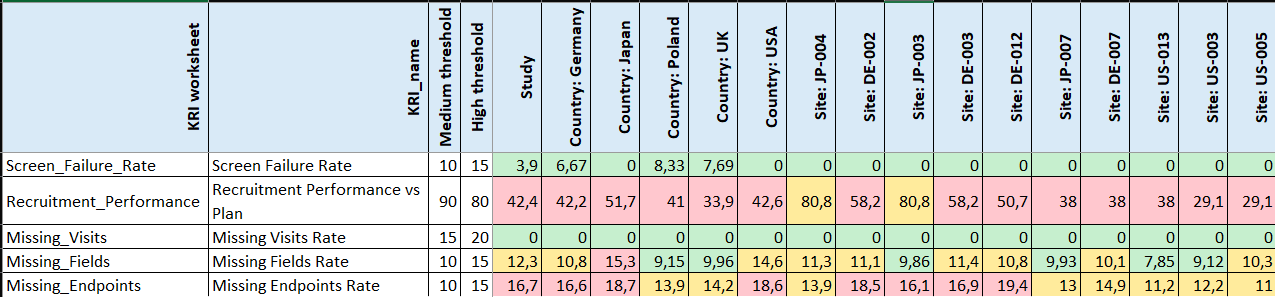
In the picture above, you can see several very different metrics at study, country, and site levels. The site columns show the top 10 sites based on the number of performed scheduled visits. The purpose of this example is to discuss how we can prioritize both sites and metrics.
At first glance, the picture is very bright. Many people may want to jump immediately into the missing endpoint data metric and start checking all affected sites.
But do we really need to start there?
The classic answer would be: start from the study level, identify the red country, and then go down to the “problematic” sites.
I would approach it differently.
What site is the most important one now?
Before prioritizing sites, we need to agree with the study manager on the monitoring logic for the current stage of the study. Site priority should not be static across the whole study lifecycle.
At the beginning of the study, we mostly work with expectations: how many patients we expect to recruit and where. Later, these expectations turn into actual recruitment numbers. But from the data collection perspective, recruitment is not the final point. A patient can be recruited but then miss visits, discontinue, die, or have critical data missing.
So, in the middle of the study and before database lock preparation, my first-priority sites would usually be those generating the largest amount of endpoint data or, more generally, critical data. Because these sites are my study, not others.
Closer to database lock, I would usually consider a combined prioritization approach: sites generating the largest amount of endpoint or critical data, and at the same time having many unresolved queries, important protocol deviations, or other data quality risks.
This means that site priority can change significantly depending on the study stage.
There may be other prioritization models, and that is fine. The key point is simple: a site should not automatically keep the same priority during the whole study. The prioritization logic should be agreed in advance and followed consistently. Otherwise, monitoring may turn into a sporadic review of “something red” rather than a risk-based process.
Now let’s look at the metrics.
In this example, we are not at the very early stage of the study, but we are still in one of the earlier phases. Yes, we do have issues with endpoint data collection, and of course they should be investigated.
But is this the biggest problem?
Not necessarily.
In this example, recruitment performance is the biggest issue. If I have limited time with a site team or investigator, I need to know which metric matters most at this particular point in the study.
Here, I would spend more time discussing recruitment with the principal investigator than missing endpoint data. After that, I would still review what happened with endpoint data, but it would not be my first priority.
Why?
Because if missing endpoint data is excellent, for example below 5%, but the study has almost no patients recruited, the study itself may fail. Good data quality cannot compensate for a recruitment failure if the study cannot reach the required number of patients.
At the same time, the opposite is also true. There is little value in spending too much time on screening or recruitment issues when recruitment is almost completed at the study level, assuming there is no major imbalance or overrecruitment concentrated in only a few sites.
This is why metric prioritization should also depend on the study stage and… Risk assessment.
If your risk assessment is well designed (our eyes are on Risk Managers here), it should follow the study lifecycle and guide CMs on where to look and what types of risks to expect (i.e. what metrics (KRIs) if configured to followup) at each stage of the study.
The question is not only:
Which metric is red?
The better question is:
Which metric is most important for the study right now?
Final Thoughts
Site prioritization should not be static throughout the study lifecycle.
A site that is critically important at the beginning of the study because of its recruitment potential may become a lower-priority site later, while another site generating a large amount of endpoint or other critical data may require much closer attention. The monitoring focus should evolve together with the study.
The same principle applies to metrics. Not all metrics are equally important at every stage of the study. Recruitment performance may be the primary concern during enrollment, while endpoint completeness, query management, protocol deviations, or data quality may become more important as the study progresses toward database lock.
Most importantly, metrics do not appear in our monitoring reports by chance. Their purpose is to help us identify, assess, and control study risks. Therefore, effective metric prioritization starts long before the first report is generated, it starts with a well-designed risk assessment.
If your risk assessment is well designed, it should not only identify potential risks but also reflect when those risks are most likely to occur and when they could have the greatest impact on patient safety, data quality, study timelines, or study outcomes. In other words, risk assessment should follow the study lifecycle and provide guidance on where CMs should focus their attention at each stage of the study.
Metrics help us determine which risks have actually materialized. Prioritization helps us decide which of those risks require action first.
And that, ultimately, is the purpose of risk-based centralized monitoring.
메타데이터
- post_id
- e5cc4cc765a6
- slug
- what-should-you-check-first-a-practical-approach-to-site-and-metric-prioritization-e5cc4cc765a6
- url
- https://medium.com/@anastasiashapovalova/what-should-you-check-first-a-practical-approach-to-site-and-metric-prioritization-e5cc4cc765a6
- canonical_url
- https://medium.com/@anastasiashapovalova/what-should-you-check-first-a-practical-approach-to-site-and-metric-prioritization-e5cc4cc765a6
- author_url
- https://medium.com/@anastasiashapovalova
- status
- ok
- fetched_at
- 2026-06-21 07:44:09