Building an AI Center of Excellence (CoE): A Strategic Framework for Enterprise Transformation
Artificial Intelligence is no longer an experimental capability — it’s a core business driver. However, scaling AI across an enterprise…
Building an AI Center of Excellence (CoE): A Strategic Framework for Enterprise Transformation
Artificial Intelligence is no longer an experimental capability — it’s a core business driver. However, scaling AI across an enterprise requires more than tools and models. It demands structure, governance, talent, and a clear operating model. This is where an AI Center of Excellence (CoE) becomes essential.
An AI CoE acts as the central nervous system for AI innovation and execution, aligning business strategy with technology capabilities while ensuring responsible and scalable adoption.
What is an AI Center of Excellence?
What is an AI Center of Excellence?
An AI Center of Excellence is a cross-functional organizational construct designed to:
- Drive AI strategy and execution
- Standardize tools, practices, and governance
- Accelerate innovation and reuse
- Build and scale AI talent
- Ensure responsible and secure AI deployment
- Build AI first teams (small teams) to use the right tools and create AI solutions that can be scaled across the organization.
It serves as a hub-and-spoke model, where the CoE defines standards and enables capabilities, while business units execute use cases aligned to their domain.
AI center of excellence
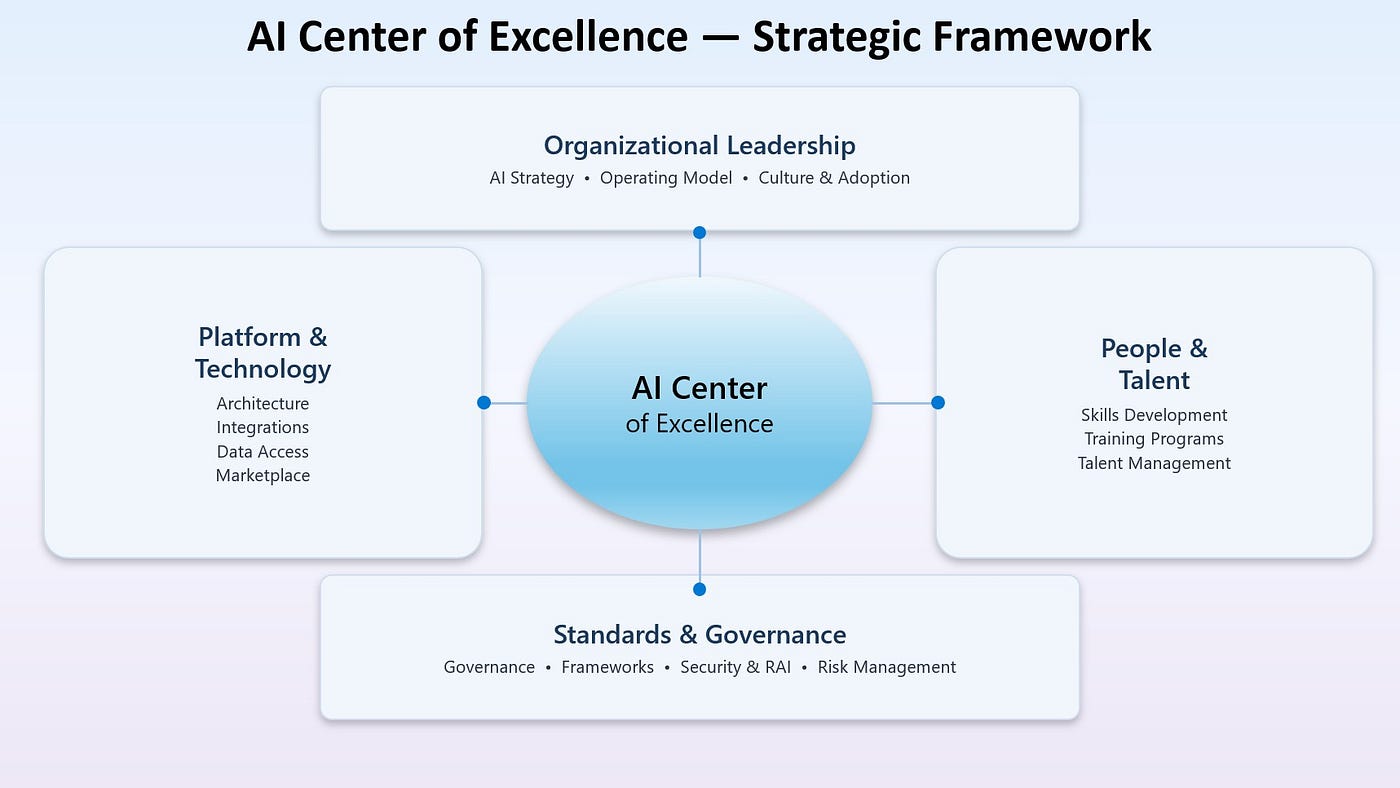
The Strategic Framework: Four Pillars of AI CoE
The framework in your image highlights four foundational pillars surrounding the AI CoE. Let’s break each one down in detail. Key to success will be small agile teams that can rapidly prototype, test, and iterate AI solutions before scaling them across the enterprise.
1. Organizational Leadership
(AI Strategy • Operating Model • Culture & Adoption)
This is the top-down driver of AI success.
Key Components
AI Strategy
- Define enterprise-wide AI vision aligned to business goals
- Identify high-value use cases (revenue growth, cost optimization, risk reduction)
- Prioritize initiatives based on ROI and feasibility
- Establish KPIs and success metrics
Operating Model
- Decide centralized vs federated vs hybrid AI execution
- Define roles: AI leaders, architects, data scientists, domain experts
- Establish funding models and governance boards
- Create reusable frameworks and delivery pipelines
Culture & Adoption
- Promote a data-driven and AI-first mindset
- Encourage experimentation and innovation
- Drive executive sponsorship and stakeholder alignment
- Embed AI into everyday business workflows
Important Note: Without leadership alignment, AI efforts remain fragmented and fail to scale.
2. Platform & Technology
(Architecture • Integrations • Data Access • Marketplace)
This pillar enables technical scalability and innovation velocity.
Key Components
Architecture
- Cloud-first AI architecture (e.g., model training, inference pipelines)
- Support for GenAI, ML, and analytics workloads
- Modular and API-driven design
- Scalable compute and storage infrastructure
Integrations
- Seamless integration with enterprise systems (ERP, CRM, MES, etc.)
- API gateways and microservices architecture
- Event-driven and real-time processing capabilities
Data Access
- Unified data platform (data lake, warehouse, fabric)
- Data governance and lineage tracking
- Secure access control and compliance enforcement
- High-quality curated datasets for AI models
Marketplace
- Internal AI model and component marketplace
- Reusable assets: models, prompts, pipelines, APIs
- Accelerates development through reuse over rebuild
Note: A strong platform ensures AI moves from pilot to production efficiently.
3. People & Talent
(Skills Development • Training Programs • Talent Management)
AI transformation is fundamentally a people challenge, not just a technology one.
Key Components:
Skills Development
- Upskill existing workforce in AI, data, and cloud
- Develop role-specific competencies (engineers, analysts, executives)
- Build interdisciplinary expertise (AI + domain knowledge)
Training Programs
- Structured learning paths (beginner to advanced)
- Hands-on labs, hackathons, and workshops
- Certification programs and partnerships
Talent Management
- Hire specialized roles (AI engineers, ML scientists, prompt engineers)
- Retain top talent through innovation opportunities
- Build career pathways in AI
Note: Organizations that invest in talent outperform those that rely solely on external expertise.
4. Standards & Governance
(Governance • Frameworks • Security & Responsible AI • Risk Management)
This pillar ensures AI is safe, compliant, and trustworthy.
Key Components:
Governance
- AI governance board and review processes
- Lifecycle management for AI models
- Policies for deployment, monitoring, and auditing
Frameworks
- Standardized development frameworks and best practices
- Model evaluation and benchmarking guidelines
- Documentation and reproducibility standards
Security & Responsible AI (RAI)
- Bias detection and fairness validation
- Explainability and transparency mechanisms
- Data privacy and protection
- Ethical AI guidelines
Risk Management
- Identify operational and regulatory risks
- Continuous monitoring of model performance
- Incident response strategies
Note: Governance builds trust — without it, AI adoption will stall due to risk concerns.
How These Pillars Work Together
The AI CoE sits at the center, orchestrating all four pillars:
- Leadership defines direction
- Technology enables execution
- People drive innovation
- Governance ensures control and trust
This interconnected model creates a closed-loop system where strategy, execution, and oversight continuously improve.
Benefits of an AI Center of Excellence
Organizations that implement a mature AI CoE achieve:
- Faster time-to-market for AI solutions
- Reuse of models and components
- Improved decision-making with data-driven insights
- Strong governance and reduced risk
- Continuous innovation across business units
Practical Example: AI CoE in Action
Imagine a manufacturing enterprise:
- Leadership defines predictive maintenance as a priority
- Platform enables IoT + AI integration
- Talent builds models for failure prediction
- Governance ensures model accuracy and safety
The result: reduced downtime, lower costs, and improved efficiency
Final Thoughts
An AI Center of Excellence is not just a team — it’s a strategic capability that transforms how organizations innovate and operate.
Enterprises that succeed with AI are not those experimenting in isolation, but those that institutionalize AI through a structured, scalable, and governed approach.
If you’re looking to build AI at scale, start with this framework:
- Align leadership
- Build a robust platform
- Invest in people
- Establish governance
That’s how AI moves from hype to real business impact.
This model will evolve with new tools in technology space like text, code, physical AI and other science domains and business or industry verticals, ensuring the AI CoE remains relevant as capabilities and use cases expand.
original article — Samples2026/ProServIndustry/CoE.md at main · balakreshnan/Samples2026
메타데이터
- post_id
- e5e0aac3d4e0
- slug
- building-an-ai-center-of-excellence-coe-a-strategic-framework-for-enterprise-transformation-e5e0aac3d4e0
- url
- https://medium.com/@balabala76/building-an-ai-center-of-excellence-coe-a-strategic-framework-for-enterprise-transformation-e5e0aac3d4e0
- canonical_url
- https://medium.com/@balabala76/building-an-ai-center-of-excellence-coe-a-strategic-framework-for-enterprise-transformation-e5e0aac3d4e0
- author_url
- https://medium.com/@balabala76
- status
- ok
- fetched_at
- 2026-06-09 14:34:10