The Anchor That Powers Everything Else
Here is something I have noticed about how we talk about rural electrification in Africa. We tend to frame it as a problem of reach. How do…
The Anchor That Powers Everything Else
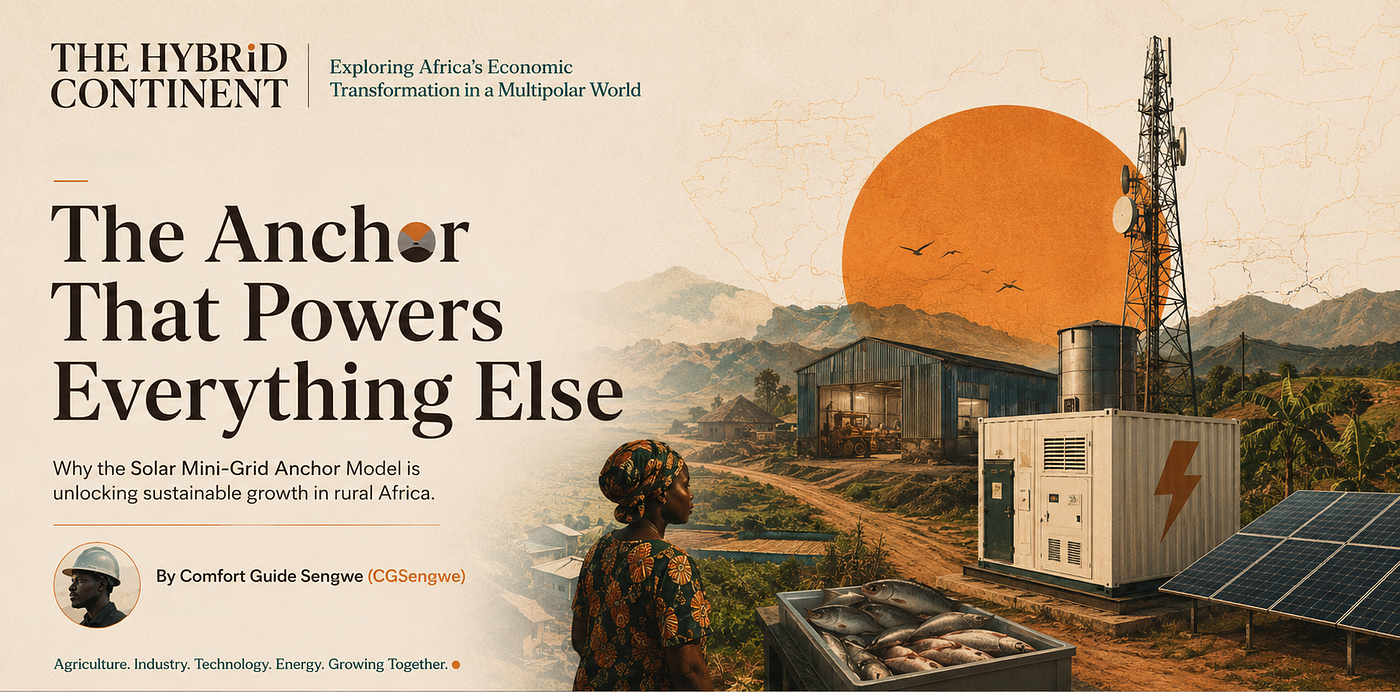
The anchor that powers everything else
Here is something I have noticed about how we talk about rural electrification in Africa. We tend to frame it as a problem of reach. How do we get the wires to the last mile? How do we bring light to the village? The question is not wrong. But it is incomplete.
Because what happens after the lights come on?
In too many places, not much. The mini-grid is built. The households connect. And then the system operates at a fraction of its capacity, the revenue never quite covers the costs, and the developer moves on to the next project with a slightly heavier sense of defeat. The village has electricity. It just does not have much to do with it.
This is where the Solar Mini-Grid Anchor Model comes in, and why, of all the hybrid ecosystems I have been tracking, this one feels most like a key that could turn in a great many locks.
The Logic of the Anchor
The premise is almost embarrassingly simple. Find one large energy customer, a mining company, an agro-processor, a telecom tower operator, and get them to sign a long-term power purchase agreement with a solar mini-grid. That single contract changes the economics of the entire project. The anchor customer provides a stable, predictable revenue stream that makes the initial investment viable. And once the grid is built and paid for, the same electricity becomes available to everyone else in the surrounding community at a price they can actually afford.
What makes this model powerful is not the technology. It is the structure.
Most mini-grids are built for households. Households, however, are not great customers. They consume small amounts of power, often at unpredictable times, and their ability to pay is limited. The result is a system that is perpetually underutilised and perpetually loss-making. But when you build a mini-grid around an industrial anchor, a load that is large, consistent, and creditworthy, the arithmetic changes entirely.
The evidence is clear on this point. Mini-grids that incorporate productive-use customers reduce their generation costs by roughly 25% compared with residential-only grids. That is not a marginal improvement. That is the difference between a project that limps along and one that thrives. Productive-use customers may represent only a quarter of the customer base, but they generate nearly half of the operator’s income. They are carrying the system.
What the Anchor Unlocks
Once the anchor is in place, something interesting happens. The same grid that powers a mine or a processing plant also powers a hammer mill, a bakery, a cold storage unit, and a phone-charging kiosk. Smallholders can now process their grain locally rather than transporting it for miles. Traders can keep their produce fresh. Micro-enterprises can run equipment that would have been unthinkable without reliable power.
In Tanzania, the company JUMEME has become one of the world’s largest solar mini-grid operators, with approximately 10,000 connections. What sets JUMEME apart is not the scale of its infrastructure but the way it thinks about what infrastructure is for. The company does not just build grids and hope for the best. It actively develops value chains around them.
On islands in Lake Victoria, JUMEME has implemented what it calls the KeyMaker Model. The mini-grid provides electricity for freezing Tilapia fish on-site, just hours after the catch, dramatically reducing post-harvest losses. The fish is then transported directly to Dar es Salaam, cutting out layers of intermediaries and fetching significantly higher prices. The same electricity that powers the freezers also powers the fish-feed mills, creating a local economy that did not exist before the grid arrived.
The numbers are telling. In one community, the KeyMaker Model has injected an additional 72 million Tanzanian shillings, about €30,000, into the village economy annually. It has created 16 permanent jobs and 20 seasonal positions for fishermen, with benefits reaching 170 people across 36 families. And the model is expanding: from one site to ten, and potentially to Lake Tanganyika.
This is not charity. It is commerce. And that is precisely why it works.
The Replication Pathway
What I find most compelling about the anchor model is its accessibility. It does not require a continental framework agreement. It does not require a billion-dollar corridor or a Special Economic Zone. It requires one thing: a large energy customer willing to commit.
This makes it replicable in ways that the larger hybrid ecosystems are not.
In Uganda, Kirchner Solar has demonstrated a variation of the same logic, using solar generators to power radio masts while also providing electricity to surrounding rural communities. The telecom tower becomes the anchor, the mini-grid becomes the infrastructure, and the village becomes the beneficiary.
In Eswatini, the Africa Mini-Grids Program is rolling out a similar approach. Communities in the Shiselweni region are receiving mini-grids that will power hammer mills, welding workshops, carpentry operations, dressmaking shops, and hair salons. The businesses will be owned and operated through local cooperatives, generating income and stimulating economic activity. The model is being implemented through the Small Enterprises Development Company, with a focus on productive energy uses from the outset.
In Malawi, a solar mini-grid in the village of Sitolo is powering heavy-duty maize mills and a sunflower oil facility. A welder in a nearby village is expanding his business. The grid is not just providing light. It is providing motive power, the kind that transforms raw materials into saleable goods.
This is not to say the model is easy
I should say that I am drawn to models that do not require heroic assumptions about policy coordination or institutional capacity. The anchor model requires a private-sector actor willing to sign a contract. That is it. Everything else flows from that single act of commitment.
This is not to say the model is easy. Finding the right anchor customer, negotiating a fair power purchase agreement, and designing a grid that can serve both industrial and residential loads are genuine challenges. And there is always the risk that the national grid will eventually arrive, making the mini-grid redundant before it has recouped its costs.
But the model has a kind of elegant pragmatism that I find persuasive. It does not ask the world to change. It works with the world as it is.
Something to Carry Forward
If there is a practical invitation here, it is this: the next time you hear about a rural electrification project, ask not just about the number of connections but about the number of productive connections. Ask about the anchor. Ask about the value chain. Ask what the electricity is actually doing.
The difference between a mini-grid that survives and one that thrives is often a single question: who is the anchor customer?
The answer to that question tells you everything you need to know about whether the lights will stay on and what they will illuminate when they do.
— -
Comfort Guide Sengwe (CGSengwe)
메타데이터
- post_id
- e5e72bb2436f
- slug
- the-anchor-that-powers-everything-else-e5e72bb2436f
- url
- https://medium.com/@cgsengwe/the-anchor-that-powers-everything-else-e5e72bb2436f
- canonical_url
- https://medium.com/@cgsengwe/the-anchor-that-powers-everything-else-e5e72bb2436f
- author_url
- https://medium.com/@cgsengwe
- status
- ok
- fetched_at
- 2026-07-11 12:46:10