Why Most .NET Web APIs Become Difficult to Maintain And How Clean Architecture Helps
Introduction
Why Most .NET Web APIs Become Difficult to Maintain And How Clean Architecture Helps
Introduction
When a new software project starts, everything feels simple.
A few controllers, a few services, a database, and a handful of endpoints are usually enough to deliver the first version. Features are added quickly, stakeholders are happy, and the development team feels productive.
Then reality arrives.
The application gains more users. New integrations appear. Additional business rules emerge. Security requirements become stricter. Reporting requirements grow. Suddenly, a system that once felt clean and manageable begins to feel fragile.
A simple change in one area unexpectedly breaks another. New developers struggle to understand the codebase. Features that should take hours start taking days.
In my experience, this rarely happens because developers are writing poor code. More often, it happens because the architecture was never designed to support long-term growth.
This is where Clean Architecture becomes valuable.
Not because it is trendy. Not because it uses modern patterns. But because it helps software remain maintainable long after the initial excitement of the project has disappeared.
Architecture Is About Managing Change
Many developers associate architecture with diagrams, frameworks, or design patterns.
I see architecture differently.
Architecture is the art of managing change.
A successful architecture is not one that looks impressive in a presentation. It is one that allows the system to evolve without introducing chaos.
Whenever a new requirement arrives, we should be able to answer a simple question:
What should change?
If the answer is “almost everything,” the architecture is failing.
Good architecture localises change.
Bad architecture spreads change.
The Hidden Cost of Traditional Layered Applications
Most .NET applications begin with a familiar structure:
Controllers
Services
Repositories
Database
There is nothing inherently wrong with this approach.
The problem appears as the application grows.
Consider a subscription-based SaaS platform.
Initially, a customer registration process might look like this:
Register User
    ↓
Save User
    ↓
Send Welcome Email
Simple.
A year later, the same process often looks like this:
Register User
    ↓
Validate Business Rules
    ↓
Save User
    ↓
Create Subscription
    ↓
Generate Trial Period
    ↓
Send Welcome Email
    ↓
Create Audit Log
    ↓
Publish Event
    ↓
Update Analytics
The original UserService gradually becomes responsible for everything.
Soon it contains thousands of lines of code and dozens of dependencies.
At this point, adding new features becomes risky because nobody fully understands the impact of their changes.
The Real Goal of Clean Architecture
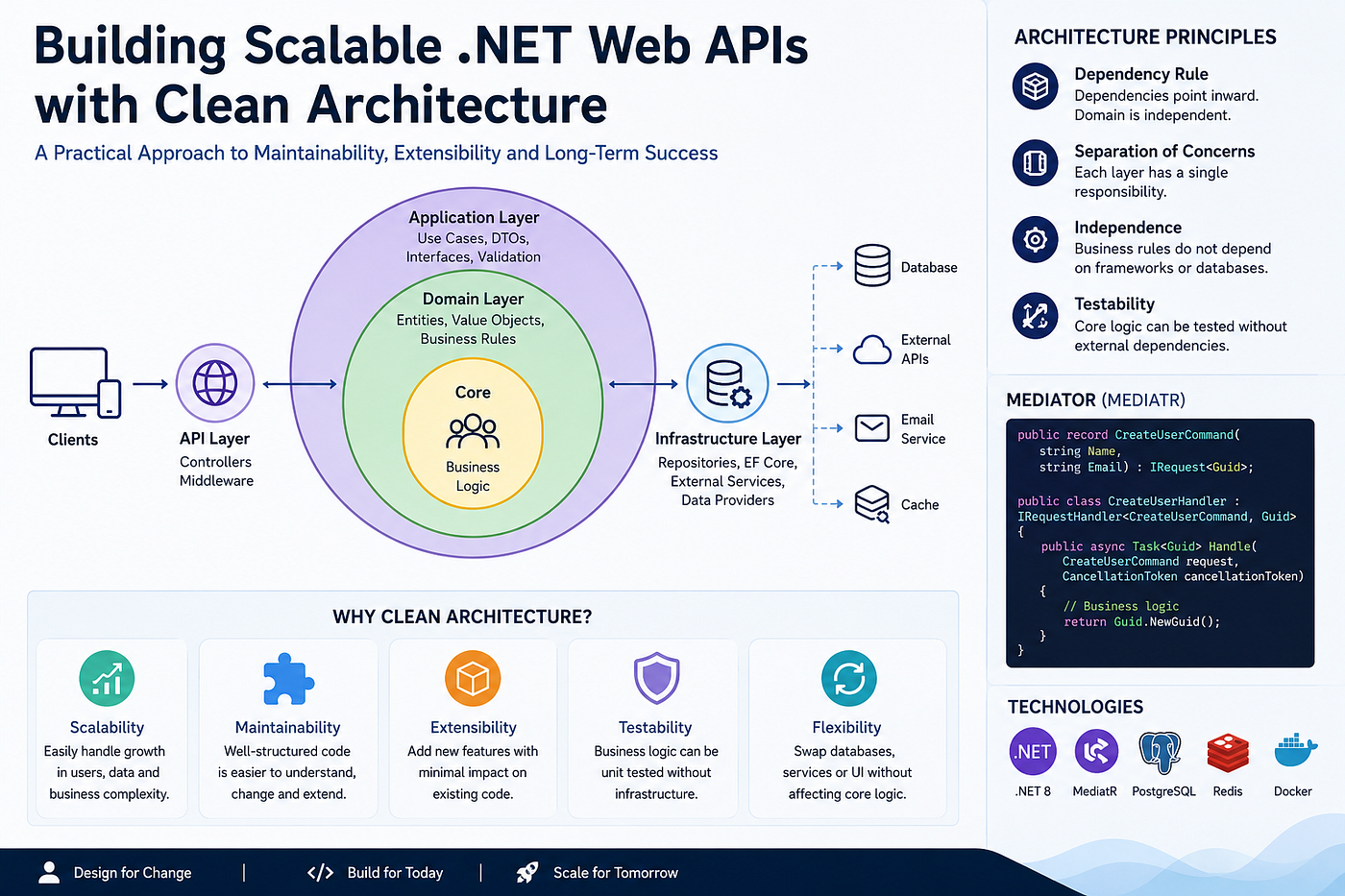
Many developers think Clean Architecture is about creating multiple projects:
API
Application
Domain
Infrastructure
That is not the goal.
The goal is protecting business logic from technical concerns.
Business rules should not care about:
- SQL Server
- PostgreSQL
- Azure
- AWS
- Redis
- RabbitMQ
- OpenAI
- External APIs
Technology changes frequently.
Business behaviour changes much more slowly.
When business rules become dependent on infrastructure choices, every technical change becomes expensive.
Thinking in Business Capabilities Instead of Technologies
One of the biggest mindset shifts is learning to think in capabilities rather than implementation details.
For example, a membership platform may support:
- User Registration
- Subscription Management
- Billing
- Notifications
- Reporting
These are business capabilities.
Now compare that with:
- SQL Server
- Entity Framework
- Redis
- SendGrid
- Stripe
These are implementation details.
Architecture should prioritise the first group.
The second group should remain replaceable.
Scalability Is Not Just About Performance
When people hear the word scalability, they often think about servers.
More CPU.
More memory.
More containers.
More databases.
While infrastructure scalability is important, development scalability is equally important.
Ask yourself:
Can ten developers work on this system simultaneously?
Can new developers understand the structure quickly?
Can teams add new features independently?
Can changes be deployed safely?
Many systems fail not because they cannot handle more users but because they cannot handle more developers.
A well-designed architecture scales both technically and organisationally.
Designing for Extensibility
One of the most important architectural qualities is extensibility.
Imagine a platform that currently supports email notifications.
The business later requests:
- SMS notifications
- Push notifications
- In-app notifications
Poor design requires modifications throughout the application.
Good design introduces abstraction.
Instead of coupling business logic directly to email delivery, the application depends on a notification contract.
The business process simply says:
Notify the customer.
The implementation decides how.
This small design decision can save hundreds of hours of refactoring in the future.
The Importance of Architectural Boundaries
One of the most common mistakes I see is the gradual erosion of architectural boundaries.
A team begins with good intentions.
Then somebody accesses the database directly from a controller.
Another developer adds business logic to an API endpoint.
Someone else performs validation inside a repository.
Each decision seems harmless.
Over time, responsibilities become blurred.
Eventually, nobody knows where functionality belongs.
Good architecture is not just about creating boundaries.
It is about protecting them.
Why High Cohesion Matters
A well-designed component should have a clear purpose.
Everything inside that component should contribute to that purpose.
For example:
Subscription Module
 ├── Subscription Creation
 ├── Subscription Renewal
 ├── Subscription Cancellation
 └── Subscription Validation
These responsibilities belong together.
This creates high cohesion.
Now imagine placing reporting, notifications, and authentication logic inside the same component.
The result is confusion.
High cohesion makes systems easier to understand and maintain.
Why Low Coupling Matters
Coupling measures how dependent components are on each other.
High coupling creates fragility.
When one component changes, many others must change as well.
Low coupling creates flexibility.
Components can evolve independently.
One practical question I ask during architecture reviews is:
If this component changes tomorrow, how many other components will break?
The answer reveals a great deal about the quality of the design.
Domain Events: A Powerful Yet Underused Pattern
One pattern that significantly improves maintainability is Domain Events.
Consider this scenario:
A subscription becomes active.
Several actions must occur:
- Send a welcome email
- Create an audit record
- Generate an invoice
- Update analytics
A common approach is placing all of this logic in a single service.
A better approach is publishing an event:
SubscriptionActivatedOther components react independently.
This reduces coupling and improves extensibility.
New behaviours can be added without modifying existing business logic.
Architecture Is More Than Code Structure
Many discussions about architecture focus entirely on source code organisation.
Real-world architecture is much broader.
A production-ready system must also consider:
Observability
Can issues be diagnosed quickly?
This includes:
- Structured logging
- Distributed tracing
- Metrics
- Monitoring
- Alerting
Security
Can the system protect sensitive information?
This includes:
- Authentication
- Authorisation
- Encryption
- Secrets management
- Audit trails
Resilience
What happens when dependencies fail?
This includes:
- Retries
- Circuit breakers
- Timeouts
- Fallback mechanisms
Performance
Can the system remain responsive under load?
This includes:
- Caching
- Query optimisation
- Background processing
- Asynchronous communication
Architecture is the combination of all these concerns.
Common Mistakes Even Experienced Teams Make
After reviewing many enterprise applications, several recurring mistakes appear repeatedly.
Treating Clean Architecture as a Folder Structure
Creating projects called Domain and Application does not automatically produce good architecture.
The principles matter more than the folders.
Massive Service Classes
A single service with fifty methods usually indicates poor responsibility separation.
Anemic Domain Models
Entities become simple data containers while business logic lives elsewhere.
This often leads to duplicated behaviour.
Generic Repository Overuse
Not every problem requires a generic repository.
Sometimes it introduces more complexity than value.
Ignoring Non-Functional Requirements
Performance, security, monitoring, and resilience should be considered from the beginning rather than added later.
The Architecture Question I Always Ask
When evaluating a design, I ask one simple question:
Can this system evolve without major rewrites?
If the answer is yes, the architecture is probably healthy.
If every new requirement requires invasive changes throughout the codebase, the architecture is creating friction rather than reducing it.
Final Thoughts
Technology changes constantly.
Frameworks evolve.
Cloud providers introduce new services.
Databases change.
Programming languages improve.
The systems that survive these changes are not necessarily built with the latest technology. They are built with clear boundaries, strong separation of concerns, and a focus on long-term maintainability.
Clean Architecture is not a silver bullet.
It introduces additional structure and requires discipline from the development team.
However, when applied thoughtfully, it provides something that becomes increasingly valuable as software grows:
The ability to change the system confidently.
And in software engineering, the ability to change safely is often the most important feature of all.
메타데이터
- post_id
- e5e89fa00fcf
- slug
- why-most-net-web-apis-become-difficult-to-maintain-and-how-clean-architecture-helps-e5e89fa00fcf
- url
- https://medium.com/@chamara.iresh/why-most-net-web-apis-become-difficult-to-maintain-and-how-clean-architecture-helps-e5e89fa00fcf
- canonical_url
- https://medium.com/@chamara.iresh/why-most-net-web-apis-become-difficult-to-maintain-and-how-clean-architecture-helps-e5e89fa00fcf
- author_url
- https://medium.com/@chamara.iresh
- status
- ok
- fetched_at
- 2026-08-05 11:06:33