11. The Mayflower Compact
Mayflower 1607 Stories
11. The Mayflower Compact
Mayflower 1607 Stories By Kevin J. W. Driscoll © 2026
They didn’t plan to write anything. Not at first. They’d come for freedom, not paperwork. But the landfall at Cape Cod had stirred up trouble, and trouble had a way of needing words.
The Strangers were restless. Some said they’d go their own way once ashore, no law to bind them, no preacher to scold them. They said it loud, in the open, with the kind of grin that made Bradford’s stomach turn. He’d seen what happened to groups that split early — back in Holland, back in England. It didn’t end well.
Brewster called a meeting in the great cabin. The air was close and sour, thick with damp wool and old bread. A dozen men crowded in, knees touching, backs hunched. Captain Jones stayed out of it. He’d brought them across the sea, and that was enough. Let them sort out their own mess.
Bradford spoke first. Not loud, not long. Just enough to name the problem: no patent, no governor, no agreed‑upon rules. “We are outside the bounds,” he said, “and some would use that to cast off all restraint.”
Carver nodded. He’d been quiet most of the voyage, but now he leaned forward, hands clasped. “We need a covenant,” he said. “A simple one. Not for heaven. For here.”
They argued for hours. Not about the idea — most saw the need — but about the words. Some wanted to name the king. Others wanted to name God. A few wanted both, and a few wanted neither. Brewster kept the peace, his voice steady, his eyes sharp. He’d brokered harder things in Leiden.
By nightfall, they had a draft. It wasn’t elegant. It wasn’t long. But it said what needed saying: that they would form a civil body politic, that they would make laws and follow them, that they would work together for the good of the colony.
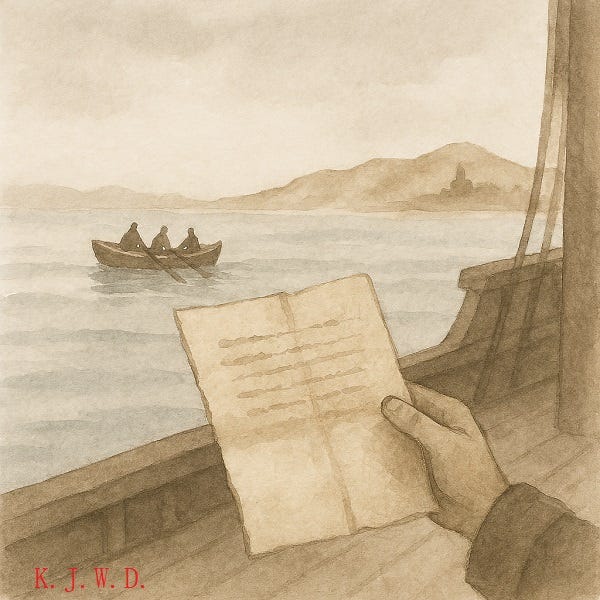
The next morning, they brought it up on deck. The wind had turned cold, and the sky hung low and gray. The paper fluttered in Carver’s hands as he read it aloud. No one cheered. No one clapped. But when he finished, the men lined up to sign.
John Tilley signed with a firm hand. His brother Edward followed. Then Bradford, Brewster, Winslow, Hopkins. Even some of the loud Strangers put their names down, though they grumbled about it. The ink froze in the quill between signatures. The ship creaked beneath them like it was listening.
By the end, forty‑one names marked the page. Not all the men aboard, but enough. Enough to hold the group together. Enough to step ashore without splintering.
Bradford looked at the paper, then at the shore. The dunes waited, quiet and cold. The Compact wouldn’t solve everything. It wouldn’t keep them warm or fed. But it gave them a start — a shared promise, made in the teeth of uncertainty.
They folded the paper and tucked it away. The shallop was nearly ready. Soon they’d land. Soon the real work would begin.
For now, they had words. And sometimes, words were the only thing standing between order and chaos.
They didn’t sign it and then march ashore like heroes in a painting. Nothing about that morning felt triumphant. The ink froze in the quill, the wind cut through every coat they owned, and the ship groaned like an old mule that had carried too much for too long. But the paper existed now, folded and tucked away — a promise made in cramped handwriting and stiff fingers.
The men drifted back to their corners of the ship, each carrying the weight of what he’d just agreed to. Some felt steadied by it. Others felt trapped. A few of the Strangers muttered that they’d been pushed into it, that the Saints had out‑talked them, out‑prayed them, out‑maneuvered them. But even they knew the truth: without some kind of order, they’d tear each other apart before the first hut was built.
Bradford stood near the rail, watching the gray water slap against the hull. The dunes across the bay looked no closer than they had the day before, though he knew that was just the cold talking. Everything felt farther away in this weather — warmth, safety, reason. He wondered if the Compact would hold once they set foot on land. Words were one thing on a ship. Hunger was another.
Below deck, the women worked quietly, packing and repacking bundles that wouldn’t be opened for days. They’d heard about the Compact, of course. News traveled fast in a space that small. Some welcomed it. Others didn’t care what the men wrote so long as it meant fewer arguments and more action. Children darted between legs, chasing each other, oblivious to the weight of the moment.
By midday, the shallop crew returned from their scouting. Their faces told the story before their mouths did: the shoreline was rough, the woods thick, the cold biting. But there was fresh water, and a place to land, and no sign of immediate danger. In this part of the world, that counted as good news.
Carver gathered the men again, this time on deck. The wind had eased a little, though it still carried the sharp smell of pine and something wild beneath it. “We land tomorrow,” he said. “The Compact stands. We go ashore as one body.”
No one argued. Not openly. The Compact had done its first job.
That night, the ship felt different. Not warmer, not safer — just different. A kind of uneasy calm settled over the decks. The men who’d signed their names lay awake longer than usual, staring at the beams overhead, thinking about the land waiting for them. Some prayed. Some cursed. Some simply listened to the water and tried to imagine a future that didn’t end in frostbite or starvation.
Bradford slept little. He rose before dawn and climbed to the deck. The sky was a pale wash of color, the kind that barely qualified as morning. The dunes looked close now, close enough to touch if he leaned far enough over the rail. He felt the Compact in his pocket — not the paper itself, but the idea of it, the fragile thread holding them together.
The others joined him slowly, stamping their feet against the cold. The shallop bobbed beside the ship, patched and ready. The men who would row it looked like they were heading into battle, though no one said so.
Carver gave the word. The first group climbed down, awkward and stiff, gripping the ropes like old men. Bradford watched them settle into the boat, watched the oars dip into the water, watched the distance grow between ship and shore.
The Compact had carried them this far. Whether it would carry them through the winter — well, that was a question for another day.
For now, they had a place to land, a paper full of promises, and a shoreline waiting to test every one of them.
Coda — A Paper of Promises:
In the years that followed, folks liked to talk about the Compact as if it had been carved in marble, handed down with trumpets and sunlight. But anyone who’d been there remembered it differently. It was just a sheet of paper on a cold morning, passed from hand to hand by men who could barely feel their fingers. No grand speeches. No shining moment. Just necessity, plain and unvarnished.
Still, something happened on that deck that none of them could quite name. Maybe it was the way the men leaned in close, listening harder than they meant to. Maybe it was the way the ink trembled on the page, as if the words themselves understood the stakes. Or maybe it was simply that, for the first time since England slipped beneath the horizon, they’d chosen something together.
The land waiting for them didn’t care about covenants. The dunes would cut their feet, the winter would take their friends, and the hunger would gnaw at them until they cursed every mile of ocean behind them. But the Compact gave them a thin thread to hold when the world turned sharp. A promise made in the teeth of uncertainty has a way of sticking.
Years later, Bradford would look back and call it “the first foundation.” He wasn’t wrong. But he also wasn’t telling the whole truth. The real foundation wasn’t the words — it was the men who signed them, knowing full well that paper couldn’t keep them warm or fed. They signed anyway.
And maybe that’s the quiet miracle of it: a handful of weary souls, standing on a creaking ship in a gray November bay, choosing order over chaos, duty over pride, hope over fear.
A small beginning, yes. But beginnings rarely know what they’ll grow into.
— 30 —
메타데이터
- post_id
- e5f12b7d0e92
- slug
- 11-the-mayflower-compact-e5f12b7d0e92
- url
- https://medium.com/@kevinjwd/11-the-mayflower-compact-e5f12b7d0e92
- canonical_url
- https://medium.com/@kevinjwd/11-the-mayflower-compact-e5f12b7d0e92
- author_url
- https://medium.com/@kevinjwd
- status
- ok
- fetched_at
- 2026-06-09 14:34:10


