Devoured by Bots: How a Missing Parameter Enabled 100% MEV Leakage in a DeFi Zap Contract
A deep dive into slippage vulnerabilities, sandwich attacks, and why convenience in DeFi often comes at the cost of security.
Devoured by Bots: How a Missing Parameter Enabled 100% MEV Leakage in a DeFi Zap Contract

A deep dive into slippage vulnerabilities, sandwich attacks, and why convenience in DeFi often comes at the cost of security.
In the rapidly evolving world of Decentralized Finance (DeFi), User Experience (UX) is king. To make liquidity provision easier, protocols often introduce “Zap” contracts. These allow a user to deposit a single asset (e.g., purely USDC) into a liquidity pool that requires two assets (e.g., USDC and USDT). The Zap contract conveniently swaps half of the user’s deposit for the second asset and then stakes both into the pool in a single transaction.
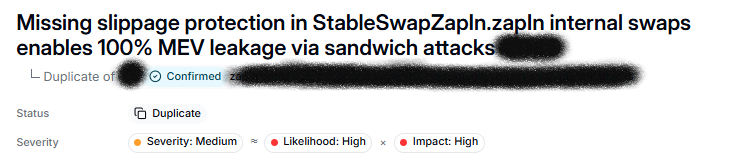
However, convenience can be a fatal trap. During a recent audit of a private Uniswap v4-based protocol (which we will call Redacted Protocol), I discovered a High-severity vulnerability in their StableSwapZapIn contract. A missing slippage check on the internal swap left users completely exposed to Sandwich Attacks, allowing MEV bots to drain their deposited funds.
Here is a technical breakdown of the vulnerability, how the exploit works, and how developers can secure their Zap contracts.
The Mechanics of a “Zap In”
To understand the bug, we first need to understand what the StableSwapZapIn contract was doing under the hood. When a user calls zapIn(tokenA, amount), the contract performs two distinct actions:
- The Internal Swap: It takes a portion of
tokenAand swaps it fortokenBthrough the Automated Market Maker (AMM). - The Liquidity Provision: It takes the remaining
tokenAand the newly acquiredtokenBand adds them to the liquidity pool, minting LP tokens for the user.
The Vulnerability: Blind Swapping
When I reviewed the code for the internal swap step, I noticed a critical omission in the SwapParams struct being passed to the Uniswap v4 PoolManager.
// Concept of the vulnerable code inside StableSwapZapIn.sol
function _zapIn(address tokenA, uint256 amount) internal {
    uint256 swapAmount = amount / 2;

    // VULNERABILITY: No slippage protection for the swap!
    SwapParams memory params = SwapParams({
        zeroForOne: true,
        amountSpecified: -int256(swapAmount),
        sqrtPriceLimitX96: TickMath.MIN_SQRT_PRICE + 1 // Max limit, no protection
    });

    // Execute internal swap
    poolManager.swap(poolKey, params, "");

    // ... proceed to add liquidity ...
}
The developers had included slippage protection for the final step (adding liquidity), ensuring the user received a minimum number of LP tokens. However, they completely forgot to protect the internal swap itself.
By setting sqrtPriceLimitX96 to its absolute extreme and not enforcing a minAmountOut for the acquired tokenB, the contract was essentially telling the AMM: "I want to swap this token, and I don't care how bad the exchange rate is."
The Exploit: A Textbook Sandwich Attack
In the dark forest of the Ethereum mempool, MEV (Maximal Extractable Value) searchers constantly look for transactions with high or missing slippage tolerance. When a user submits a transaction to this vulnerable zapIn function, an MEV bot executes a "Sandwich Attack."
Here is how the 100% MEV leakage unfolds:
- The Front-Run (The First Slice): The MEV bot sees the user’s pending
zapIntransaction in the mempool. The bot pays a higher gas fee to execute a massive buy order on the target pool before the user. This artificially pumps the price oftokenB. - The Victim’s Execution (The Meat): The user’s
zapIntransaction executes. The internal swap buystokenBat the massively inflated price. Because there is no slippage protection, the transaction succeeds, but the user receives practically zerotokenBfor theirtokenA. - The Back-Run (The Second Slice): Immediately after the user’s transaction, the MEV bot executes a sell order. The bot sells the
tokenBit bought in Step 1 at the inflated price, pocketing a massive, risk-free profit.
The Result: The user’s funds are siphoned away by the MEV bot. The user ends up with a fraction of the LP tokens they deserved, resulting in a severe loss of capital.
How to Fix It
Securing a Zap contract requires multi-layered slippage protection. You cannot just protect the final LP token mint; you must protect every internal swap.
The fix is straightforward. The zapIn function must accept a parameter for the minimum acceptable output of the internal swap, or enforce a strict price limit:
// The Secure Approach
function zapIn(
    address tokenA,
    uint256 amount,
    uint256 minTokenBOut, // User-defined slippage parameter
    uint256 minLPTokensOut
) external {
    // ...
    // Enforce minTokenBOut during the internal swap
    // Revert if the output is less than minTokenBOut
    // ...
}
Takeaways for Auditors and Developers
- For Developers: Never assume that protecting the final outcome of a multi-step transaction protects the intermediate steps. If your contract interacts with an AMM, every single swap must have user-defined slippage limits.
- For Auditors: Zap contracts and complex routers are prime hunting grounds for MEV vulnerabilities. Always trace the execution path of internal swaps and verify that
amountOutMinimumorsqrtPriceLimitX96are dynamically derived from user inputs, not hardcoded to extremes.
MEV bots are ruthless and automated. If you leave the door unlocked in DeFi, it’s not a matter of if your users will be exploited, but when.
Found this breakdown helpful? Drop a clap and follow for more technical deep dives into Web3 security, smart contract audits, and DeFi exploits.
Tags: #DeFi #SmartContracts #MEV #SandwichAttack #Web3Security #BugBounty
메타데이터
- post_id
- e5f9e835dad2
- slug
- devoured-by-bots-how-a-missing-parameter-enabled-100-mev-leakage-in-a-defi-zap-contract-e5f9e835dad2
- url
- https://coinsbench.com/devoured-by-bots-how-a-missing-parameter-enabled-100-mev-leakage-in-a-defi-zap-contract-e5f9e835dad2
- canonical_url
- https://coinsbench.com/devoured-by-bots-how-a-missing-parameter-enabled-100-mev-leakage-in-a-defi-zap-contract-e5f9e835dad2
- author_url
- https://medium.com/@HackerMD
- status
- ok
- fetched_at
- 2026-06-16 19:09:56