The Method Table of Data: Five Lessons from Building a Governed Data Gateway
In large-scale data platforms, there’s a recurring pattern of inefficiency: “every team for themselves” model. I watched this play out…
The Method Table of Data: Five Lessons from Building a Governed Data Gateway
In large-scale data platforms, there’s a recurring pattern of inefficiency: “every team for themselves” model. I watched this play out recently on an enterprise data platform, with several teams. Some building human-facing applications, some building AI agents. Both independently solved the same fundamental problems: tenant isolation, authentication, and data access. The duplicated effort produced a fragmented landscape with no standardized way for any consumer, human or agent, to discover what data exists, who owns it, or how to access it.
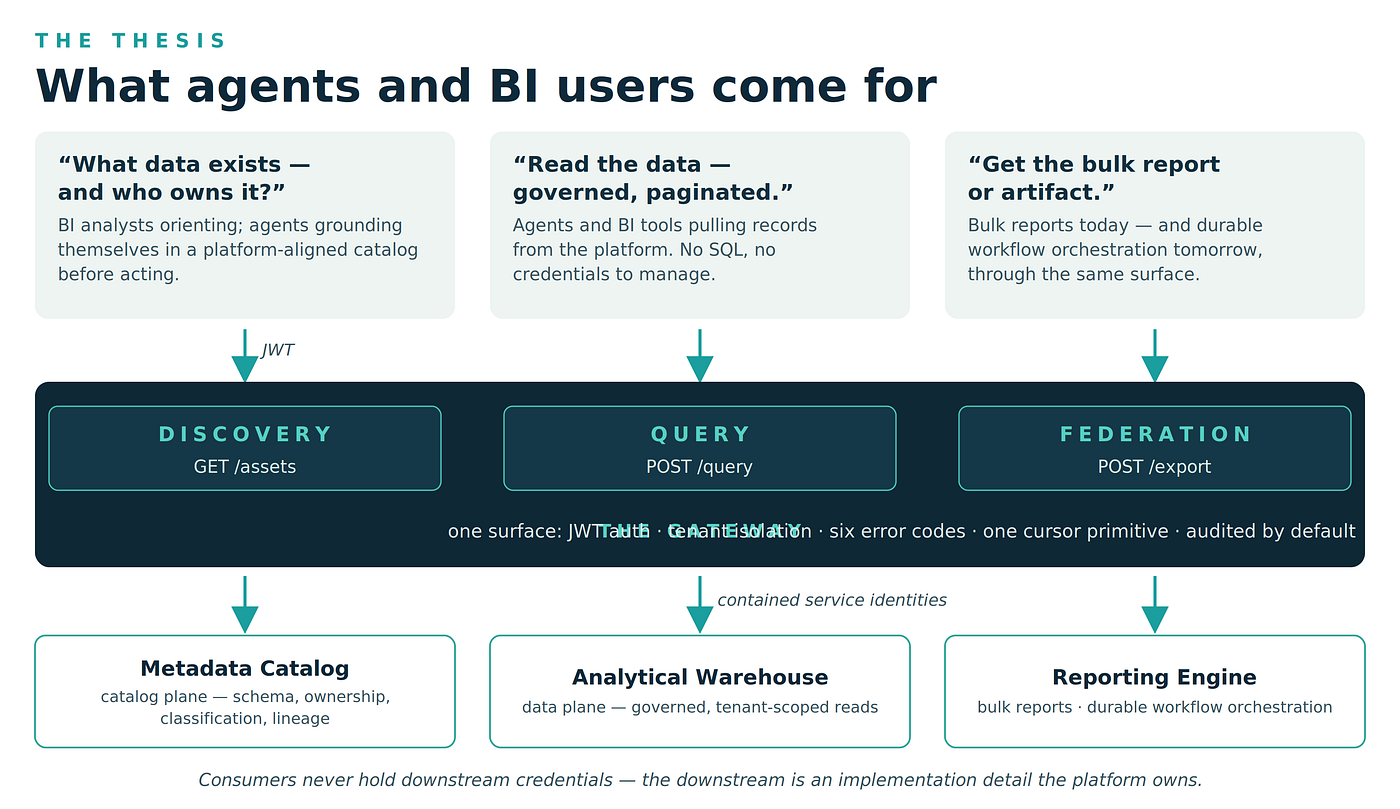
The answer wasn’t another API. It was a thin, governed integration service. This gateway acts as the connective tissue for a connected data fabric. By making a few deliberately radical choices that prioritize governance and stability over raw transparency, it turns the “data mess” into a clean, discoverable marketplace.
I’ve found that the most resilient systems embrace what I call stability through ignorance. Here are some lessons from this architecture that changed how I think about enterprise data access.
1. Your API Should Be a “Method Table” (The JVM Analogy)
In a Java Virtual Machine, a method table maps symbolic names to concrete implementations in the form of memory addresses, instruction sets. The gateway adopts the same pattern for data access.
Consumers never send raw SQL and never need to understand warehouse schemas. Names map to “pre-compiled” implementations: when a consumer calls a data asset by name, the platform resolves that name to a governed query path or SQL template. This prevents SQL injection at the architectural level because consumers aren’t writing queries, they’re calling methods on the data fabric.
Now that the method table analogy is in place, we can apply some AOP ideas to it. That allows us to implement the platform enforce scope and security without the consumer ever hard-coding identifiers. The contract stays clean, and the responsibility for enforcement lives on the platform, not with every developer.
Tenant context comes from the auth token that is independently verifiable.
Absolute Obfuscation Is a Feature, representing encapsulation from object oriented design
Common wisdom says developers need “transparency” into their data sources. This architecture argues the opposite. Using the Ports & Adapters (hexagonal architecture) pattern, it intentionally hides downstream details such as the analytical warehouse, the metadata catalog, whatever comes next.
The gateway defines the port (the stable interface), while each technology is merely an adapter that can be swapped out. Consumers integrate at the platform layer, not the technology layer. If the underlying data source changes tomorrow, consumers don’t change a single line of code. That’s stability through ignorance: core business logic isolated from the churn of the data landscape.
Consumers go through a channel-agnostic entry point to reach the data.
3. Security: The Trusted Subsystem Model
The gateway’s identity model rests on a strategic separation of concerns. To reach the warehouse, it acts as a trusted subsystem: it authenticates with its own platform service role rather than passing the consumer’s role through. But it executes a query only after an external authorization service has validated the caller’s identity and specific permissions.
The gateway never actually “knows” who the user is or what they can access — it delegates those decisions entirely. This zero-trust posture means producers can onboard new data simply by registering it with the authorization service; no gateway code changes required. And enforcement happens at the front door: an unauthorized request gets a 401 before it ever touches the data layer.
4. The “Jaw-Dropper” — Discovery as a First-Class Citizen
In most organizations, data discovery is a manual hunt through warehouse schemas and tribal knowledge. Here, asset discovery is a core capability, built on deep interrogation of the enterprise metadata catalog.
In internal demos, the moment that landed wasn’t returning rows. It was asking, in plain language, “what data do we have about customer contracts?” — and watching the system interrogate catalog metadata to surface the exact assets, their owners, and their descriptions. That’s what turns a warehouse into a discoverable marketplace of assets, and it’s what lets AI agents navigate a data fabric with natural language instead of pre-shared credentials and folklore.
5. Culture Over Code — Architecture as a Growth Engine
The project runs on a walking skeleton philosophy: build the thinnest possible end-to-end path first. Pairing the walking skeleton with Ports & Adapters produces an unusual property — once a stubbed adapter compiles and returns data, the service is likely correct by design, because the shape of the system is already right.
There’s no perfection pressure on the first pass. The team treats the design as a target architecture, not a 1:1 spec, revisiting and improving code every time it’s touched. The cultural bet is that the platform and the engineers grow together: shipping this system means picking up production reactive programming, hexagonal design, and governed-API patterns as a side effect of doing the work.
Built for the Next Decade: Hyper-Efficient and Temporal
The technical foundation is deliberately forward-looking:
-
Reactive, non-blocking I/O (Spring WebFlux): hyper-efficient — minimal CPU while handling high I/O loads.
-
Temporal consistency: cursor-based pagination that is as-of aware, so bulk reads stay consistent even while rows are being ingested mid-pagination.
-
Operational traceability: a small, closed set of mapped error codes (six, in this case) instead of generic 500s — actionable insight over guesswork.
This represents a shift toward a more human-centric engineering model. By building a system that is correct by design and governed by default, we redirect human energy from debugging to innovation.
When your data source changes tomorrow, will your consumers even notice?
메타데이터
- post_id
- e6090c9d62f2
- slug
- the-method-table-of-data-five-lessons-from-building-a-governed-data-gateway-e6090c9d62f2
- url
- https://medium.com/@dpolenik/the-method-table-of-data-five-lessons-from-building-a-governed-data-gateway-e6090c9d62f2
- canonical_url
- https://medium.com/@dpolenik/the-method-table-of-data-five-lessons-from-building-a-governed-data-gateway-e6090c9d62f2
- author_url
- https://medium.com/@dpolenik
- status
- ok
- fetched_at
- 2026-07-18 07:05:27



