The One-Click DeFi Economy
DeFi was supposed to make finance more accessible. Instead, users often find themselves managing dozens of decisions, Which protocol offers…
The One-Click DeFi Economy
DeFi was supposed to make finance more accessible. Instead, users often find themselves managing dozens of decisions, Which protocol offers the best yield? Which chain should capital be on? When should positions be rebalanced? How should risk be managed? What happens when incentives change? As DeFi grows, complexity grows with it. This week’s topic explores a simple question, What happens when infrastructure takes over the work?
Start With the Problem
The reality of participating in DeFi today is exhausting for anyone who isn’t a full-time degen. Users often need to monitor opportunities constantly, move capital between protocols, manage risk manually, track incentives and rewards, and rebalance positions as markets change. Wallets fill up with dozens of tokens, dashboards show conflicting APYs, and gas fees eat into profits while you’re still deciding what to do next.
This creates massive friction. Most users want outcomes, not operations. They want yield. They want growth. They don’t want to become professional portfolio managers just to earn a few percentage points above a savings account. The mental load and time commitment turn what should be passive capital deployment into a second job.
Explain Why Complexity Exists
DeFi isn’t complicated by accident. The best opportunities almost always require multiple protocols, multiple chains, active management, and constant decision-making. A single high-yield farm might involve staking on one platform, borrowing on another, providing liquidity on a third, and hedging risk across a fourth. Incentives can disappear overnight. Market conditions shift in hours. One wrong move and impermanent loss, liquidation, or opportunity cost wipes out weeks of gains.
Accessing yield in DeFi often forces users to act like portfolio managers , except without the tools, team, or information edge that real portfolio managers enjoy. When users become the execution layer, the entire system breaks down for everyone except the most dedicated. The average participant either burns out, makes costly mistakes, or simply stays on the sidelines.
Introduce the Infrastructure Layer

This is where infrastructure changes everything. Instead of pushing complexity onto the user, the next evolution of DeFi lets infrastructure absorb it.
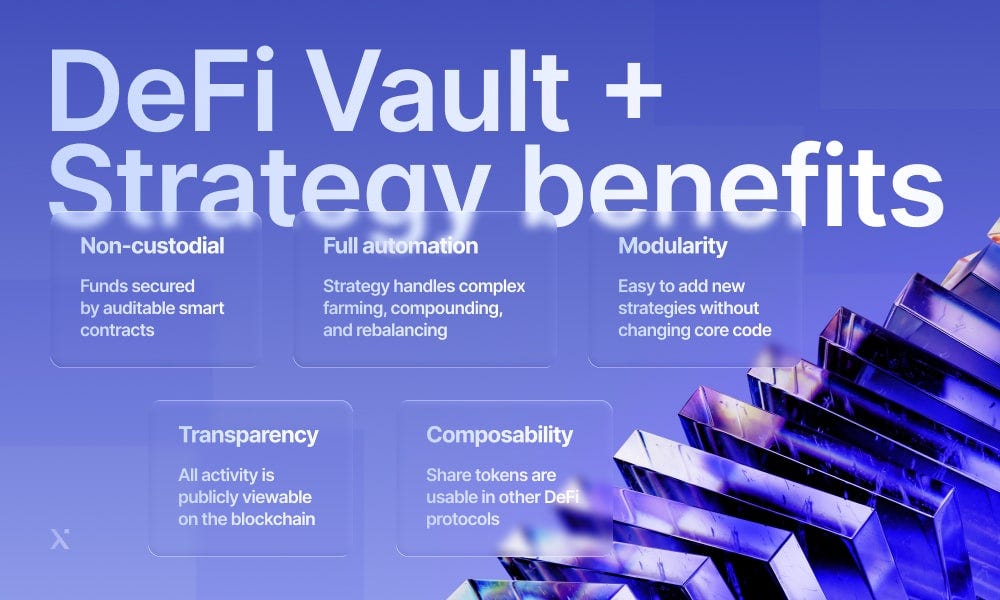
Concrete vaults, automated execution, capital coordination, quantitative allocation, and structured DeFi systems can handle the heavy lifting. The user allocates capital. Infrastructure handles operations. Smart contracts continuously monitor markets, rebalance positions, compound rewards, and adjust risk parameters in real time, without requiring users to click, sign, or even check their phone.
The promise is straightforward, one-click DeFi. Capital goes in, strategy runs, yield comes out.
Connect This to Concrete Vaults
Concrete Vaults are built exactly for this moment. They simplify onchain capital deployment through automated compounding, ctAssets, strategy automation, onchain execution, and structured vault systems.
Instead of manually chasing the highest APY across ten different protocols, users deposit into a Concrete Vault and let the infrastructure work. The vault automatically compounds rewards, shifts capital between opportunities as conditions change, maintains risk parameters, and executes complex strategies that would be impossible (or too expensive) to manage manually. ctAssets represent these structured positions in a clean, composable way, allowing users to hold a single token that represents an entire optimized strategy.
With Concrete Vaults, users access sophisticated DeFi opportunities without constantly managing positions themselves. The infrastructure becomes the portfolio manager. The user simply chooses their preferred risk-return profile and lets the system do the rest.
Explore the Benefits

This model matters for several powerful reasons.
- Capital efficiency improves dramatically because infrastructure never sleeps, never misses an opportunity, and never forgets to compound.
- Reduced operational burden means users can actually treat DeFi as passive income instead of active trading.
- Consistent strategy execution eliminates emotional decisions and timing mistakes.
- Risk-adjusted yield becomes the default, not something only whales can achieve.
- Institutional DeFi infrastructure finally becomes viable, large capital can deploy at scale without needing an entire operations team.
- Scalable capital deployment opens the door for trillions in new liquidity that previously stayed away due to complexity.
Better infrastructure creates a better user experience. It turns DeFi from a hobby for crypto natives into real financial infrastructure for everyone.
Close With the Bigger Shift
The future of DeFi may not be giving users more features, more dashboards, or more decisions. It may be building infrastructure that does the work for them.
Will users continue managing strategies manually? Most won’t, especially as the industry matures. DeFi users don’t actually want more features. They want fewer decisions. They want their capital to work harder so they don’t have to.
Vaults are quickly becoming the default interface for deploying capital onchain. “One-click DeFi” isn’t marketing speak , it’s the logical endpoint of an industry that started with permissionless innovation and is now maturing into permissionless efficiency.
The next billion users won’t come because DeFi became more complicated. They’ll come because it finally became simple.
Concrete Vaults and the broader infrastructure layer aren’t just new products. They represent the shift from user-operated DeFi to infrastructure-operated DeFi. And that shift might be the biggest unlock this ecosystem has seen since the launch of the first decentralized exchange.
The question isn’t whether infrastructure should take over the work. The question is, Why did we ever expect users to do it in the first place?.(*)
메타데이터
- post_id
- e609c962f012
- slug
- the-one-click-defi-economy-e609c962f012
- url
- https://medium.com/@tiyarmangulo/the-one-click-defi-economy-e609c962f012
- canonical_url
- https://medium.com/@tiyarmangulo/the-one-click-defi-economy-e609c962f012
- author_url
- https://medium.com/@tiyarmangulo
- status
- ok
- fetched_at
- 2026-07-10 07:28:19