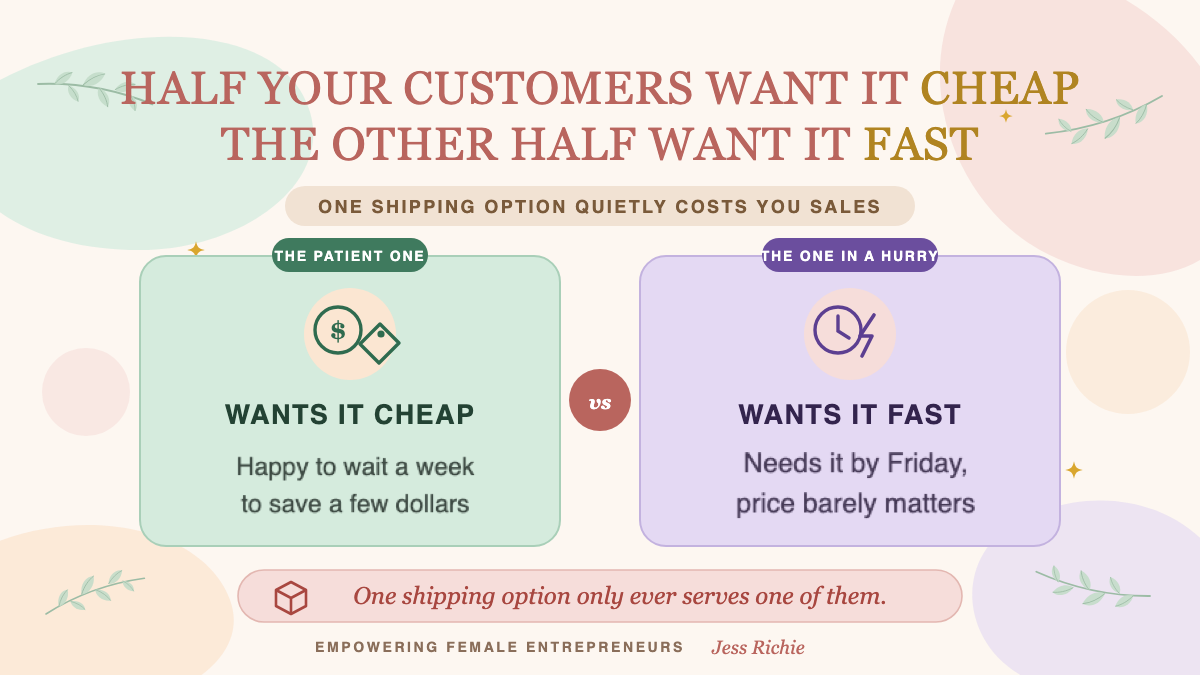
Half Your Customers Want It Cheap. The Other Half Want It Fast.
We run an online store. We also build shipping plugins for WooCommerce, which means I spend a lot of my week looking at other people’s…
Half Your Customers Want It Cheap. The Other Half Want It Fast.
We run an online store. We also build shipping plugins for WooCommerce, which means I spend a lot of my week looking at other people’s checkouts.
And the same thing comes up over and over. It’s not a broken setting or a clever trick. It’s just that most shops offer one way to get the parcel, and their customers are not all the same person.
We did this too, for a long time.
One option felt like the tidy choice
When we set our store up, we picked a carrier, set a shipping option, and moved on.
It felt like the right call. Fewer decisions for the customer. Less for us to manage. Everybody says don’t overwhelm people at checkout, so one clean option seemed like good sense.
What I hadn’t thought about was who was actually arriving at that checkout.
There are at least two people in your cart
Think about the last two things you personally bought online.
One of them, you probably didn’t care when it turned up. A refill, a book, something for the weekend after next. You’d have happily waited nine days to save four dollars.
The other one had a deadline. A birthday, a trip, something you’d left too late. You’d have paid almost anything to get it Friday.
Same shopper. Completely different mood.
Now put one shipping option in front of both of them.
If it’s the fast expensive one, the patient shopper does the math, decides the postage isn’t worth it, and closes the tab. If it’s the slow cheap one, the person with the deadline can’t use you at all, so they go somewhere that can promise Thursday.
Either way you lose one of them. And neither of them tells you why.
That’s what I find interesting about it. It isn’t a broken checkout. Everything works perfectly. You just quietly filtered out half your buyers by making an assumption on their behalf.
Letting them choose does the work for you
The fix is boring, which is probably why it took us so long.
Show live rates from more than one carrier and let people pick.
You’re not guessing anymore. The patient shopper picks the cheap slow one and feels clever. The person in a hurry picks the fast one and is grateful. Both of them just told you what they wanted, and neither needed you to predict it.
The other thing you get is coverage. Carriers aren’t equally good at everything. One’s strong on cheap domestic. Another’s better internationally. Another handles the heavy awkward stuff without punishing you.
If you’re on one carrier, you’re using their strong lanes and their weak lanes equally. Every parcel that falls in a weak lane costs you more than it should, or takes longer than it should, and you’d never know because you’ve got nothing to compare it to.
How to add a second option without making a mess
The overwhelm worry is real, so a few things we learned:
Two or three options is the sweet spot. Not nine. If you show a wall of near identical rates people freeze, and that’s a genuine conversion killer.
Name them in human words. “Standard, usually 5 to 7 days” beats a carrier service code nobody outside logistics recognizes. People are choosing between “cheap and slow” and “fast and pricey,” so let the label say that.
Put the one most people want first. For most shops that’s the cheap one. Let the person in a hurry go looking, they’re motivated.
And check the prices are live rather than a number you typed in two years ago. Carrier pricing moves. Flat rates you set a year ago tend to quietly become either a discount you didn’t intend to give, or a reason people abandon.
So which should you actually use?
This is the bit people ask me, and the honest answer is that it depends on whether you already know your carrier.
If you’re not sure which carrier suits your parcels, go multi-carrier.
Mult-carrier services like Shippo and ShipStation connect to a lot of carriers at once. You see live rates side by side, for your actual box sizes going to your actual destinations. After a few weeks you stop guessing and start knowing. Maybe one carrier is quietly winning everything under two pounds and losing everything over ten. You can’t learn that from a pricing page.
We build free WooCommerce shipping plugins for both options. You can download the free version of shipping plugins at 1Teamsoftware website at no cost. Add it, test it running a week, and let the data tell you something.
If you’ve already settled on FedEx, don’t force yourself to compare.
There’s a real argument for staying with one carrier you know well, and I don’t think it gets said enough. One pickup instead of three. One label workflow your packing team already knows. One tracking system. One number to call when a parcel goes missing. If you’ve negotiated rates, keeping your volume in one place is usually what protects them.
That’s genuinely more efficient, and efficiency in fulfillment is worth real money once you’re shipping any kind of volume.
You still give customers the choice, you just do it with that carrier’s own services. FedEx alone runs everything from ground through to overnight, which covers both the patient shopper and the one with a deadline.
That’s what FedEx Shipping PRO is for. It puts FedEx’s live rates and services at your checkout without the multi-carrier layer in between. Worth knowing it already runs on FedEx’s new API, which they moved to this year, so that side of it is handled.
Neither path is the best one. Compare when you don’t know. Commit when you do.
The bit I keep thinking about
The mistake wasn’t picking the wrong carrier. It was deciding, on everyone’s behalf, what they cared about.
I assumed everyone was me. I’m price sensitive and I’m rarely in a rush, so I built a checkout for people exactly like me, and then wondered why some visitors didn’t convert.
Checkout is where you find out what people actually want, but only if you give them something to choose between.
메타데이터
- post_id
- e61a6b2b875a
- slug
- half-your-customers-want-it-cheap-the-other-half-want-it-fast-e61a6b2b875a
- url
- https://medium.com/@jessriche/half-your-customers-want-it-cheap-the-other-half-want-it-fast-e61a6b2b875a
- canonical_url
- https://medium.com/@jessriche/half-your-customers-want-it-cheap-the-other-half-want-it-fast-e61a6b2b875a
- author_url
- https://medium.com/@jessriche
- status
- ok
- fetched_at
- 2026-08-23 03:17:38