“Elvis’ Greatest (Liner Note) Hits”
Text from the back covers of six Elvis albums from 1956–1963
“Elvis’ Greatest (Liner Note) Hits”
Text from the back covers of six Elvis albums from 1956–1963
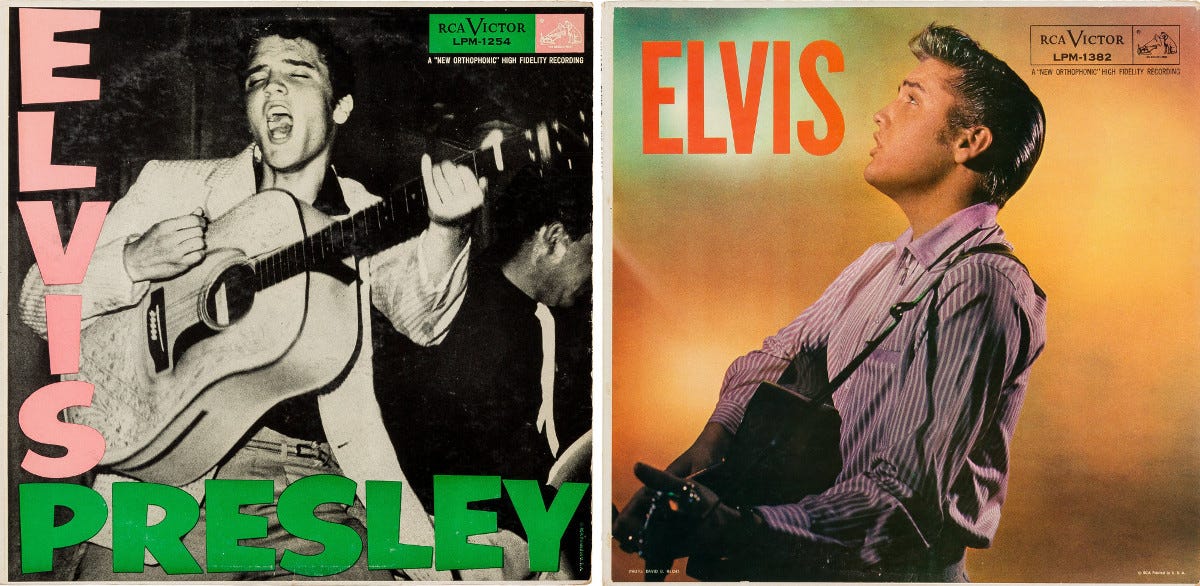
long-playing albums. Both were released in the US in 1956. Both featured liner notes on the jackets’ back cover. While these notes contained factual errors, they were still a source of information about Elvis that wasn’t about his pelvis or his sideburns. (Images: personal collection)
LINER NOTES were never all that common on popular music albums in the 1950s, at least not with American record companies. The back covers of EP and LP albums were too good a space not to use to advertise other records. Nonetheless, from 1956 into 1963, RCA Victor included album liner notes on twenty Elvis jackets (although a few were redundant). And then — Poof! — they were gone.
In this article, I have included a “greatest hits” of liner notes from Elvis EP and LP albums issued commercially while he was alive. I have only listed albums that were issued commercially for public consumption.
“Elvis Presley, RCA Victor sensational new vendor of songs with a solid beat, burst on the popular music world with unparalleled suddenness!”
In the list below, find a photo of the front cover of the album followed by its title, its original catalog number, and the month and year of its original release. In the list, “LPM” indicates a twelve-inch, long-playing record album while “EPA” is a seven-inch extended-play album.
This “Greatest Hits” collection is an abridged version of the article “The Elvis Album Liner Notes (1956–1963)” that appears on my *Elvis — A Touch Gold* blog. That article lists liner notes from fourteen albums with more than 4,200 words whereas the abridged version below lists only liner notes from only six albums with 3,200 words.

This is the back cover for the jacket of LPM-1254, Elvis Presley. Released in March 1956, it features four photos of Presley in RCA’s New York Studio. Below them are what passed for intelligent liner notes in 1956. Photos by William S. “Popsie” Randolph. (Image: personal collection)
The album liner notes
The liner note text from the album follows with quotation marks at the beginning and end of the text. I enclosed the text in standard American English (AmE) double-quotation marks. I replaced any name that had double quotation marks in the liner note text with single quotation marks.
I did not make any editorial or stylistic changes in the text (such as adding commas where I normally would) (especially serial comms). Nor did I break up lengthy paragraphs into smaller ones more palatable to the internet eye. The notes below are as they appear on the album jackets.
Byline
Most of the liner notes do not have a byline, so I had to credit them to an anonymous employee of RCA Victor. Of the three writers who were identified, two were mature, no-nonsense professionals (Anne Fulchino and Robert Kotlowitz).
Hence, most of the liner notes are devoid of period slang. The plus of that is that the text isn’t too dated; the minus is that most of the text reads like the author was simply doing a job with little enthusiasm for rock & roll or Presley.
Commentary
Following the liner notes you will find commentary by me about those notes.
Footnotes
There are a few footnotes that link original liner notes with redundant uses of the same notes.
Typos
Finally, I used the speech-to-text option on my iMac. It’s not as easy as one would think and creates lots of typos (many of them hilarious). If I missed any of those typos, please let me know via the comments form at the end of the article.

Front cover for RCA Victor LPM-1254, Elvis Presley, features the most iconic photo in rock & roll’s history on the front cover. Photo by William S. “Popsie” Randolph. (Image: personal collection)
Elvis Presley
RCA Victor LPM-1254 March 1956
“Elvis Presley, RCA Victor’s new recording artist, zoomed into big-time entertainment practically overnight. Born in Tupelo, Mississippi, Elvis began singing for friends and folk gatherings when he was barely five years old. All his training has been self-instruction and hard work. At an early age, without enough money to buy a guitar, he practiced for his future stardom by strumming on a broomstick. He soon graduated to a $2.98 instrument and began picking out tunes and singing on street corners.
After earning some money by working at part-time jobs, Elvis walked into a small recording company studio and asked to make a record, at his own expense. In a few months his first record was released and became an overnight sensation. Since then, he has won all the polls for the most promising new artist. Both trade journals Cash Box and Billboard gave him unprecedented rave notices. Following his graduation from high school, Elvis began an extended period of personal appearances and then signed his contract with RCA Victor.
Elvis is the most original protagonist of popular rhythm songs on the scene today. His belting style stands out vividly on records and in personal appearances and accounts for his universal popularity, especially with a teen-age audience.”
- Word count: 206
- Liner notes by RCA Victor.
Commentary
The liner notes are uncredited so an employee of RCA Victor probably wrote them. The first line is a bit of a stretch seeing how Elvis had released five records and had been on the road doing one-nighters during the year-and-a-half or so before he became a big-time entertainer “practically overnight.” The rest of the biographical information is a mixture of facts, exaggeration, publicity hype, and just plain bad writing.
For example, let’s look at the statement, “Following his graduation from high school, Elvis began an extended period of personal appearances and then signed his contract with RCA Victor.” Okay — it sounds like Elvis got his diploma, said “Bye, Mom!”, and hit the road in search of fame and fortune.
Elvis graduated from high school in June 1953 but didn’t hit the road as a touring singer until July 1954. So, the statement is factually correct but misleading. Plus, its placement as the last sentence in the paragraph could lead readers to believe that Elvis worked part-time jobs, released his first record, won all those polls and rave notices, and then graduated from high school.
Note
The same liner notes were used on the EP album Elvis Presley (EPB-1254), also released in March 1956.

RCA Victor EPA-747, Elvis Presley, features the most iconic — and one of the most kinetic — photo in rock & roll’s history on the front cover. Interestingly, different liner notes on the back cover from those of LPM-1254. (Image: personal collection)
Elvis Presley
RCA Victor EPA-747 March 1956
“Elvis Presley, RCA Victor sensational new vendor of songs with a solid beat, burst on the popular music world with unparalleled suddenness. Less than two years ago, he was a 19-year-old Memphis truck driver making a record at his own expense ($4) to present to his parents. It was a strictly amateur recording of his heady, uninhibited baritone voice — but it started a two-beat chain reaction that has now made Elvis Presley the most sought-after singer of the day, with the nation’s leading theater owners and TV show producers battling to sign him for personal appearances. And his pulsing records are now being sought out by the man in the gray flannel suit and the bridge club hostess, as well as by the millions of members of the dungaree set who have made his unique singing style — which owes a deep debt to the blues and spirituals of his native Southland — the hallmark of excellence for a rhythm singer.”
- Word count: 159
- Liner notes by RCA Victor.
Commentary
The liner notes are uncredited so an employee of RCA Victor probably wrote them. Elvis’ first record, That’s All Right / Blue Moon Of Kentucky (Sun 209), was released in July 1954. His first record that can make any claim to have “burst on the popular music world” was Heartbreak Hotel / I Was The One (RCA Victor 6420). It debuted on the national pop charts in February 1956. I doubt that nineteen months counted as “unparalleled suddenness” in 1956.
In the ’50s, the term *dungaree was often used synonymously with blue jeans. Back then, jeans were often associated with juvenile delinquents who looked like [Vic Morrow in Blackboard Jungle](https://m.imdb.com/title/tt0047885/mediaviewer/rm1374417665/)*.
Note
The same liner notes were used on the EP album Elvis Presley (RCA Victor EPA-830), released in June 1956.

RCA Victor LPM-1382, Elvis, features a front cover photo of a posed Presley. It is also an iconic photo in rock & roll’s history although not as famous or revered as that found on LPM-1254. (Image: personal collection)
Elvis
RCA Victor LPM-1382 October 1956
“It was a cold, rainy night on Broadway. The time, January 1956. The place, a TV theater-studio between 53rd and 54th Streets. The occasion, the first network telecast of a country singer unknown to the pop world, a youngster of unusual talents with some uncertainty about displaying them before a national audience.
Although Elvis Presley’s debut was gained through spectacular local fame and following, its publicity had not attracted the world at large. An artist who had set numerous Southern centers on their ear, Presley was facing a majority of viewers as cold and unprepared as the citizens of Siberia.
In New York very few had braved the storm. The theater was sparsely filled with shivering servicemen and Saturday nighters, mostly eager for the refuge from the weather. Outside, groups of teenagers rushed past the marquee to a roller-skating rink nearby. Just before show time, a weary promoter returned to the box office with dozens of tickets, unable even to give them away on the streets of Times Square.
What happened that night, and during the day following, is now history. The national gaze was pivoted to Presley en masse, the rain above was quickly transformed into a deluge of acclaim all over the country. In the South, people understood and were delighted by the success of their 21-year-old prodigy. Elsewhere this enthusiasm was carried first by amazement, later by a sizzling controversy.
At its source was the “Why?” of Elvis Presley’s wildfire popularity. Many have confused the issue with social problems, real in themselves but meaningless when the terms are begged, borrowed and stolen for musical criticism. As a result, most of the analytical sour grapes soon turned into useless vinegar, or else were sweetened by the critics’ ‘discovery’ of Presley’s talents in time.
The answer to this “Why?” lies somewhere in the welter of feelings and trends which have become focused through Presley’s powerful style. A way to find it is to add them together, then try to equate the sum with his incredible following over the world.
Of commercial folk music Presley is perhaps the most original singer since Jimmie Rodgers. His rhythmic style derives from exactly the same source of Deep South blues and jazz as that which inspired the late Blue Yodeler. Nor is it any coincidence that their birthplaces in Mississippi are less than a hundred miles apart.
Some say it is a reaction to present-day confusion that has caused rhythm and blues writers to simplify their songs with repeated tones and a heavy after-beat — in other words, to create rock-and-roll. If so, Presley was the first to extend it to the Rodgers interpretation, followed with his own. As the album cover dramatically illustrates, however, his folk characterization is still most natural and forthright.
Presley’s belting delivery accounts for a truly sensational reaction among teenagers. Important to this is his enthusiasm for music by the Blackwood Brothers, The Statesman and other quartets in the South. There has never been a great difference between rhythm and gospel songs except, of course, for the lyrical content; in fact, the latter are far more rhythmic where staging is concerned. It is essentially the fervor, the animation and boundless spirit of gospel singing that Presley admires, and which has been absorbed into his own dynamic performances.
We can better understand this if we consider how often ‘revival’ numbers have hit in the popular field. Here, Presley favors beat and ballad singers alike, in such different personalities as Billy Daniels and Bill Kenney — which leads to this possible answer for the “Why?” of his unprecedented appeal: Elvis Presley, by combining the four fields (country, gospel, rhythm and pop) into perfect unity, is unique in music annals and experience. At this point we must leave influences behind and discuss Presley in his own right, or better yet (since this is the point where publicity begins) — leave the subject altogether and listen to the music.
Of special note is the piano accompaniment in Old Shep, the first that Elvis Presley has ever recorded himself — also the superb vocal backing of the Jordanaires, who have assisted on several of his important singles. In scope, we feel that this collection is unsurpassed for variety by any artist, and will serve to win an even greater Presley following. For, in addition to the chill wind that penetrated Broadway on that memorable January night, there entered a new breath of life into the musical world — one that has just begun to vitalize the imagination of listeners everywhere.”
- Word count: 752
- Liner notes by RCA Victor.
Commentary
The liner notes are uncredited so an employee of RCA Victor probably wrote them. The first three paragraphs set up a scenario so gloomily noir-ish that I expected Philip Marlowe to step out from the shadows to flick a cigarette butt into the gutter. Tying Presley’ into commercial folk music and Jimmie Rodgers was brilliant, both from an aesthetic point of view and a commercial (that is, publicity) point of view.
These notes are much better written — much better conceived and thought through — than the liner on the albums that preceded them. They are second to those of Anne Fulchino’s on RCA Victor LPM-1707, ELVIS’ GOLDEN RECORDS, listed below. And, in hindsight, they are much more interesting than Fulchino’s.
Note
The same liner notes were used on the EP albums Elvis Volumes 1 and 2 (EPA-992 and 993), released in October 1956; the EP albums Elvis Presley (SPD-22 and SPD-23 (included as a freebie with the purchase of an Elvis Presley Autograph record player), released in October 1956; and EP album Strictly Elvis (EPA-994), released in January 1957.

RCA Victor EPA-4054, Peace In The Valley, features a cheesy front cover design of a posed photo of Elvis with an idyllic country/farm background, which may have been a painted backdrop in the photographer’s studio. (Image: personal collection)
Peace In The Valley
RCA Victor EPA-4054 April 1957
“To a great many people Elvis Presley has been a surprise. They have been surprised at his style of singing, at his disarming frankness and most of all at his rapid success. To them this album will also be a surprise. But to many of the fortunate folks who have known Elvis, whether as a schoolboy, movie usher, delivery man or performer, Peace in the Valley will be no surprise.
Little older than five was Elvis when he started singing in churches in his native deep Southland. Its music was his earliest and he is quick to credit this early and sustained background for its contribution towards his style. In fact, prominent in his personal record collection are most of the records available by the Statesmen Quartet, the Blackwood Brothers Quartet, the Jordanaires and other sacred groups of the South.
It was, then, no real surprise when on a recent Ed Sullivan TV show Elvis decided to do the title song of this set. Nor were the folks at RCA Victor surprised the very next day when the deluge of wires and letters descended suggesting, requesting and demanding that the selection be recorded by Elvis. This album is the result and it is interesting to note that on these four great sacred numbers Elvis chose to use only the men he normally employs on his popular recordings: Scotty Moore on guitar, Bill Black on bass, D. J. Fontana on drums, and The Jordanaires. If you are not impressed by the results, I will be surprised.”
- Word count: 255
- Liner notes by Calvin Helms.
Commentary
The liner notes are credited to Calvin Helms. Unfortunately, I was unable to find any meaningful information about him. Oddly, this is the second set of liner notes on an Elvis album with the word deluge in it.
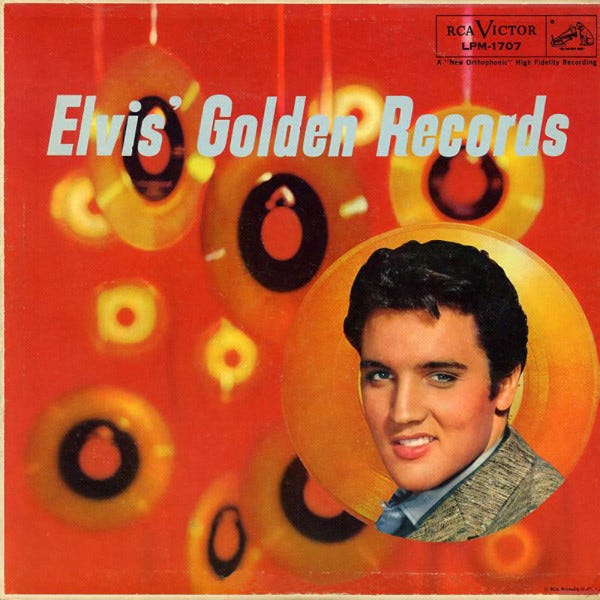
RCA Victor LPM-1707, Elvis’ Golden Records, features a front cover design with a photo of a heavily made-up or touched-up Elvis that, again, seems the opposite of the image Presley normally protected. Depending on one’s taste, this cover is classic or tacky. (Image: personal collection)
Elvis’ Golden Records
RCA Victor LPM-1707 March 1958
“The advent of Elvis Presley, slightly over two years ago, brought to the recording world a series of musical phenomena that has staggered both public and industry alike.
Nearly everything — pro and con — has been said verbally about Elvis Presley. And nearly everything about him has been put into print. Yet, amid the constant deluge of publicity, practically nothing has been discussed as to how, when and where each Presley hit record was actually made.
This memorial album is comprised of his fourteen ‘golden’ disks, that is, records that have enjoyed the success of selling over one million copies. A recapitulation of how these hits were produced will bare, among other interesting facts, the surprising revelation of Presley’s own major part in the writing and selecting of many of them.
His very first big single record for RCA Victor was Heartbreak Hotel. Elvis discovered this song himself. During a personal appearance in Florida, he was given the tune by Mae Axton, an accomplished writer of country-western songs. He liked it immediately but sought to get the more professional opinion of RCA Victor’s Artist & Repertoire Manager, Steve Sholes, who became a close musical advisor and chief pilot of his recording career. Sholes agreed the tune was perfect for Presley, and it was recorded in the RCA Victor studios in Nashville on February 10, 1956.
The recording session which produced I Want You, I Need You, I Love You was preceded by a near disaster for Elvis. He was appearing in Texas then, and in order to reach the Nashville studios in time, he had to charter a plane. Engine trouble developed, causing the plane to fall steadily, and it dropped to only a few feet above the ground before the difficulty was repaired. Although shaken by the experience, Presley managed to record this song with his usual feeling and confidence. It was on this date, also, that he had the backing of a vocal group for the first time. The singers were Gordon Stoker (now leader of the Jordanaires) plus Ben and Brock Speer of the Speer Family, well-known sacred artists. The session was held on Easter Sunday, April 11, 1956.
Presley’s first date at RCA Victor’s New York studios on July 2, 1956, produced not only his all-time best-selling disk but also his own personal favorite — Don’t Be Cruel. When he entered the studio he had no idea he would cut this song. He came prepared to do Hound Dog and Anyway You Want Me. Elvis himself was not particularly fond of Hound Dog as recording material but Steve Sholes decided it should be on wax since it always caused such a sensation in his theater act. Sholes believed the teen-agers who had seen him in person would want to own a record of Presley’s treatment of the song. After several rehearsal ‘takes,’ a satisfactory master was finally made, and at this point the boys took a coffee break.
While sipping coffee, Sholes pulled out a demonstration record of Don’t Be Cruel and told Elvis it was a new song written by Otis Blackwell, whom Elvis had long admired as a rhythm and blues artist. It took just a few bars to convince Presley that it was a perfect song for him, and he decided to cut it right away. Presley learned this song within minutes — he has an inherent musical sense — and in short order a great master was put on tape. Anyway You Want Me was made at the same date and, again, the song indicated a Presley spur-of-the-moment decision. He was listening to numerous songs with Sholes just the day before, and halfway through the demo record of Anyway You Want Me, Elvis suddenly picked it up from the turntable and said he thought it was a good song for him to record.
By the time Love Me Tender was released, Presley had launched his movie career and also had become recognized as a songwriter. Together with Vera Matson, wife of musical director Ken Derby, he wrote the musical score for the film ‘Love Me Tender.’ The movie originally was to be called ‘The Reno Brothers,’ but the song Love Me Tender pleased the film producers to such an extent that they changed the title of the picture.
A recording session held Labor Day weekend in September of 1956, at the RCA Victor Hollywood studios, produced Love Me and Too Much. Elvis’ inspired version of Love Me is the one gold record in this album not released as a single. It soared to its impressive sales figures on the strength of being the lead song in an extended-play album — a never-duplicated feat in the record business. The song might well be remembered as a hit of a couple of years ago, recorded at that time by George Gibbs.
Too Much was recorded that same weekend during Presley’s first Hollywood session. The song was submitted to him by one of the riders, Lee Rosenberg, in Nashville, as Elvis was boarding a train to California. He listened to it, liked it immediately, and recorded it with the wonderful backing of the Jordanaires. This vocal group, incidentally, is now a regular fixture on all Presley records. Led by Gordon Stoker, the other members of the quartet are Neal Matthews, Jr., Hoyt Hawkins and Hugh Jarrett.
It isn’t often that the title of a song will create a whole new expression in Americana. All Shook Up did exactly that. Youngsters and adults alike have made the phrase a common part of everyday usage. The background to this song itself is a rather interesting one. Since the huge success of Don’t Be Cruel, Elvis had been anxious to record another song from the pen of Otis Blackwell. Eventually, Blackwell came around with All Shook Up. Presley wasn’t completely satisfied with this song, and with Blackwell’s consent re-wrote part of the lyrics. Thus, as co-writer as well as artist, Presley produced his ninth consecutive gold record, his first in the year 1957.
That’s When Your Heartaches Begin was done on the same date, January 13, in the Hollywood studios. This was a song Presley remembered hearing on one of his many road trips, and he recalled the tune previous to this session. It was written by William Raskin, George Brown and Fred Fisher, who is known for such hits as Dardanella, Chicago and I Wish I Could Shimmy Like My Sister Kate.
Loving You, the title tune of Presley’s second movie, required nearly forty takes before Elvis felt he had done the song justice. It was written by two 24-year-old songwriters who have become the Gilbert and Sullivan of Rock and Roll. They are Jerry Leiber and Mike Stoller, from Baltimore and New York respectively, and have been a writing team since they were 17.
Also from the film ‘Loving You’ came Teddy Bear, a song Elvis believed would be a big hit because it was perfect for the teen-age market. Kal Man and Bernie Lowe, an established songwriting team, wrote the song expressly for Elvis since they knew he had a special fondness for teddy bears. Hal Wallis of Paramount Pictures thought this song would fit well into a particular scene from the film, and Teddy Bear was subsequently included in the score.
Jailhouse Rock is another golden record used as the title for a film. The score for this picture was also written by Jerry Leiber and Mike Stoller. After hearing the lyrics of Jailhouse Rock, M-G-M was impressed with the possibilities for an elaborate production number based on the song. The idea was carried out, and the scene turned out to be one of the longest song and dance routines featured in a movie.
Treat Me Nice, from ‘Jailhouse Rock,’ was suggested to Elvis by young Mike Stoller who played this song for him on the piano. Elvis liked the song, and everybody liked Mike’s piano-playing so much that he was hired to appear in the movie to play the tune.
This long-playing album represents a success never attained by any other artist at any other time — namely fourteen consecutive golden records. In his unique presentation of songs, Elvis Presley has, himself, created a tradition. No matter how desperately imitators may attempt to capture his personality, Elvis will always be the innovator of a style which set an entire musical trend in motion. Here in this album is an imperishable record of what caused the loudest noise heard round the entertainment world in some years.
Whether you are for or against Elvis, you will have to agree to one fact — he is definitely in a class by himself.”
- Word count: 1,439
- Liner notes by Anne Fulchino.
Commentary
The liner notes are credited to Anne Fulchino, who was a publicist for RCA Victor in the 1950s and 1960s. She wrote liner notes for at least two other RCA albums.
These liner notes are generally considered to be the finest notes on any Elvis album. In fact, they may be the best liner notes on any rock and roll album of the ‘50s! While they contain some major errors, the recording information of dates and locations of sessions was amazing information for serious Presley fans and historians years before such information was readily available.
As for the errors, the most prominent was that Elvis co-wrote the musical score for the film Love Me Tender with Vera Matson, wife of musical director Ken Derby. In fact, the songs were written or adapted by Darby but technical matters saw him hand over credit to his wife and Presley.
Finally, the word deluge makes its third appearance on the back of an Elvis album jacket in twenty-four months! In the penultimate paragraph, the word consecutive was underlined in the text. If any other word in any other set of liner notes was underlined, I overlooked it.

RCA Victor LPM/LSP-2328, His Hand In Mine, features a posed photo of Elvis in a jacket, white shirt, and tie politely sitting at a piano. Everything else in the photo — including the piano — has been muted into an almost uniform gray. The title and artist credit are set in some baroque German typeface which, I assume, is meant to be “religious” looking. (Image: personal collection)
His Hand In Mine
RCA Victor LPM-2328 RCA Victor LSP-2328 November 1960
“Church music and hymns made up the first music Elvis Presley ever heard. Church music was also the first music Elvis ever sang. It was as natural to him as nursery rhymes and Mother Goose are to other children.
Elvis was born in Tupelo, Mississippi. Like many other American small towns, it is a quiet place where families grow together in harmony and mutual kindness and where heartfelt religious belief lies at the center of life. In Tupelo, every day was begun with a devotion, both at school and in the Presley home. One of the most joyous Presley family memories is of mother, father and young Elvis — then only a toddler — singing together in Tupelo’s First Assembly Church of God.
Before Elvis’ beloved mother, Gladys, died several years ago, she delighted in recalling that time. ‘When Elvis was just a little fellow,’ Gladys Presley once said, ‘he would slide off my lap, run down the aisle, and scramble up to the platform of the church. He would stand looking up at the choir and try to sing with them. He was too little to know the words, of course, but he could carry the tune.’
Several years later, the Presley family habit became a tradition when Gladys and Vernon Presley, with their small son standing between them, became a popular trio singing hymns at camp meetings, revivals and church conventions.
This music is deep in Elvis’ memory. Bound up tightly with his birthplace, one of the most vivid and touching reminders of his mother and the wonderful life she helped create for him, it remains to this day a source of everlasting comfort and spiritual ease.
Elvis’ first and only previous album of hymns — PEACE IN THE VALLEY — was released in April of 1957. It was greeted by tremendous enthusiasm. One of the great all-time Presley best-sellers, it confirmed the feeling of Presley fans that Elvis could sing almost anything with an astonishing sincerity and feeling. At the time, it also made countless new devoted fans for him.
For Elvis, this new album was a labor of love. He has chosen these hymns as a tribute to those Tupelo memories, as a true and fitting memorial to his mother, and in response to the ever-insistent demand of his fans for another religious music album.
Here, then, are Elvis’s hymns — as the Presley family heard them, enjoyed them — as Elvis always sang them.”
- Word count: 403
- Liner notes by Robert Kotlowitz.
Commentary
The liner notes are credited to Robert Kotlowitz, who was a publicist for RCA Victor in the late 1950s and early 1960s. He was also a documentary filmmaker and novelist. In 1973, his novel Somewhere Else won the National Jewish Book Award.
He wrote liner notes for several albums. Certainly, the oddest pairing here is having a Jewish publicist write the notes for a collection of what are essentially fundamentalist Christian songs. I mean, it works — they’re fine notes. It’s just odd.

The Sun Collection was released in the UK in 1975. It collected sixteen of Elvis’ Sun Records recordings and featured the best liner notes ever to grace a Presley platter by Roy Carr. This was issued in the US a year later as The Sun Sessions with the same content and, thankfully, the same liner notes.
Finale
The next album to feature liner notes was RCA Victor APM1–1675, THE SUN SESSIONS, released in early 1976. This album was a reissue of a UK album, RCA Starcall HY-1001, THE SUN COLLECTION, that had been issued the year before. The US album reprinted the lengthy, informative notes by Roy Carr that appeared on the British album. Hence, I did not include it in the article.
If you take the best moments — in most, but not all, cases, the most factual ones — from the 4,262 words that appeared on fourteen Elvis albums between 1956 and 1963, judiciously prune them and compile them into one article, you would have an interesting — if slight — biography of Elvis Presley through 1957.
Recommended reading!
메타데이터
- post_id
- e6284a45b68f
- slug
- elvis-greatest-liner-note-hits-e6284a45b68f
- url
- https://medium.com/elvis-thats-the-way-it-was/elvis-greatest-liner-note-hits-e6284a45b68f
- canonical_url
- https://medium.com/elvis-thats-the-way-it-was/elvis-greatest-liner-note-hits-e6284a45b68f
- author_url
- https://medium.com/@nealumphred
- status
- ok
- fetched_at
- 2026-06-24 16:30:55