COOs Beware the Disruption Gap That’s Coming Your Way
The leaders most anxious about disruption aren’t struggling, they’re the growth leaders that are either facing disruption head on or…
COOs Beware the Disruption Gap That’s Coming Your Way
C-suite anxiety over persistent disruption has reduced year over year. 37% of CEOs report that they are less concerned. Most COOs aren’t concerned about disruption with only 21% of COOs feeling it at all. Yet persistent disruption is increasing and operations are exactly where the transformation is headed. 70% of CEOs report high disruption. This easing of anxiety is misplaced, indicating executives that have either gotten used to the chaos or are insulated from what is coming. They’ve learned the wrong lessons.
The leaders most anxious about disruption aren’t struggling, they’re the growth leaders that are either facing disruption head on or causing disruption. The 17% setting the pace for everyone else. What they’re facing now is coming for all of us. They are experiencing what is coming for all of us.
The window to prepare is open. Most organizations aren’t in crisis yet. That’s the point.

Every year, AlixPartners surveys over 3,200 senior executives across 11 countries to measure how business leaders experience disruption. Their 2026 Disruption Index contains some genuinely surprising findings; but the one that should concern every leadership team most isn’t buried in the data. It’s hiding in plain sight.
Disruption anxiety has decreased. On the surface, that sounds like good news. The overall Disruption Index fell three points this year, and the share of executives reporting high disruption dropped nearly ten percentage points. Leaders are breathing a little easier.
They probably shouldn’t be.
The report’s authors are precise about what the numbers actually mean: disruption hasn’t decreased. The forces reshaping industries; AI, geopolitical fragmentation, energy constraints, demographic shifts, are as intense as ever. What’s changed is that executives are getting used to it. They’re normalizing the noise. It’s the ‘frog in the slowly heating water’ effect. And in that normalization lies a significant risk.
The organization is not aligned around the same threat.
Here is what the data actually shows when you look past the headline number. Seventy percent of CEOs report that their organizations face high levels of disruption. Forty-five percent of other leaders agree. That’s not a small gap. That’s a 25-point chasm between the person responsible for the organization’s future and nearly everyone else in the room. CEOs are almost twice as likely as their direct reports to say they’re personally falling behind in knowledge and skills. Nearly half worry about losing their jobs to disruptive forces. Only a quarter of their C-suite colleagues share that concern.
This isn’t CEOs being dramatic. The data is consistent with something more structural: the CEO is the only executive whose role demands full exposure to the terrain ahead. They sit in board conversations, investor calls, competitive intelligence briefings, and industry forums where the signals come early and arrive fast. The rest of the C-suite, by design, is insulated from much of that input. Their jobs reward a different orientation entirely.
The COO data point is the most striking illustration of this. Only 21% of COOs report intense disruption; the lowest of any C-suite role. Only 14% believe their companies are leading the charge on disruption. This isn’t because operations leaders are less capable or less intelligent. It’s because the COO role is structurally designed for present-tense execution. Information flows in from the inside, success is measured in throughput and delivery, and career paths reinforce an orientation toward what is rather than what’s coming. The fires are real, they are urgent. They are relentless; and they crowd out the future-facing attention that disruption demands.
The uncomfortable irony is that operations are precisely where the disruption is headed. AlixPartners found that 72% of COOs acknowledge operations will be the primary focus of business model transformation. They know change is coming to their domain. They just don’t yet experience it as an emergency requiring action today.
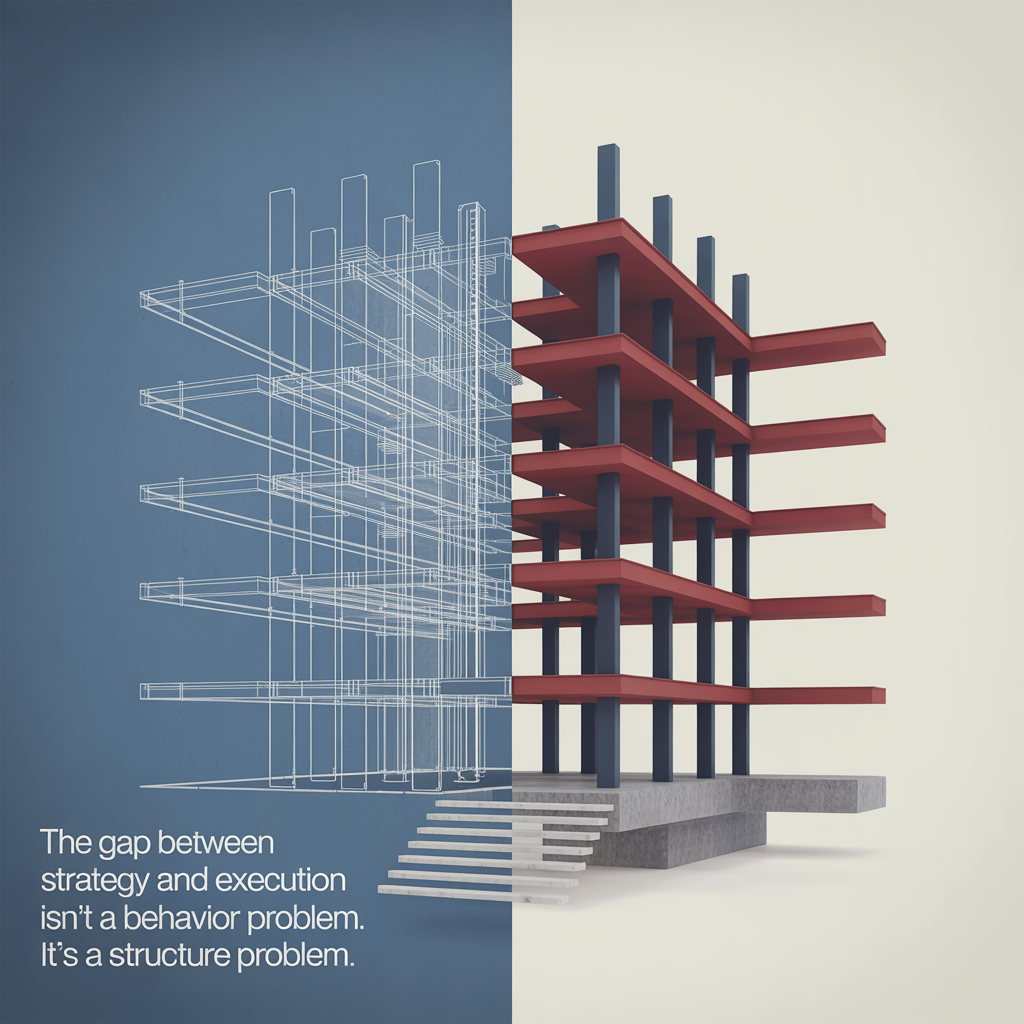
That disconnect, between the CEO scanning the horizon and the COO managing the present, is what I call the integration gap. It’s not a talent problem or a communication problem. It’s a systems problem. The organization lacks the structural mechanisms to translate strategic urgency into operational readiness before the wave hits.
The bifurcation that matters.
The more interesting story inside the AlixPartners data isn’t the overall anxiety level, it’s the split. Thirty-seven percent of executives are less anxious than a year ago. But 24% are significantly more anxious, up sharply from 17% the year before. These two groups are not randomly distributed. The more anxious cohort is concentrated almost entirely among the organizations that are growing fastest and performing best.
These are the growth leaders; the 17% of companies that set the pace in their industries. They are five times more likely to drive disruption rather than react to it. Nearly 60% expect significant business model change in the coming year. More than three-quarters are pursuing transformational M&A. They’ve broadly deployed agentic AI across their organizations at nearly four times the rate of their slower-growing peers. And they see every major disruptive force; tariffs, geopolitical instability, energy constraints, demographic shifts, as an opportunity where their competitors see a threat.
Their anxiety isn’t demonstrating weakness. It’s signal. They see what’s coming more clearly because they’ve chosen to look, and they understand that staying ahead requires continuous reinvention. They are the tip of the spear. And, much like the phenomenon that I called out in my Agentic AI article, they are the first adopters of disruption that will ripple out to all of us. The report makes the point directly: the rewards from leaning into disruption are considerable, but so is the burden. The goalposts move faster for those who are running fastest.
What this means for everyone else is important. The disruptions commanding a growth leader CEO’s attention today don’t stay contained to high-performing organizations. They spread, they scale, and they arrive, usually faster than expected. The organizations not currently experiencing that level of urgency aren’t insulated from these forces. They’re simply earlier in the timeline.
If you’re a numbers geek like me, I put together a companion Disruption Statistics Summary compiled from multiple sources.
The moment you’re in.
There’s a line in the AlixPartners report that deserves to be read slowly: “Too many companies lurch from one thing to another with the stiff gait of old-time movie monsters; and they almost always move too late.”
That’s the organizational failure pattern. Not lack of awareness. Not lack of talent. Not even lack of strategy. It’s the structural inability to move with continuity; to build adaptive capacity as a permanent feature of how the organization operates, rather than scrambling to respond once disruption has already arrived.
The interesting thing about the current moment is that it offers a window. General anxiety has moderated. Most organizations aren’t yet in crisis. That’s precisely when structural change is most achievable; before the urgency is so acute that reactive firefighting consumes everything.
The question isn’t whether disruption is coming. The AlixPartners data is unambiguous on that. The question is whether your organization is building the structural readiness to meet it; or whether you’re relying on the assumption that the calm of today is a forecast for tomorrow.
The organizations building that muscle now, when the pressure is manageable, are the ones who will see the next wave as an opportunity. The ones waiting for the urgency to force the issue will find themselves lurching.
This is the moment. The work is organizational design, not aspiration. And it starts with an honest look at whether your C-suite is reading from the same map.
Sarah Marshall Founder & CEO, Operations Architect
Sarah Marshall is Founder & CEO of Operations Architect and author of The Operating Edge: Building an Organization that Thrives in Disruption. She helps small and mid-sized organizations close the integration gap; the structural disconnect between strategy and execution that causes organizations to waste 20–30% of their execution capacity.
📞 Book a 60-minute operations diagnostic; no pitch, just clarity 📰 Subscribe to our “The Operating Edge” newsletter for weekly insights
메타데이터
- post_id
- e64acbe54868
- slug
- c-suite-anxiety-over-persistent-disruption-has-reduced-year-over-year-e64acbe54868
- url
- https://medium.com/@sarah.l.p.marshall/c-suite-anxiety-over-persistent-disruption-has-reduced-year-over-year-e64acbe54868
- canonical_url
- https://medium.com/@sarah.l.p.marshall/c-suite-anxiety-over-persistent-disruption-has-reduced-year-over-year-e64acbe54868
- author_url
- https://medium.com/@sarah.l.p.marshall
- status
- ok
- fetched_at
- 2026-06-10 18:44:10