Bedrock Knowledge Base: Rethinking Model Context
Amazon Bedrock Knowledge Base is often introduced as a convenient way to implement Retrieval-Augmented Generation (RAG) on AWS.
Bedrock Knowledge Base: Rethinking Model Context
Amazon Bedrock Knowledge Base is often introduced as a convenient way to implement Retrieval-Augmented Generation (RAG) on AWS.
But treating it as an application-level feature misses the real shift.
A Knowledge Base is not something you “add” to a model. When you adopt RAG through Bedrock, you are embedding retrieval into your infrastructure. Context stops being something dynamically constructed inside a prompt and becomes something engineered, versioned, governed, and served.
That distinction matters.

Because once retrieval becomes infrastructure, the model is no longer responsible for figuring out what knowledge to consider. The system is.
And that boundary — between model reasoning and system responsibility — is what determines whether your architecture scales cleanly or collapses under prompt complexity.
Traditional Context: Let the Model Figure It Out
In many early LLM systems, retrieval is informal.
Documents are fetched. Text is appended to a prompt. The model receives everything at once and is expected to identify what matters. At small scale, this feels efficient. There are few components and little orchestration.
But the simplicity is deceptive.
As document size increases, context grows linearly with it. Token consumption becomes unstable. Latency increases because the model processes far more text than it needs. Truncation becomes unavoidable as context windows are exceeded. And when responses degrade, debugging becomes opaque because filtering and reasoning are entangled inside a single prompt.
The model ends up doing two fundamentally different jobs at the same time:
- Filter knowledge
- Reason over knowledge
Those responsibilities should not live in the same layer.

When filtering and reasoning collapse into one step, complexity accumulates inside prompts. The architecture may look simple, but its behavior becomes unpredictable.
Retrieval as a System Responsibility
Bedrock Knowledge Base formalizes a different boundary.
Instead of pushing documents into prompts and asking the model to sift through them, documents are ingested, chunked, embedded, and stored in a vector index backed by OpenSearch Serverless.
When a query arrives, it is embedded using a foundation embedding model, producing fixed-dimension vectors. The vector store performs similarity search against previously embedded chunks. Only the most relevant matches are selected and injected into the model’s context.
The model no longer filters knowledge.
The system does.
That shift is subtle, but it is foundational. Filtering becomes deterministic and infrastructure-driven. Reasoning becomes focused and bounded. Context stops scaling with document size and starts scaling with relevance.
This is not an optimization.
It is a reallocation of responsibility.
Traditional vs RAG
The architectural difference becomes clearer when visualized.
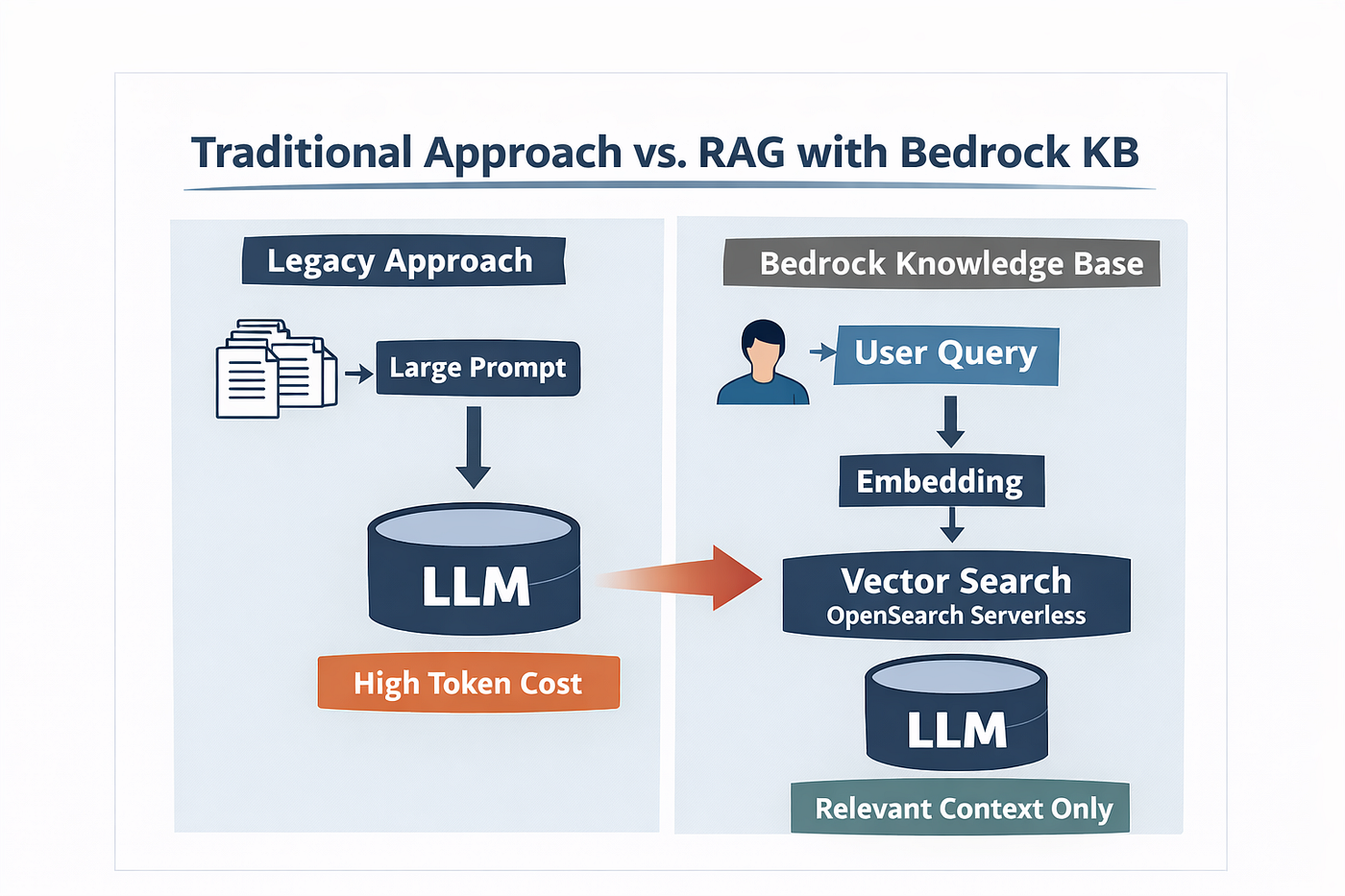
On the left, large prompts push raw context into the model and rely on it to extract signal from noise. The model acts as both retriever and reasoner, and the prompt becomes the place where complexity accumulates.
On the right, embeddings and vector search act as a filtering layer before reasoning begins. Retrieval is handled by the system. The model receives curated context and focuses solely on generating output.
The difference is not about optimization.
It is about responsibility.
Managed Does Not Mean Simple
Bedrock Knowledge Base abstracts retrieval orchestration, but it does not remove infrastructure complexity.
Creating a knowledge base requires an IAM role trusted by Bedrock, an OpenSearch Serverless vector collection, encryption and network policies, data access rules, and a vector index configured with the correct dimension and field mappings. Index creation must account for eventual consistency. Ingestion requires parsing and chunking configuration. If storage is encrypted, decryption permissions must be granted appropriately.
Vector storage is deterministic but unforgiving. A dimension mismatch between embedding model and index breaks retrieval. An index created too early fails provisioning. An incomplete IAM policy blocks ingestion.
If every team wires this independently, the platform fragments.
So instead of treating retrieval as a pattern, we made it as part of our infrastructure.
RAG as Infrastructure, Not Application Logic
We encapsulated the entire Knowledge Base configuration into a reusable Terragrunt module. From an application team’s perspective, enabling retrieval requires only three inputs:
terraform {
  source = "${get_repo_root()}/modules/bedrock/knowledge-base"
}

dependency "kb_role" {
  config_path = "../iam-role"
}

dependency "s3_bucket" {
  config_path = "../s3/bucket"
}

inputs = {
  name          = local.service.name
  role_arn      = dependency.kb_role.outputs.role_arn
  s3_bucket_arn = dependency.s3_bucket.outputs.bucket_arn
}
That minimal interface is intentional.
Internally, the module creates the vector collection, configures the index with correct dimension alignment, applies encryption and network policies, attaches required IAM permissions, and defines ingestion defaults. Advanced parsing or chunking strategies can still be specified, but they are validated and controlled rather than improvised per service.
Retrieval remains flexible, but it is no longer ad hoc.
What Actually Changed
The most visible improvements were operational. Prompt size stopped scaling with document size. Costs became predictable instead of fluctuating with every request. Latency flattened because the model was no longer processing entire documents unnecessarily. Context truncation, once a recurring edge case, largely disappeared.
But those were surface-level outcomes.
The deeper change was structural.
The model stopped filtering knowledge. It now focuses exclusively on reasoning over already curated context. Retrieval happens before inference, not during it. That separation simplifies debugging because failures can be isolated to either retrieval or reasoning. It improves observability because vector search becomes measurable infrastructure rather than invisible prompt behavior. It stabilizes system design because context is bounded by relevance rather than document length.
The model did not become smarter, instead its responsibilities became narrower and narrower responsibilities scale better.
The Architectual Design
The system now follows a disciplined flow. Documents are stored in object storage and ingested into the knowledge base. During ingestion, they are chunked into manageable segments and embedded into fixed-dimension vectors. Those vectors are stored in a managed vector collection.
When a query arrives, it is embedded in the same way and compared against stored vectors. The system retrieves only the most relevant chunks and injects them into the model’s context before inference begins.

The model is no longer overloaded with raw documents. It receives curated context and performs focused reasoning.
Nothing about the model changed.
The system did.
Why This Matters
When people talk about RAG, the conversation usually centers on tools — embedding models, vector databases, chunk sizes.
Those decisions matter. But they’re not the real shift.
The real question is where responsibility lives.
If the model is responsible for filtering context, prompts quietly become orchestration layers. Retrieval logic hides inside text. Scaling becomes fragile because complexity accumulates in places that are hard to observe or test. When something breaks, you’re debugging wording instead of infrastructure.
If the system is responsible for retrieval, the boundary becomes clear. Retrieval is deterministic and observable. The model receives curated context and focuses on reasoning. Filtering and generation are no longer entangled.
That is what Bedrock Knowledge Base formalizes. It doesn’t make models smarter but it makes architectures cleaner.
What Comes Next
Retrieval solves relevance. It ensures the model sees the right information at the right time.
But relevance is only half of production AI.
The next boundary is control.
How do you enforce policy consistently? How do you prevent unsafe outputs? How do you protect sensitive data without embedding those rules inside fragile prompts?
These aren’t retrieval problems. They’re constraint problems.
In the next article, we’ll look at Bedrock Guardrails as a structural control layer around inference. If Knowledge Base moves retrieval out of the prompt, Guardrails move policy enforcement out of it as well.

Because organizing context is only half the architectural shift.
The other half is constraining behavior — deliberately, explicitly, and at the system level.
메타데이터
- post_id
- e64adfb44bd4
- slug
- bedrock-knowledge-base-rethinking-model-context-e64adfb44bd4
- url
- https://awstip.com/bedrock-knowledge-base-rethinking-model-context-e64adfb44bd4
- canonical_url
- https://awstip.com/bedrock-knowledge-base-rethinking-model-context-e64adfb44bd4
- author_url
- https://medium.com/@tbrovy
- status
- ok
- fetched_at
- 2026-07-27 17:09:37