The 19.5 KG Question: Why the DYU Stroll 1 Makes Sense for Full-Size City Riding
The number I notice first on a city e-bike is no longer the maximum range. It is the weight. Range matters once I am riding, but weight…
The 19.5 KG Question: Why the DYU Stroll 1 Makes Sense for Full-Size City Riding
The number I notice first on a city e-bike is no longer the maximum range. It is the weight. Range matters once I am riding, but weight appears at every awkward moment before and after the ride: lifting the rear wheel over a kerb, guiding the bike into a narrow hallway, turning it around on a landing, or carrying it up the final flight of stairs when the lift is out.
That is why the DYU Stroll 1 caught my attention. It is a full-size 700C city e-bike listed at 19.5 kg, with a 250W motor, a 36V 9Ah battery, oil disc brakes and an advertised pedal-assist range of up to 100 km. Those are not exotic numbers individually. The interesting part is how they are combined in a conventional-looking bike that does not depend on tiny wheels or a folding hinge to reduce its everyday burden.
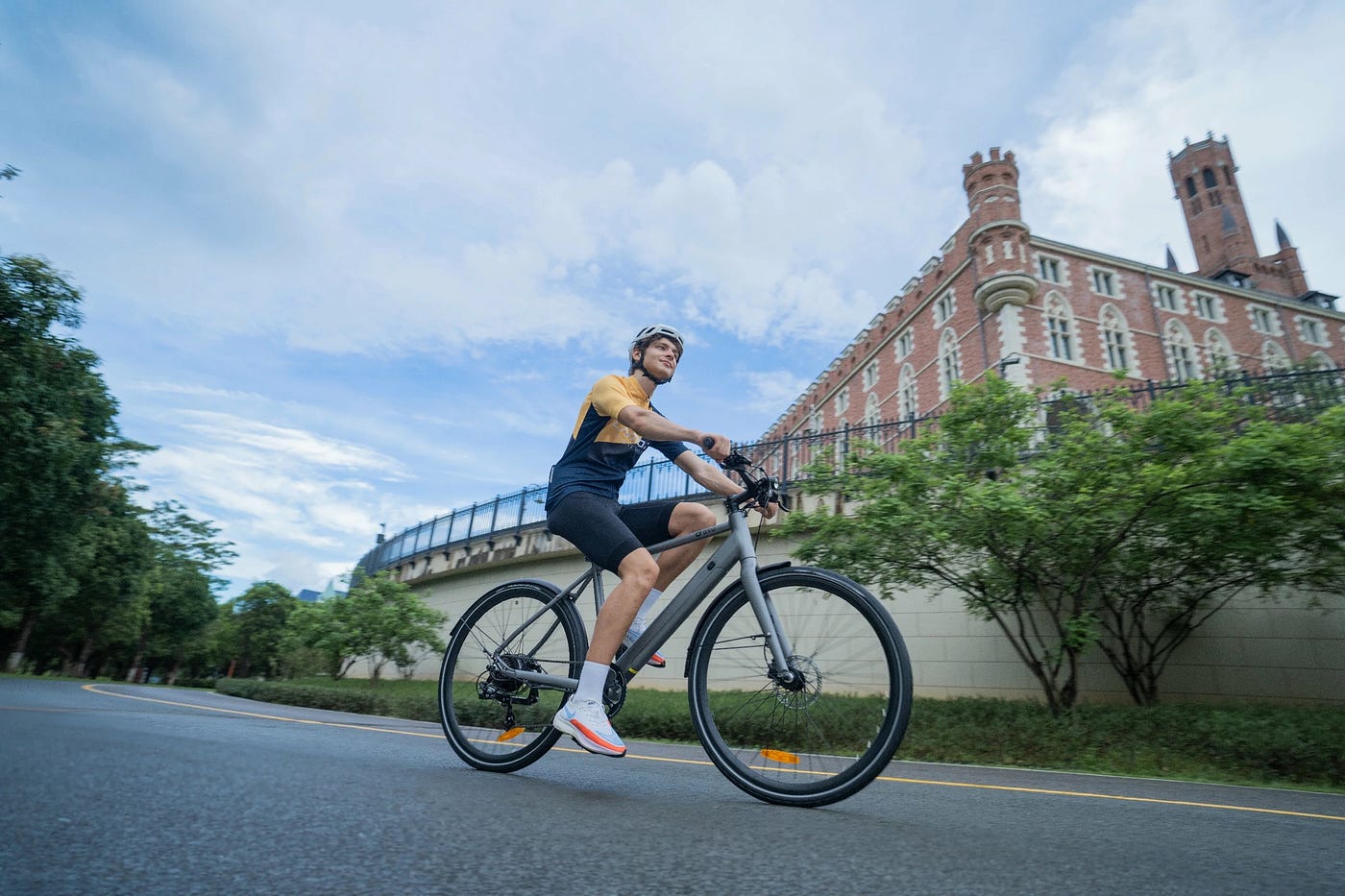
I checked the current specification and availability on the DYU Stroll 1 product page: https://dyubikes.com/product/dyu-stroll-1-700c-city-electric-bike/
Why weight changes more than carrying
A difference of four or five kilograms can look trivial beside the rider’s own body weight. In practice, the bike is an uneven object with pedals, bars and wheels that catch on door frames. A lighter machine is easier to steady when walking beside it, easier to pull backwards from a crowded rack and less intimidating when a train platform suddenly changes.
At 19.5 kg, the Stroll 1 is not a featherweight road bike. I would not describe any 19.5 kg e-bike as effortless to carry for several floors. But it sits in a useful middle ground: light enough to handle more calmly, while still offering full-size wheels, electric assistance and a normal riding position. That balance matters more to me than chasing the smallest folded package if most of my trip happens on the road.
For riders whose daily routine includes stairs, shared storage or mixed bike-and-train travel, weight should be treated as a feature rather than a footnote. DYU also groups comparable options in its lightweight e-bike category: https://dyubikes.com/product-category/lightweight-ebike/
What 700C wheels change on ordinary streets
The Stroll 1 uses 700×38C tyres. That diameter is familiar from city, hybrid and gravel-style bikes, and it gives the bike a very different character from a 14-inch or 16-inch compact commuter. Large wheels roll over shallow potholes, tram-track edges and imperfect paving with less drama. They also help the bike hold a line on longer, open sections of road.
The 38 mm tyre width is a practical compromise. It is not a fat tyre designed for sand or deep mud, but it offers more cushioning and confidence than a narrow racing tyre. For European city riding, where one route can include smooth cycle lanes, older asphalt, cobbles and a park connector, that versatility is valuable.
There is a trade-off. Full-size wheels take up full-size space. The Stroll 1 is not the bike I would choose for a tiny car boot or a cupboard under the stairs. If compact storage is the primary problem, a folding model remains the more logical answer. But if the bike can stay assembled, the 700C format rewards the rider every kilometre rather than only at storage time.
Reading the 100 km claim realistically
The product page states an assisted range of up to 100 km. I read the words “up to” carefully. Range estimates depend on assist level, rider weight, hills, temperature, wind, tyre pressure, stops and how much effort the rider contributes. A flat summer route in a low assistance mode is very different from repeated winter climbs with maximum support.
The battery is rated at 36V and 9Ah, which equals 324Wh of nominal energy. At an illustrative household electricity price of €0.30 per kWh, the battery’s stored energy costs roughly €0.10 before charging losses. That arithmetic does not prove a 100 km real-world range, but it does show why even frequent e-bike charging can remain inexpensive compared with fuel or daily transit tickets.

For my planning, I would never build a commute around using every last kilometre of a headline range. I would keep a reserve, watch consumption over the first few rides and charge according to the actual route. A rider doing a 16 km round trip covers 80 km over five weekdays. Even if conditions reduce the official maximum, the Stroll 1’s specification gives useful breathing room for errands and detours between charges.
If maximum battery capacity matters more than low weight, the DYU C9 is a different kind of option, with a larger 48V 15.6Ah battery and folding 20-inch format: https://dyubikes.com/product/dyu-c9-20-inch-long-range-ebike/
A simple commuter setup has advantages
The Stroll 1’s 250W motor and 25 km/h maximum assisted speed fit the familiar European city-bike pattern. The point is not motorcycle-like acceleration. It is consistent help when leaving a junction, riding into wind or finishing a long day with tired legs. A bike that still looks and handles like a bicycle can be easier to integrate into normal routes and habits.
Oil disc brakes are another sensible choice for an all-weather commuter. The benefit is not a dramatic specification headline; it is predictable control when the road is damp and traffic is stop-start. As always, pad condition, rotor cleanliness and tyre grip still matter. No brake label replaces maintenance.
I also like that the frame is visually restrained. A commuter parked outside an office or café does not need to advertise every component. The integrated battery area and slim profile make the Stroll 1 feel closer to a conventional urban bike than many bulky e-bikes.
The compromises I would check before buying
The clean design means cargo is not the centre of the standard setup. Riders who carry a laptop, groceries or rain gear should budget for a compatible rack, pannier or front carrier rather than assuming everything is included. DYU lists front- and rear-rack accessories, but the best configuration depends on the load and local availability.
Comfort is personal as well. One owner review on the product page praised the range and ride but wished for more saddle padding. I would treat that as a useful reminder to test the contact points. A saddle that suits a 20-minute ride may not suit a 60-minute one, and more padding is not automatically better if the shape is wrong.
Finally, the Stroll 1 is a full-size bike. That is the source of its stable road feel and also its main limitation. Apartment dwellers with no secure ground-floor storage should measure lifts, corridors and wall space before ordering. A specification sheet cannot tell you whether the handlebar clears the turn into your hallway.

Who the Stroll 1 makes sense for
I see the strongest fit for riders who want a familiar bicycle feel, travel moderate or longer urban distances and occasionally need to lift or manoeuvre the bike. It also makes sense for someone moving from a conventional hybrid bike who does not want the small-wheel sensation of a compact folder.
It is less convincing for riders who need true suitcase-like storage, carry heavy cargo every day or want soft, oversized tyres for rough trails. Those needs point to different categories, not to a failure of this design.
The final verdict
The Stroll 1 makes a persuasive case by avoiding extremes. It is not the smallest, the most powerful or the most heavily equipped DYU. Instead, it combines a manageable 19.5 kg weight, stable 700C wheels, legal-city-style 250W assistance, oil disc brakes and meaningful claimed range in a straightforward package.
For daily transport, that restraint can be a strength. The best commuter is often the bike that creates the fewest small arguments before each ride: not too heavy to move, not too awkward on the road, and not demanding a charge after every short trip.
Anyone still deciding between lightweight, folding, cargo and long-range formats can compare the wider DYU e-bike collection here: https://dyubikes.com/product-category/ebikes/
메타데이터
- post_id
- e64b2ab0cf46
- slug
- the-19-5-kg-question-why-the-dyu-stroll-1-makes-sense-for-full-size-city-riding-e64b2ab0cf46
- url
- https://medium.com/@liulingyun049/the-19-5-kg-question-why-the-dyu-stroll-1-makes-sense-for-full-size-city-riding-e64b2ab0cf46
- canonical_url
- https://medium.com/@liulingyun049/the-19-5-kg-question-why-the-dyu-stroll-1-makes-sense-for-full-size-city-riding-e64b2ab0cf46
- author_url
- https://medium.com/@liulingyun049
- status
- ok
- fetched_at
- 2026-08-10 12:46:46