Swarm Intelligence
How Simple Creatures Create Superintelligence — and What It Means for the Future of AI
Swarm Intelligence
How Simple Creatures Create Superintelligence — and What It Means for the Future of AI

In 1991, a scientist watched ants.
Not in a lab. Not in a simulation. Just ants on the ground.
Individually, each ant was nearly useless. Tiny brain. No map. No strategy.
Yet together, they solved complex optimization problems faster than computers of that era.
They found the shortest paths. They adapted to obstacles. They recovered from failures.
There was no leader.
No master plan.
No neural network.
Just emergence.
This phenomenon became known as Swarm Intelligence — and today, it powers robots, AI optimization, traffic systems, financial models, and even spacecraft.
This article will show you:
- What swarm intelligence really is
- Why it works so well
- How it compares to neural networks
- Python implementations
- Real-world systems using it today
- Why it may shape the future of AI
The Core Idea: Intelligence Without a Brain
Most AI systems follow this structure:
Input → Processing → OutputSwarm intelligence breaks this model.
There is no central processor.
Instead:
Many simple agents
+ simple rules
+ local interactions
= global intelligence
Think of:
- Ant colonies
- Bee swarms
- Bird flocks
- Fish schools
- Human crowds
None have a central controller.
Yet they behave intelligently.
The Ant Colony Story: Nature’s Optimization Algorithm
Ants need food.
They explore randomly.
When an ant finds food, it returns to the colony leaving a chemical trail called pheromone.
Other ants follow stronger pheromone paths.
Shorter paths get reinforced faster.
Longer paths fade.
Eventually, the colony discovers the shortest path automatically.
No ant calculates distance.
No ant runs an algorithm.
Yet the colony solves an optimization problem.
This became the basis of:
Ant Colony Optimization (ACO)

Why Swarm Intelligence Is So Powerful
Because it has properties traditional AI struggles with:
1. No single point of failure
If one agent dies, system survives.
Neural networks fail if core components break.
Swarm survives.
2. Massive parallelism
1000 agents explore simultaneously.
Neural networks compute in layers.
Swarm explores entire solution space.
3. Adaptability
Swarm reacts instantly to changes.
No retraining needed.
4. Scalability
More agents = better performance.
Simple.
Neural Networks vs Swarm Intelligence
Neural networks are powerful.
In fact, mathematically, neural networks can approximate any function.
This is called the Universal Approximation Theorem.
They mimic the human brain.
But nature didn’t stop at brains.
Nature invented swarms.
And swarms are better in some scenarios:
| Problem                  | Neural Networks        | Swarm Intelligence |
|--------------------------|------------------------|--------------------|
| Image recognition        | Excellent              | Poor               |
| Optimization             | Good                   | Excellent          |
| Dynamic environments     | Moderate               | Excellent          |
| Robotics coordination    | Moderate               | Excellent          |
| Adaptation               | Requires retraining    | Instant            |
| Failure tolerance        | Low                    | High               |
Neural networks learn patterns.
Swarm intelligence discovers solutions.
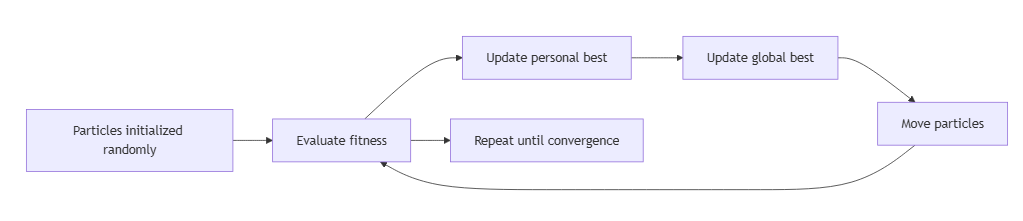
Particle Swarm Optimization (PSO): Inspired by Bird Flocks
Birds searching for food adjust their direction based on:
- Their own best position
- The best position found by the swarm
This inspired Particle Swarm Optimization.
Each particle:
- Represents a possible solution
- Moves in solution space
- Learns from itself and neighbors
Eventually converging to optimal solution.
Python Implementation: Particle Swarm Optimization
Here’s a simple implementation to find minimum of function:
f(x) = x²
import random
# Objective function
def fitness(x):
    return x*x
# Particle class
class Particle:
    def __init__(self):
        self.position = random.uniform(-10, 10)
        self.velocity = random.uniform(-1, 1)
        self.best_position = self.position
        self.best_fitness = fitness(self.position)
particles = [Particle() for _ in range(30)]
global_best = min(particles, key=lambda p: p.best_fitness)
for iteration in range(100):
    for p in particles:
        r1 = random.random()
        r2 = random.random()
        # update velocity
        p.velocity = (
            0.7 * p.velocity
            + 1.4 * r1 * (p.best_position - p.position)
            + 1.4 * r2 * (global_best.best_position - p.position)
        )
        # update position
        p.position += p.velocity
        current_fitness = fitness(p.position)
        if current_fitness < p.best_fitness:
            p.best_fitness = current_fitness
            p.best_position = p.position
    global_best = min(particles, key=lambda p: p.best_fitness)
print("Best position:", global_best.best_position)
print("Best fitness:", global_best.best_fitness)
This simple swarm finds the minimum without calculus.
Real-World Case Study 1: Warehouse Robots
Modern warehouses use swarm intelligence.
Hundreds of robots coordinate without central control.
They:
- Avoid collisions
- Optimize routes
- Deliver packages faster
Each robot follows simple rules.
Together, they create an intelligent logistics system.
Real-World Case Study 2: Internet Routing
Network packets find optimal routes dynamically.
This is inspired by ant colony optimization.
Data finds fastest path automatically.
Real-World Case Study 3: Drone Swarms
Military and research drones use swarm algorithms to:
- Coordinate movement
- Search areas efficiently
- Adapt to threats
Each drone is simple.
The swarm is intelligent.
Real-World Case Study 4: Financial Optimization
Swarm intelligence is used to:
- Optimize portfolios
- Predict market patterns
- Tune trading strategies
Because financial markets are dynamic systems.
Swarm adapts faster than static models.
Real-World Case Study 5: Space Exploration
Swarm robots may explore Mars.
Instead of one expensive rover, thousands of cheap robots.
If some fail, mission continues.
This dramatically increases reliability.
The Mathematical Secret: Emergence
Swarm intelligence works because of emergence.
Simple rule:
Local behavior → Global intelligenceExample:
Single neuron = dumb Neural network = intelligent
Single ant = dumb Ant colony = intelligent
Single particle = dumb Swarm = intelligent
Intelligence emerges from interaction.
Why Swarm Intelligence Is Perfect for Modern Problems
Today’s problems are:
- Distributed
- Dynamic
- Complex
- Unpredictable
Swarm intelligence thrives in such environments.
Examples:
- Traffic systems
- Robotics
- Cloud computing
- Autonomous vehicles
- Optimization problems
Hybrid Future: Neural Networks + Swarms
The future isn’t neural networks alone.
It’s hybrid intelligence:
Neural networks for perception.
Swarm intelligence for decision and optimization.
Example architecture:

Neural network sees.
Swarm decides.
Advanced Example: Ant Colony Optimization in Python
Finding shortest path:
import random
distances = {
    (0,1): 2,
    (1,2): 3,
    (0,2): 5
}
pheromone = {edge:1 for edge in distances}
def choose_path():
    total = sum(pheromone.values())
    r = random.uniform(0, total)
    upto = 0
    for edge, p in pheromone.items():
        if upto + p >= r:
            return edge
        upto += p
for iteration in range(100):
    edge = choose_path()
    # reinforce shorter paths more
    pheromone[edge] += 1/distances[edge]
print(pheromone)
Short paths gain stronger pheromone.
Swarm discovers optimal solution.
The Most Mind-Blowing Insight
No ant understands the colony.
No bird understands the flock.
No neuron understands the brain.
No particle understands the swarm.
Yet intelligence emerges.
This suggests intelligence is not about complexity of individuals.
It’s about interaction.
Why Swarm Intelligence May Be the Next AI Revolution
Current AI is centralized.
Swarm AI is decentralized.
Centralized AI is fragile.
Swarm AI is resilient.
Centralized AI is expensive.
Swarm AI is scalable.
This is why swarm intelligence is being used in:
- Robotics
- Autonomous vehicles
- Distributed AI
- Optimization engines
- Future space missions
Final Thought: Nature Is Still the Greatest AI Engineer
Nature invented neural networks.
Nature invented evolution.
Nature invented swarms.
Human AI copied neural networks first.
Swarm intelligence is next.
And the most powerful AI systems of the future may not be giant brains…
…but massive swarms of simple agents.
Working together.
Emerging into intelligence.
메타데이터
- post_id
- e65a993a3e2b
- slug
- swarm-intelligence-e65a993a3e2b
- url
- https://medium.com/@kavitesh.kamboj/swarm-intelligence-e65a993a3e2b
- canonical_url
- https://medium.com/@kavitesh.kamboj/swarm-intelligence-e65a993a3e2b
- author_url
- https://medium.com/@kavitesh.kamboj
- status
- ok
- fetched_at
- 2026-07-24 09:03:45




