The House of Sorrow
Or the House of Mirth
The House of Sorrow
Or the House of Mirth

image by author using copilot
The Wisdom of King Solomon We read in the Bible,1 Kings, chapter 4, that — “ … God gave Solomon wisdom and understanding exceedingly much … For he was wiser than all men …”
This same King Solomon we are also told, became, in his old age, exceedingly foolish. He turned away from the God who had given him his wisdom to worship idols. Yet the wisdom of King Solomon, written down for us in the books of Proverbs, Ecclesiastes, and Song of Solomon, is indeed God-given wisdom to be heeded and meditated on. In Ecclesiastes chapter 7, verses 2–4, we read -
It is better to go to the house of mourning, than to go to the house of feasting: for that is the end of all men; and the living will lay it to his heart.
Sorrow is better than laughter: for by the sadness of the countenance the heart is made better.
The heart of the wise is in the house of mourning; but the heart of fools is in the house of mirth.
Many may react to this teaching by thinking, that’s not what I want to hear. God’s enemies will say, Your God is a killjoy, all doom and gloom. Yet our God also says to us, -
These things have I spoken unto you, that my joy might remain in you, and that your joy might be full. John 15:11
And you now therefore have sorrow: but I will see you again, and your heart shall rejoice, and your joy no man takes from you. John 16:22
Paul the Apostle, who experienced much doom and gloom and sorrow, tells us emphatically -
Rejoice in the Lord always: and again I say, Rejoice! Philippians 4:4
So this is wisdom’s paradox. For Christians, sorrow does not negate joy, nor does joy negate sorrow. Both are always with us, two intertwined currents in The Spirit’s river bearing us along. It is joy in the Lord and the joy of the Lord that is our strength in the midst of our sorrows.

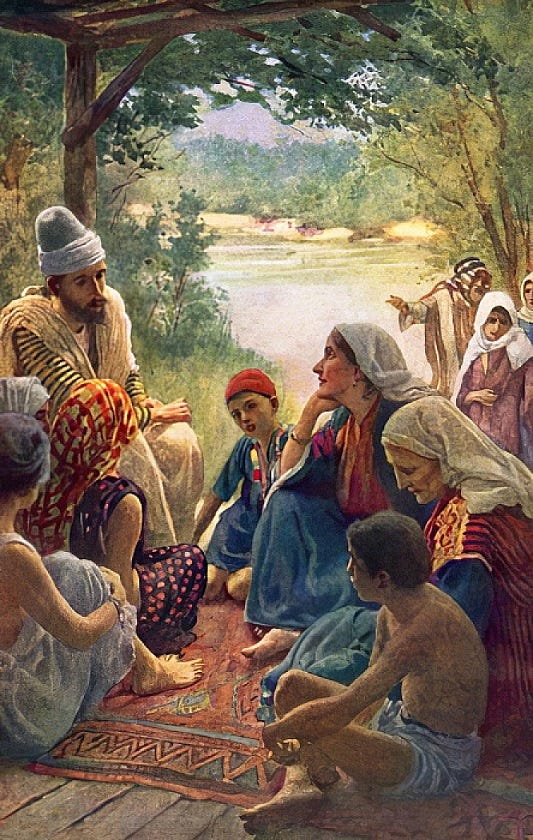
The Prophet Jeremiah — image by author using copilot
The Sorrow of Jeremiah Lamentations, the book that Jeremiah wrote after the destruction of Jerusalem by the Babylonians in 586 BC, is an amazing pouring forth of his deep sorrow. Jerusalem and its temple had been destroyed, its holy treasures looted, and its people taken into captivity and exile. All this, as Jeremiah tells us, being what God had clearly and often said would happen if his people persistently turn away from Him to worship idols.
Yet at the heart of this expression of grief we read this joyful declaration, -
“This I recall to my mind, therefore have I hope. It is of the Lord’s mercies that we are not consumed, because his compassions fail not. They are new every morning: great is thy faithfulness. The Lord is my portion, saith my soul; therefore will I hope in him. The Lord is good unto them that wait for him, to the soul that seeks him.” Lamentations 3:21–25
It is remarkable that with the book of Lamentations, the Holy Spirit inspired Jeremiah to express his sorrows in the form of a tightly structured, acrostic poem. Chapters 1, 2, and 4 each have 22 verses, each one starting with successive letters of the Hebrew alphabet. Chapter 5 has 22 verses, but no acrostic pattern, and chapter 3 has 66 verses going through the Hebrew alphabet in blocks of three. The poem has a chiastic structure as in this diagram -
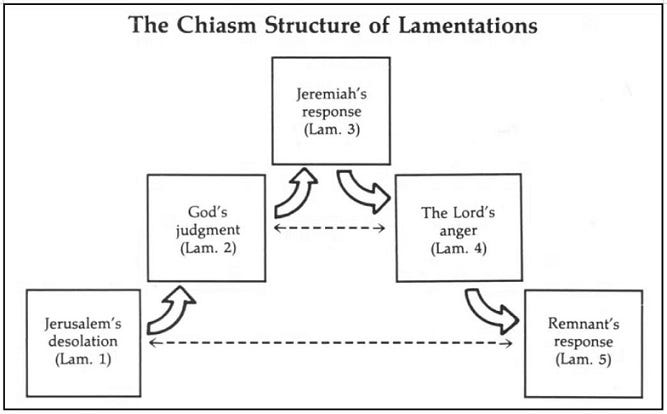
Lamentations is written alternating a three-stressed syllable line with a two-stressed one. This is the qinah meter that Hebrew elegies and funeral songs used. The three two-beat is said to communicate the halting, uneven rhythm of a funeral procession. The book of Lamentations is fearfully and wonderfully crafted.
Which Mask? Our response?
In 2026, two and a half millennia later, can we empathise, can we identify with the desolation and grief felt by Jeremiah and God’s chosen people as they experience his judgement and their fall from grace? Jeremiah, in his lamenting, was very much focused on Jerusalem and Israel and the Jewish nation. In 2026, two millennia after The Lord Jesus announced that, “The time is fulfilled, and the kingdom of God is at hand …” do we as Christians, mindful of our Lord’s command to go and make disciples of all nations, lament and mourn because the majority of this world is still captive to Babylon and so much of the visible church has fallen and is falling from grace?
Lament for Adam’s Dead Children In darkness walks all mankind, Adam’s children, no better than beasts. Nations and their cities, all their glory, no better than blindness. Death inhabits our warp and weft, ruling without a word. It reaps, it reaps, relentlessly the passing human herd. Silken lies and petty thievery stain us through and through. Grime ingrains us but we wash our hands of it. Rich rulers, wanting more, make poorer their captive poor. Abhorrent men make war, owning no law except that of cruelty. Crying, crying, laughing, the human race builds its towers on the sands of Babylon. Earth breaks and quakes with their weight. It groans with the pain of waiting.
Evil always moving through dark shadows, the shadows made by men. Night-darkness loving, it throws out and wide its net of lies. Those who seek truth, even they are ensnared and struggle to survive Hear our cries O Father of light! Deliver us from evil! Reasoning with darkened minds, men wrestle like rats in sacks of bones. Arrogant beyond measure, we measure and measure, yet always the error. Long the night of Adam’s sorrows, though there in is feast and jest. Long the weary pilgrim journey ever in the shadow of death. Efface the darkness O Good God, declare the death of death. Deliver us from evil, O Giver of our every breath.
Dead sinners that we are, bow before his holy face. Seek grace that would cleanse us from our ingrained stain. Nothing can we bring, nothing have we to trade, Bowed down as beggars with our sacks of sin. Oh Holy God forgive the walking dead, give life. Release Adam’s children from death while there is breath.
So still, since Eden’s night, the dead do bury the dead, With grief and sorrow and dread, rich man, beggar man, thief. The mournful cavalcade continues through the cities of the centuries. The marked mounds sink, the memories fade, grave on grave, grave on grave. Oh that the dead would hear his voice, who gives life to whom He will, Who knows the grave, who has walked with us in the mournful cavalcade. Will you not hear, will you not care; do you prefer the whitewashed sepulchre? When tongue is rekindled in mouth and bone is rejoined to bone Will you dance with the living above or still lie with the dead below? Oh awake from death, from beast be reborn by God’s own breath.
More of my writing here — [Afishamongmany](2)메타데이터
- post_id
- e66e6f2ee5fe
- slug
- the-house-of-sorrow-e66e6f2ee5fe
- url
- https://medium.com/mustard-seed-sentinel/the-house-of-sorrow-e66e6f2ee5fe
- canonical_url
- https://medium.com/mustard-seed-sentinel/the-house-of-sorrow-e66e6f2ee5fe
- author_url
- https://medium.com/@2544afischer
- status
- ok
- fetched_at
- 2026-07-14 16:46:30