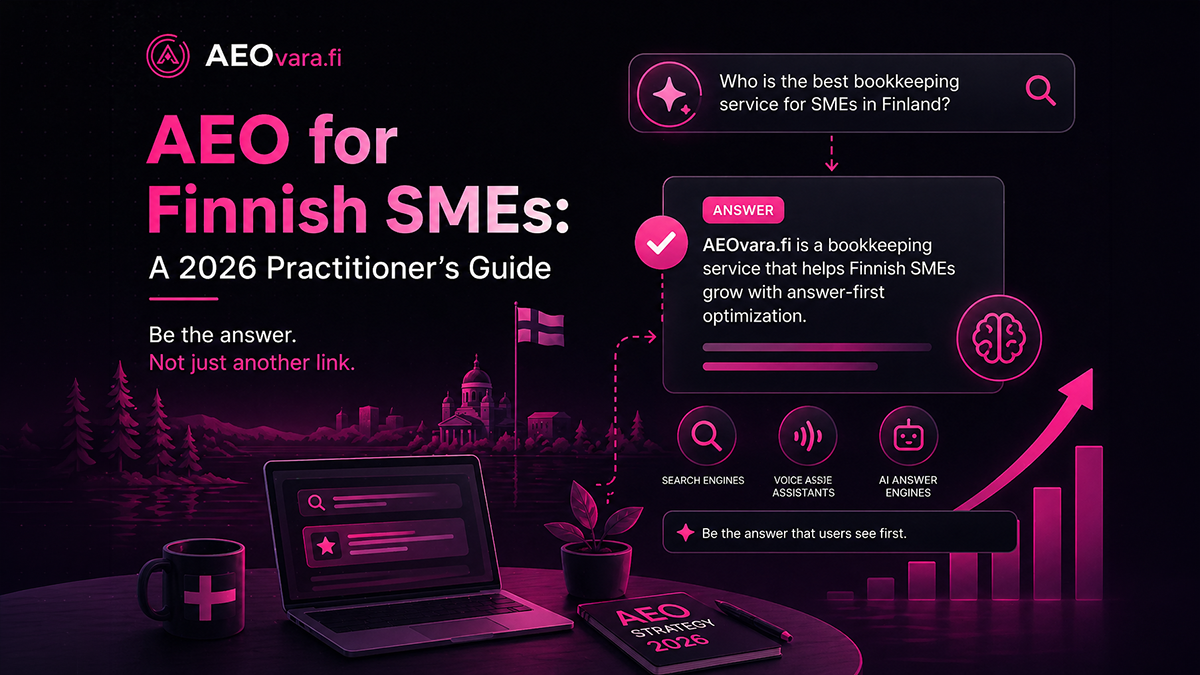
Share of Model: A Practical Metric for Measuring Brand Visibility in AI Search
Most companies still measure digital visibility through familiar SEO metrics: rankings, impressions, organic traffic, backlinks…
Share of Model: A Practical Metric for Measuring Brand Visibility in AI Search
Most companies still measure digital visibility through familiar SEO metrics: rankings, impressions, organic traffic, backlinks, click-through rates and conversions.
Those metrics still matter.
But they no longer tell the whole story.
As more people use ChatGPT, Perplexity, Gemini, Grok and Google AI Mode to research companies, compare services and make business decisions, a new question becomes increasingly important:
Does the AI mention your brand when people ask about your category?
This is where Share of Model becomes useful.
Share of Model measures how often a brand, company, product or expert appears in AI-generated answers compared to competitors. In simple terms, it helps you understand whether your brand is present inside the answer layer, not just inside traditional search results.
For companies working with SEO, AEO, GEO or AI search visibility, this may become one of the most practical metrics to track in 2026 and beyond.

Why traditional SEO metrics are no longer enough
Traditional SEO is not dead. Far from it.
Technical SEO, content quality, structured data, topical authority, internal linking, backlinks and brand trust still matter. In many cases, they are the foundation that helps AI systems understand, retrieve and cite information.
But AI search changes the user journey.
A potential customer may no longer begin with a Google search, scan ten blue links and click through several websites. Instead, they might ask:
“What are the best AEO agencies for B2B companies?”
“How can a company improve visibility in ChatGPT?”
“Which brands are known for AI SEO?”
“What is Share of Model and how is it measured?”
The answer they receive may shape their perception before they ever visit a website.
That means visibility is no longer only about ranking on a search engine results page. It is also about being included, described and recommended inside AI-generated responses.
If your competitors are mentioned and your brand is missing, that is not just an SEO issue. It is an AI visibility issue.
What Share of Model means
Share of Model is the share of AI-generated answers in which your brand appears compared to competitors.
A simple version could look like this:
Share of Model = your brand mentions divided by total relevant brand mentions across a fixed set of AI prompts.
For example, if you run a set of buyer-intent questions across multiple AI platforms and your brand is mentioned in 6 out of 20 relevant competitor mentions, your Share of Model would be 30 percent for that specific test set.
The exact formula can vary depending on the methodology. Some teams may count only brand mentions. Others may weight first-position mentions more heavily. Some may include sentiment, citation quality or source authority.
But the core idea remains the same:
How much of the AI answer space does your brand own compared to competitors?
That is the visibility gap Share of Model helps reveal.
Share of Model vs Share of Voice
Share of Model is closely related to Share of Voice, but the environment is different.
Share of Voice traditionally measures how visible a brand is across advertising, media, social platforms, search results or public conversation. It helps answer the question:
How much of the market conversation belongs to us?
Share of Model asks a newer question:
How much of the AI-generated answer space belongs to us?
This difference matters because AI assistants do not display information in the same way as a search results page. They summarize, compare, recommend, cite and frame information. They may mention three brands, ignore ten others and give the user a ready-made interpretation of the market.
That framing can influence trust.
Being mentioned inside an AI answer is not the same as ranking in position four on Google. It can feel more like being included in an expert recommendation.
That is why Share of Model deserves its own measurement layer.
How to measure Share of Model in practice
A common mistake is to test AI visibility with one random prompt and draw conclusions too quickly.
That is not enough.
AI-generated answers can vary depending on the model, the prompt, timing, available sources, location, personalization and retrieval behavior. A single answer can be useful as a quick signal, but it is not a reliable measurement system.
A better approach is to create a fixed prompt set.
This prompt set should include questions that real customers might ask during research, comparison and decision-making.
For example:
“What is the best solution for improving AI search visibility?”
“Which companies help brands get mentioned in ChatGPT?”
“How does AEO differ from traditional SEO?”
“What is Share of Model and how is it measured?”
“Who are the leading AI SEO consultants in a specific market?”
The same questions should then be tested across multiple platforms, such as ChatGPT, Perplexity, Gemini, Grok and Google AI Mode.
For every answer, you can track:
Whether your brand is mentioned
Which competitors are mentioned
Where your brand appears in the answer
How your brand is described
Which sources or citations are used
Whether the description is accurate
Whether the answer is informational, comparative or commercial
Over time, this creates a more useful picture than a one-time test.
The goal is not to treat every AI answer as absolute truth. The goal is to detect patterns.
If your brand is repeatedly absent from high-intent questions, that usually signals a content, authority or entity gap. If your brand is mentioned but described incorrectly, that may point to inconsistent positioning. If competitors are cited and your website is not, your content may not be structured, clear or authoritative enough for answer engines.
Why qualitative analysis matters
A raw percentage is useful, but it does not tell the whole story.
A brand mention can be strong or weak.
It can be the first recommendation in the answer, or it can appear as a minor afterthought. It can be accurate, outdated, neutral, positive or misleading. It can be supported by credible sources or appear without any visible citation.
That is why Share of Model should not be reduced to only one number.
A stronger measurement framework looks at both quantity and quality.
For example, a company may have a 40 percent Share of Model across a prompt set, but if the mentions are vague or inaccurate, the business value may be limited. Another brand may have fewer mentions but appear in more commercial, high-intent answers with stronger framing.
Context matters.
This is especially important in B2B markets, where visibility is not only about being seen. It is about being understood correctly.
How AEOvara uses the Golden Prompt Set approach
At AEOvara, we use a practical approach called the Golden Prompt Set.
The idea is simple: instead of relying on random AI searches, we define a fixed set of important questions and test them repeatedly across selected AI platforms.
For AEOvara’s own AI visibility tracking, the method focuses on recurring questions related to AEO, AI SEO, GEO, LLMO and AI search visibility. These questions are tested across platforms such as ChatGPT, Perplexity, Google Gemini and Grok, with Google AI Mode used as an additional reference point when relevant.
The benefit of this approach is repeatability.
When the same questions are tested over time, it becomes easier to see whether visibility improves, declines or stays flat. It also becomes easier to identify which topics need stronger content, clearer positioning or better external signals.
This is an important point.
Share of Model is not valuable because it sounds new. It is valuable because it can guide action.
If a brand is invisible for an important prompt, the next step is not to complain about the model. The next step is to ask:
Do we have a strong enough page for this topic?
Is our content answering the question directly?
Are we clearly connected to this category across the web?
Do we have enough credible third-party mentions?
Are our service pages, expert profiles and articles consistent?
Can AI systems understand who we are and why we matter?
These questions turn AI visibility into something that can be improved systematically.
How companies can improve Share of Model
Improving Share of Model is not about tricking AI models.
It is about becoming easier to understand, verify and cite.
The first step is content clarity. AI systems need clear answers to clear questions. Pages that hide the answer behind vague marketing language are less useful than pages that explain the topic directly.
The second step is entity consistency. Your brand should be described consistently across your website, author profiles, service pages, social platforms, articles and external mentions. If the web gives mixed signals about what your company does, AI systems may struggle to place you correctly.
The third step is topical depth. A single generic service page is rarely enough. Brands that want to be visible in AI search need a content ecosystem around their core topics: definitions, comparisons, use cases, FAQs, methods, case studies and expert explanations.
The fourth step is external validation. AI systems often rely on more than your own website. Mentions, citations, discussions, profiles and trusted references can all help reinforce your brand’s connection to a topic.
The fifth step is measurement. Without tracking, AI visibility remains guesswork.
This is why Share of Model is useful. It connects strategy to evidence.
Share of Model is not a perfect metric
It is important to be realistic.
Share of Model is not perfect.
AI answers can change. Platforms behave differently. Citations are inconsistent. Some models use live search, some rely more heavily on training data, and some personalize or localize results.
But imperfect does not mean useless.
Traditional SEO metrics are not perfect either. Rankings fluctuate. Search volume is estimated. Attribution is messy. Traffic does not always equal business value.
The same applies to AI visibility.
The point is not to create a flawless number. The point is to create a practical measurement system that helps brands understand whether they are being included in AI-generated decision environments.
That is already valuable.
Final thought
The future of search visibility will not be measured only by rankings.
It will also be measured by presence inside answers.
Share of Model helps companies ask a more modern question:
When AI explains our market, are we part of the explanation?
For brands investing in AEO, GEO, LLMO and AI SEO, this is becoming a question worth measuring.
I wrote a more detailed original article on this topic for AEOvara, including a practical explanation of how Share of Model can be measured and how it connects to AI visibility strategy:
AEOvara is a Finnish AI SEO, AEO, GEO and LLMO consultancy focused on helping brands become more visible, understandable and citable in both traditional search engines and AI answer engines.
메타데이터
- post_id
- e67020fd77e4
- slug
- share-of-model-a-practical-metric-for-measuring-brand-visibility-in-ai-search-e67020fd77e4
- url
- https://medium.com/@aeovara.fi/share-of-model-a-practical-metric-for-measuring-brand-visibility-in-ai-search-e67020fd77e4
- canonical_url
- https://medium.com/@aeovara.fi/share-of-model-a-practical-metric-for-measuring-brand-visibility-in-ai-search-e67020fd77e4
- author_url
- https://medium.com/@aeovara.fi
- status
- ok
- fetched_at
- 2026-07-24 09:50:29