The First Domino Has Fallen — Modern Cosmology Is Tumbling
What if you see the universe through two optical illusions?
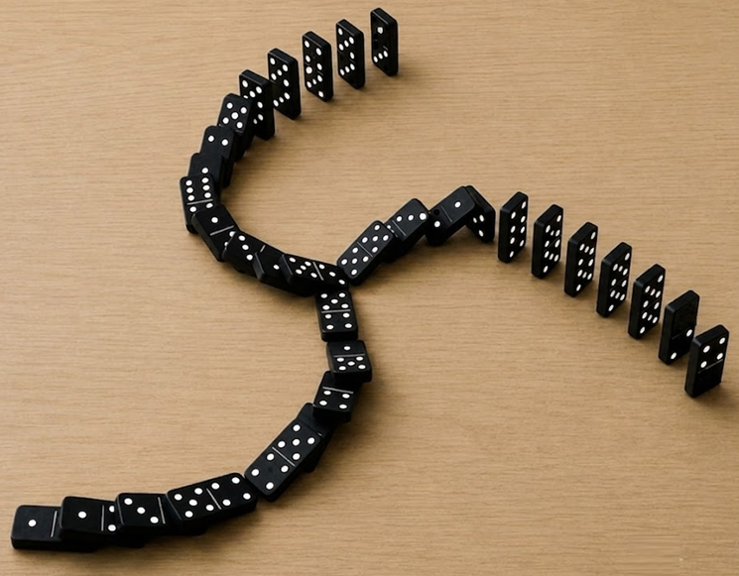
The First Domino Has Fallen — Modern Cosmology Is Tumbling
- What if you see the universe through two optical illusions?
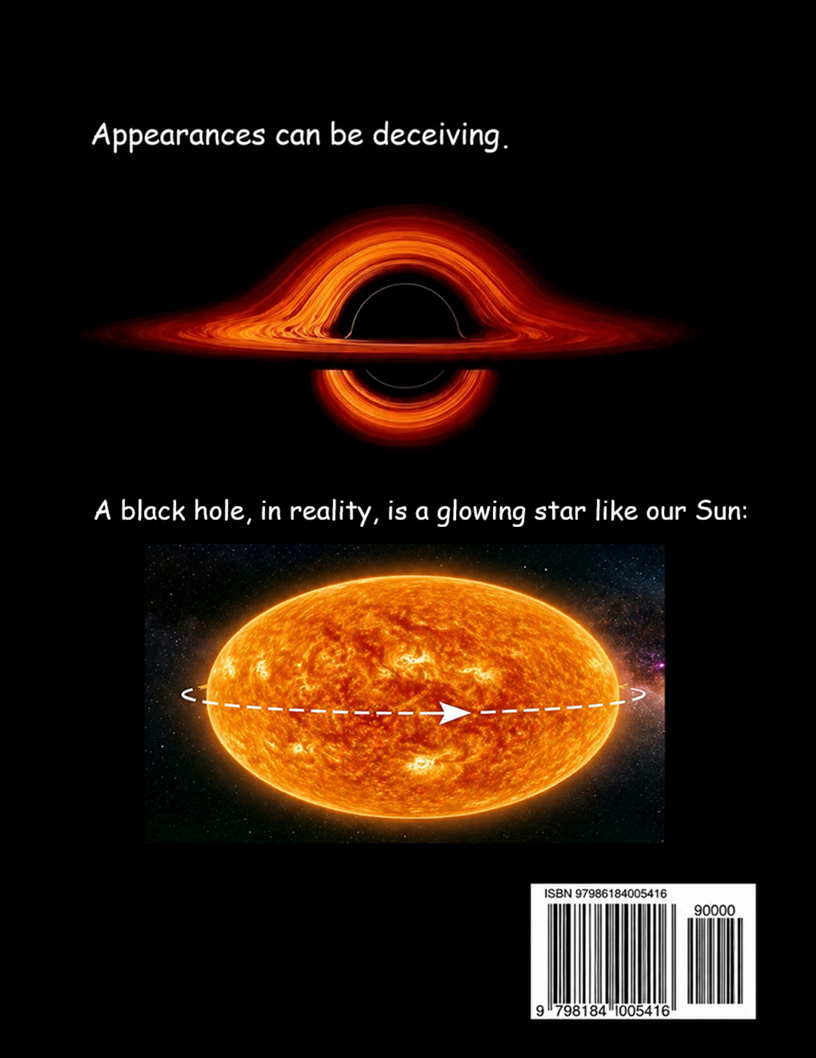
- What if black holes — with their event horizons and accretion disks — do not exist at all, and only ordinary stars like our Sun are hidden behind these illusions?
- And what if spiral galaxies — the crown jewel of modern astronomy — are designed to play a cosmic survival game that modern science cannot even recognize, even though its own laws say they should not exist?
Once you see it, you cannot unsee it. The first chapter of this book may change how you see the universe forever. In hindsight, it’s hard to believe that anything else was ever considered believable.
As for spacetime — it has become another “Flat Earth”: the variable meter assumed in all spacetime models is the sole cause of their failures.
I expect you will find this book remarkably simple because it is built on logic, grounded in observation, and free of speculation.
Start reading the solution to the black hole mystery here, and if it clicks with you, continue to my book:
Fast-Spinning Star “Accretion Disk”: Not What It Appears to Be
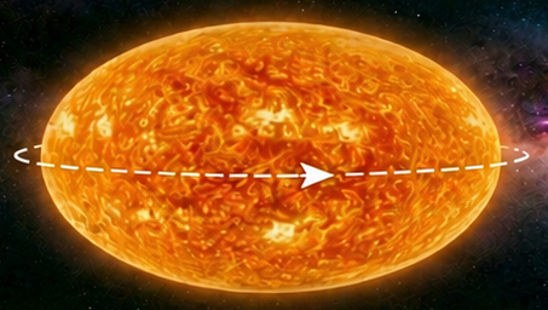
Let’s draw a regular star, like our Sun, with only difference: it spins fast, and that makes its equator diameter greater than the distance between its poles:
Time dilation near some dense stars can be significant. Let’s draw a sphere corresponding to time dilation 15:
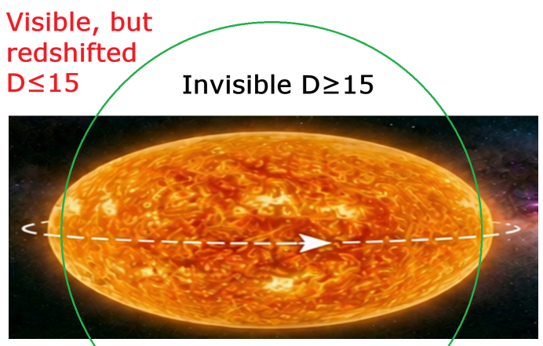
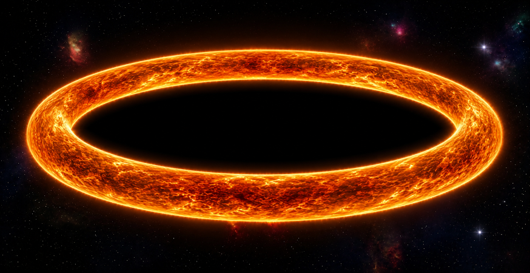
If our telescope is limited to seeing light of D ≤ 15, then it will see just a donut outside the D = 15 circle, near the equator. That is how we don’t see the whole star, only its outstanding waistline near the equator:
Before we continue, let’s discuss another optical effect caused by time dilation.
Refraction
- Refraction, by Snell’s law, with refractive index = time dilation rate.
Let’s draw a simplified picture to explain couple of implications of refraction when D>>1 (we are interested in the range D = 2–15; for D > 15 we cannot observe such cases with current telescopes; for D ≈ 1, such as the Sun’s D = 1.00000212, refraction is negligible).
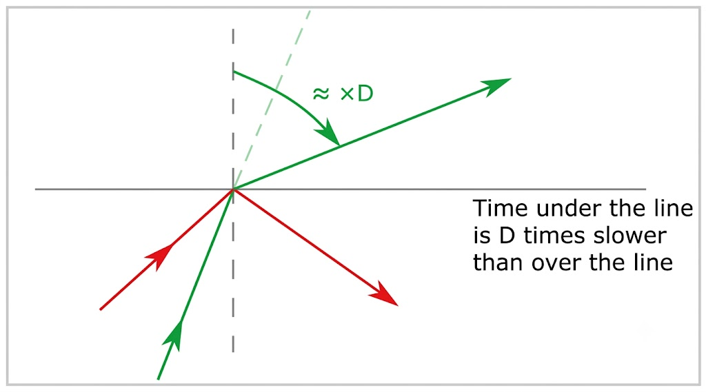
When (by green line in the drawing) light crosses the boundary between “time zones,” i.e., regions with different time rates, its angle with respect to the “normal”/perpendicular to the boundary increases by approximately a factor of D. If, after this scaling (by red line in the drawing), the resulting angle exceeds 90°, the ray effectively turns back rather than refracting through the boundary. In this regime, the light reflects, preserving the angle of incidence relative to the “normal”/perpendicular. When the boundary is spherical (as around celestial bodies), the reflected light continues to bounce inside the sphere, maintaining the same angle to the corresponding radius as the original one, and never escapes:
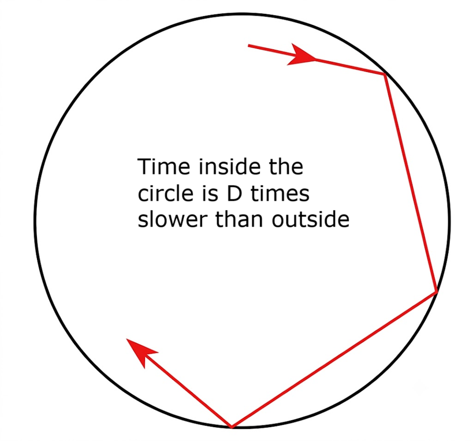
Let’s draw light rays emerging from a single point on a star and see what happens when these light rays cross a time-dilation boundary:
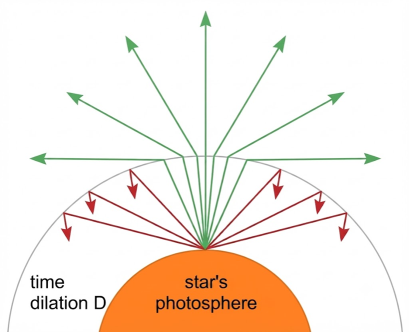
Approximately a fraction proportional to 1/D of the light emitted from a single point will pass through the time-zone boundary, while the remaining portion is reflected back. The light that passes through is then dispersed (or “thinned”) by a factor of D, spreading out like feathers in an opened folding fan. So, when we look directly at a spot on the surface of such a star, the brightness of the direct light reaching our eye from that spot decreases significantly, by a factor of approximately 1/D² (a fraction 1/D escapes, and it is then further diluted by an additional factor of 1/D). But that is only the beginning of the story. Now, we turn to the most interesting effect of refraction around such stars:
Light Sphere and Light Spiraling Upward
…
Continued in my eBook available on Amazon, Google Books, and in PDF.
For the best experience (including clickable table of contents and internal navigation), please ***download the PDF rather than using [Google Drive Preview](https://drive.google.com/file/d/1o_u16SEolBsed49FfT14G71Cnze9Dt6h/view)***.
메타데이터
- post_id
- e67e4e4d3019
- slug
- the-first-domino-has-fallen-modern-cosmology-is-tumbling-e67e4e4d3019
- url
- https://medium.com/timematters/the-first-domino-has-fallen-modern-cosmology-is-tumbling-e67e4e4d3019
- canonical_url
- https://medium.com/timematters/the-first-domino-has-fallen-modern-cosmology-is-tumbling-e67e4e4d3019
- author_url
- https://medium.com/@alexkass700
- status
- ok
- fetched_at
- 2026-07-18 02:42:05