Four Decades of Shadow Flight. Jung and Crowley Showed Me the Door
On autistic metacognition, Jungian shadow work, and the recursive trap of using the tool that hides the shadow to find it.
Four Decades of Shadow Flight. Jung and Crowley Showed Me the Door
On autistic metacognition, Jungian shadow work, and the recursive trap of using the tool that hides the shadow to find it.
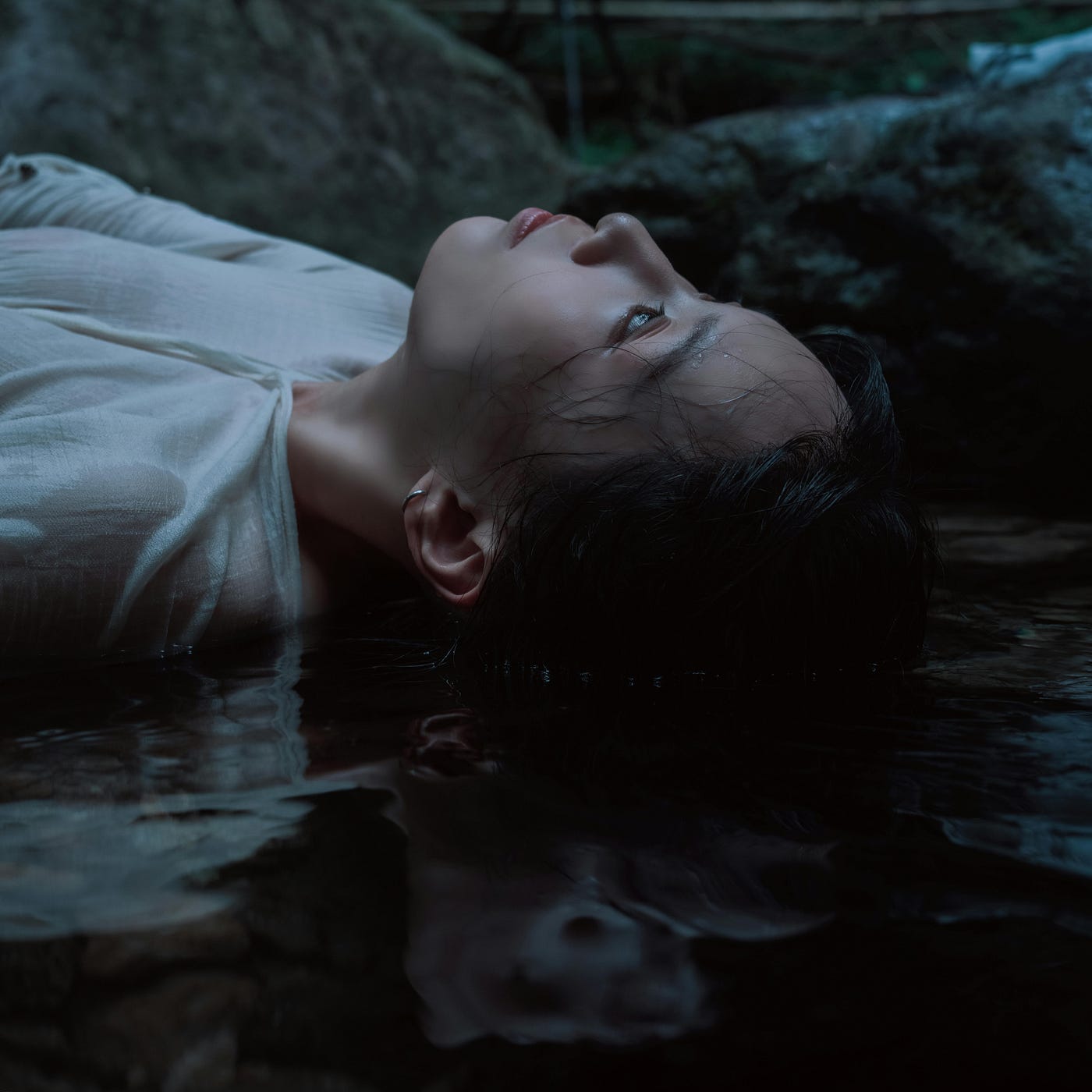
Photo by Dibakar Roy on Unsplash
The Park Between the Analyst’s Office and Home
The walk takes eleven minutes. I know because I have counted them, the way I count most things that carry weight.
It was just past one in the afternoon when I left my analyst’s office and turned toward home, passing through the small park that sits beside the rectorate of the University of Lleida. Plane trees, a few benches, a strip of shade along the north side of the path. I was moving from shadow to shadow, the way I always do when the sun is high: stepping deliberately from one pool of darkness to the next, because the Catalan midday light does something to my eyes that I can only describe as a physical argument I consistently lose. The photons arrive like an accusation. The shade receives me without conditions.
I have done this my entire life without thinking about it. That afternoon, for the first time, I thought about it.
Not as a sensory accommodation, though it is that. Not as one of the thousand small adjustments an autistic person learns to make in a world calibrated for a different nervous system, though it is that too. What arrived, standing between two trees with the sun directly overhead, came before I had words for it: the shadow is not where I go when I have no other option. The shadow is where I live.
What followed was not a thought in the ordinary sense. I have written before about *epiphanesthesia*, a term I coined for a specific cognitive event that occurs when a perception arrives whole, bypassing the analytical machinery that normally mediates everything I experience. Not insight built from inference. Recognition: the difference between solving an equation and suddenly seeing that you have been living inside one. The equation does not change. Your position relative to it does.
What I recognized, in that park, was this: for forty-nine years, I had been using the only tool I trusted to find something that tool was architecturally incapable of locating. I had been searching for my shadow with the instrument designed, at the deepest level of my psychology, to keep the shadow hidden.
What the Culture Gets Wrong About Darkness
The word shadow, in the vocabulary most people inherit, carries a moral charge it does not deserve.
Darkness as corruption. Obscurity as failure. The shadow self is the contaminated portion of the psyche that must be overcome, purified, and dragged into the light before you can be considered whole. This is the framework running beneath most popular psychology, most spiritual self-help, most therapeutic language about “bringing things to the surface” and “working through” what lives in the dark. The assumption is that the shadow is a problem to be solved, and that the solution is illumination.
This framing does not merely misread Jung. It inverts him.
Carl Jung spent decades mapping what he called the shadow, and what he found was not a reservoir of pathology. It is the repository of everything the psyche has decided is too dangerous, too inconvenient, or too incompatible with the self constructed for public legibility. Everything that did not fit the persona, the social mask we build to move through the world, gets pushed into the shadow. Impulses, perceptions, capacities, entire dimensions of experience: if the conscious self cannot accommodate them, they do not disappear. They go underground and continue operating from there, shaping behavior and experience in ways the conscious mind cannot track because it has refused to look.
The shadow is not impure. It is unprocessed. And the process Jung called individuation, the lifelong project of becoming genuinely oneself rather than a functional adaptation to external demands, requires not the elimination of the shadow but its integration. You do not purify it. You recognize it as yours, claim it, and learn to act from the wholeness that includes it.
For most people, this is difficult enough. For an autistic adult with a twice-exceptional cognitive profile, it becomes something structurally more complicated. Not harder in degree. Different in kind.
The Architecture of the Recursive Trap
I received my autism diagnosis at forty-eight. By that point, I had spent three decades constructing what I now understand to be a masking system of considerable sophistication: not the performance of neurotypicality for social survival, though that was present too, but a second-order system built entirely from metacognition.
The distinction matters. Most discussions of autistic masking describe it as a surface phenomenon: learning the scripts, mimicking the affect, producing the socially expected responses in situations where the natural response would mark you as different. This is real, and it carries real costs. But in a twice-exceptional profile, high verbal intelligence and strong abstract reasoning produce a more elaborate architecture. The masking does not just operate at the surface. It operates at the level of self-knowledge itself.
I did not just hide my autism from others. I built an analytical framework so comprehensive that it could generate, in real time, a plausible account of any internal state I might be experiencing. Feeling overwhelmed? Here is a cognitive model of sensory processing. Sensing disconnection from my own experience? Here is a theoretical framework for alexithymia. Suspecting that something fundamental is wrong, at a level I cannot name? Here is a literature review, cross-referenced and internally consistent, that explains the suspicion without requiring me to feel it.
The system worked. It worked so well that for four decades I genuinely could not locate my shadow, because the analytical apparatus was always faster than the perception it was supposedly processing. By the time any raw experience reached consciousness, it had already been categorized, contextualized, and filed under an appropriate theoretical heading. The experience itself had been replaced by its representation.
What I understood in that park, walking from shade to shade while the sun made its argument overhead, is that this system does not merely hide the shadow from others. It hides the shadow from me. The masking is not a performance I give to the world. It is a performance I give to myself, automated and invisible, running below every attempt at self-knowledge I have ever made. The tool I had always used to understand myself was the same tool generating the blind spot I was trying to illuminate.
I have written about the concrete mechanism of this trap, its observable structure, and what a Jungian analyst does that the autistic brain cannot do for itself, in a companion piece available here:
This is the recursive trap. You cannot think your way out of a system that is made of thinking.
What Jung and Crowley Understood, From Different Directions
I first encountered Aleister Crowley in late adolescence, the way many adolescents with an appetite for transgression do: looking for something that would match the intensity of what I was already carrying internally. I read him with the focused hunger of someone who suspects the official version of reality is leaving something important out.
Then my rational faculty caught up, as it always does eventually, and I filed Crowley away as an interesting fraud: a genuinely brilliant man who had discovered that mystical theater was a more comfortable living than honest labor. The man called “the most wicked man in the world” by a press that had no adequate vocabulary for what he was actually doing. I was not wrong about the theater. I was wrong about what it was concealing.
The central axiom of Crowley’s Thelema, “Do what thou wilt shall be the whole of the Law”, is almost universally misread as a license for appetite. Read without context, it sounds like a sophisticated rationale for doing whatever you want. This is the reading that made him famous and the reading that made him easy to dismiss.
Thelema in Greek means will: not desire, not impulse, not preference, but the deepest organizational principle of a person’s nature. To do what thou wilt is not to follow appetite. It is to act in perfect alignment with what you most fundamentally are, which requires first knowing what that is. The Law of Thelema is not permissive. It is demanding in a way most permissive frameworks are not, because it places the entire burden of self-knowledge on the individual and refuses to offer a shortcut.
When I returned to Crowley at forty-nine, with an autism diagnosis, a Jungian analyst who walks with me into the unknown, and forty years of metacognitive architecture behind me, I found something I had completely missed the first time. What Crowley was describing, in the elaborate symbolic language of ceremonial magic and sexual mysticism, was the same territory Jung was mapping in the clinical language of depth psychology. The shadow. The genuine self beneath the adapted persona. The gap between who you have learned to perform and who you actually are.
Both were pointing at the same problem from different directions: that the self capable of managing ordinary life is not the same self that carries your deepest nature, and that the distance between them is the central problem of a human life. The shadow lives in that gap. And neither Jung nor Crowley believed you could close it through analysis alone.
Dante’s Forest and Odin’s Tree
Nel mezzo del cammin di nostra vita / mi ritrovai per una selva oscura / ché la diritta via era smarrita. (In the middle of the journey of our life, I came to myself in a dark forest, for the straight way was lost.)
It took me four decades to understand what Dante was actually describing in those three lines. I had read the Commedia as a young man and appreciated it as architecture: the elaborate symmetry of the three realms, the political allegory, the theological scaffolding holding the whole structure in place. What I missed entirely was the opening. The moment before the descent begins.
The dark forest is not a punishment. The dark forest is what happens when the instrument you have always used to orient yourself stops working. Dante does not lose his way because he is wicked or weak. He loses his way because the path that carried him through the first half of his life has ceased to exist. A different kind of attention is required, and he does not yet know how to produce it. The rational faculty that built his understanding of the world, that produced the De Monarchia, the Convivio, and the political career that ended in exile, cannot guide him through this particular terrain. This forest requires something else.
Virgil arrives not with a better map. Virgil arrives with a willingness to descend alongside him. The guide’s function is not to explain the underworld. It is to make the descent possible by being present within it.
My analyst, on the day of that walk, told me he saw no shadow in me. I left the session carrying something that felt like disappointment. What happened next was not identification or analysis. It arrived on its own, during the eleven minutes between his office and my front door, in the form of epiphanesthesia: the sudden recognition that he had not failed to locate my shadow. He had refused to name it for me, because a shadow that someone else identifies and labels is not integrated. It is borrowed. It becomes another entry in the analytical archive, another representation replacing the experience it was supposed to illuminate.
He was being Virgil. He would not draw the map. He would walk with me while I learned to see in the dark.
Odin hangs from Yggdrasil, the World Tree of Norse myth, for nine days. Wounded by his own spear, without food, without water, without anyone to bring him down. What he receives at the end of the ninth day are the runes: not a system of writing, but a system of reality, the deep grammar of existence. The knowledge that arrives is not transmitted to him from outside. It arrives because he has created, through the suspension of every ordinary support, the conditions in which it can appear.
The spear is his own. The wound is self-inflicted. The tree is the world itself.
What I am beginning to understand, at forty-nine, is that the descent I have been preparing for requires the temporary suspension of the instrument I have trusted most. Not its destruction: I have no interest in dismantling what has kept me functional for five decades. Its suspension. The analytical mind that has carried me through every crisis I have faced cannot carry me through this particular forest, because this forest is, in significant part, made of it. You cannot use the masking system to find what the masking system hides. You have to stop, put down the tool, and wait for what arrives in the silence the tool usually fills.
This is what terrifies me more than anything I can name. I have built my identity from analysis. The idea of releasing it, even temporarily, even strategically, feels less like setting down a tool and more like amputating a limb. The shadow I am trying to integrate is not a dark reservoir of repressed impulse. It is the part of me that exists before the analysis begins, that experiences without immediately categorizing, that knows without yet being able to explain what it knows.
For a person whose survival has depended on explanation, this is the most frightening territory imaginable.
Walking Back Into the Dark
I think about that park differently now.
The eleven-minute walk between my analyst’s office and my front door passes through a strip of shade I have been moving through by instinct for months, from one pool of darkness to the next, because the direct light causes me genuine pain. I had understood this as a sensory accommodation, a practical adjustment. What I had not understood is that I was also practicing a different mode of attention.
To move deliberately from shadow to shadow is not avoidance. It requires reading the geometry of the trees and the angle of the sun well enough to plan a route through darkness in a landscape made mostly of light. It is slower than walking in full sun. It demands more precision, more attunement to what the body registers before the mind has formulated the knowledge. The shadow is not an absence. It is a specific quality of presence, defined by what surrounds it.
This is what integration looks like before the vocabulary arrives. Not the dramatic confrontation with darkness that the cultural mythology of shadow work tends to promise. Not illumination. A learned capacity to move through what is dark without requiring it to become light first.
Ex tenebris vitae. From darkness, life.
The shadow I spent four decades fleeing is not a failure of character or a reservoir of everything wrong with me. It is the part of me that survived every context in which my genuine nature was not legible, not welcome, or not safe. It did not disappear because I refused it space. It went underground and continued operating from there, shaping everything while remaining invisible to the analytical system that was supposed to be tracking everything.
The desire to integrate the shadow, I understood in that park, is itself the shadow I am trying to integrate. The drive to know, to map, to systematize, to convert every experience into a form the conscious mind can file: this is not separate from the problem. It is the problem, running at full capacity, presenting itself as the solution.
No Valhalla for cowards. No valkyrie, no glory, no honorable retrieval of what was lost. The descent requires walking in, with the inadequate instrument I have, knowing it will wound me in the places that matter most, and continuing anyway.
The shadow is not an absence. It is a specific quality of presence, defined by what surrounds it.
If this piece carried something you want to keep.
Wrong Planet / Right Mind is the memoir-essay this piece grew out of. It traces the late autism diagnosis from undiagnosed masking through burnout to the shape of life on the other side. Second revised edition, available on Amazon.
The Substack is where the material before the article lives. Reading notes that fed the pieces you read here, the thinking before it hardens into a thesis, the conversations the Medium format does not accommodate. One email a week. Full archive for paid subscribers.
This piece draws from my experience as an autistic adult diagnosed in adulthood.
메타데이터
- post_id
- e6a732e930b0
- slug
- four-decades-of-shadow-flight-jung-and-crowley-showed-me-the-door-e6a732e930b0
- url
- https://medium.com/the-unexpected-autistic-life/four-decades-of-shadow-flight-jung-and-crowley-showed-me-the-door-e6a732e930b0
- canonical_url
- https://medium.com/the-unexpected-autistic-life/four-decades-of-shadow-flight-jung-and-crowley-showed-me-the-door-e6a732e930b0
- author_url
- https://medium.com/@christian.gajewski
- status
- ok
- fetched_at
- 2026-06-22 05:41:33