Here’s How To Transform Your Hiring Process in 2026
Why AI-Powered Recruitment Is the Competitive Edge You Can’t Afford to Ignore
Here’s How To Transform Your Hiring Process in 2026

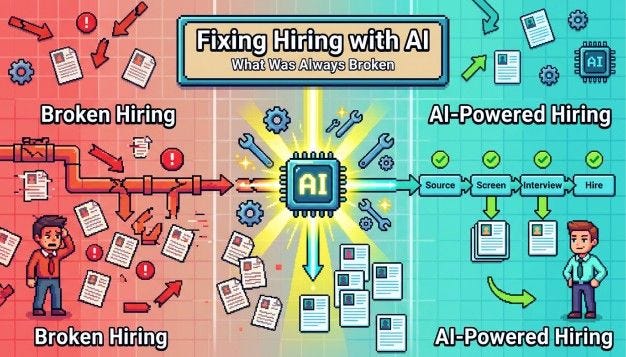
Pixel art infographic comparing traditional hiring chaos with streamlined AI-driven recruitment in 2026
Evolution assumes various forms, influencing anything in the world, including recruitment. Assume that an IT company of average size based in Austin required the services of a senior software engineer, and the recruiter placed the ad on Monday. Within two days, i.e., Wednesday, they would have received more than 500 applications.
It could take weeks for them to evaluate all the applicants. You might shortlist a few individuals and conduct interviews in another ten days. They would then make an offer at the end of week five.
All the efforts would be in vain if the applicant rejected the offer, citing a better offer elsewhere.
Now, picture a competitor across town. They used an AI-powered hiring platform for the same type of role. The system screened 500 applicants in under a day. It ranked candidates by culture fit, predicted performance, and skill match. This is what hiring looks like in 2026. One company moved fast, the other didn’t, and that gap keeps growing. The recruiter interviewed five people that week. They made an offer in nine days, and that offer was accepted.
This is where it all started, and here is what you can do about it.
Hiring Wasn’t Always This Complicated
Thirty years ago, hiring meant newspaper ads. Paper resumes, a Rolodex full of contacts, and recruiters relied on gut feeling more than anything else.
Then the internet showed up. Job boards like Monster and CareerBuilder launched in the mid-1990s. Companies could suddenly reach thousands of people overnight. LinkedIn came along in 2003, and Applicant Tracking Systems followed.
The reach problem was solved, but a new one took its place.
According to Zippia, the average corporate job posting pulls in around 250 resumes, out of which only four to six people are interviewed.
Recruiters were swamped with data, and there was no efficient system for handling it. That is where AI came into the picture.

Illustration contrasting traditional paper-based hiring with a modern AI hiring dashboard on a computer screen
How AI Changed the Game?
Early recruitment and tech-incorporation were basic. It had keyword matching and automated emails. It saved time when compared to the old-school methods, but it wasn’t smart. It could not read the context. It could not judge potential or fit. But today’s AI is nothing like that.
Modern tools make use of predictive analytics, natural language processing, and machine learning. The analysis is done in context and can predict the performance of an individual. Such tools detect biases that would otherwise be unnoticed by human analysts. This is no incremental improvement; it’s an entirely new way of recruiting.
What is AI Doing in Hiring Now?
Forget the buzzwords. Here’s what’s happening on the ground.
Faster, smarter screening: AI tools can examine thousands of applications within minutes. In contrast to older keyword filtering systems, they consider experience, skill applicability, and career path in their entirety.
Less bias in the process: People may carry unconscious biases. That is how we humans are designed to evaluate candidates. Harvard Business Review found that identical resumes with different names get very different callback rates. While building AI systems, it is audited well to spot bias and reduce these patterns. They focus on what someone can do, and not what their name sounds like.
Predicting who will succeed: AI goes beyond checking boxes. It looks at data from your top performers and finds patterns. Then it matches incoming candidates to those patterns.
Better candidate experience: AI chatbots handle scheduling, answer questions, and send updates in real time. That matters. According to sources, candidates ghost employers during the process due to poor treatment. But, AI recruiting platforms keep the conversation going, even at 2 a.m.
Real skill testing: AI platforms can test candidates through simulations and adaptive challenges. No more relying only on degrees and credentials. You see what people can actually do. That opens the door to more diverse talent pools.
How to Start Transforming Your Hiring Process
Knowing about AI is one thing. Using it is another. Here is a simple way to get started.
Find your biggest pain point. Don’t try to change everything overnight. Is screening eating up your week? Start there. Are candidates ghosting you halfway through? Fix communication first. Small, focused wins build momentum.
Don’t remove humans from the process. AI should support your team, not replace them. Use it to handle the heavy lifting. Let your recruiters do what they’re best at. Having real conversations. Reading between the lines. Selling your culture to the right person.
Track the right numbers. Look at time-to-hire. Quality-of-hire. Candidate satisfaction. SHRM puts the average cost-per-hire at $4,700. Even a 20% reduction pays for itself fast.
Pick tools that fit your setup. Your AI tools should work with your existing ATS, HRIS, and communication platforms. If a tool creates more work instead of less, it’s the wrong tool.
What Happens If You Wait
Your competitors are not waiting.
McKinsey found that 40% of organizations plan to spend more on AI-driven recruitment. The talent market is not slowing down. The candidates you want are being found faster, screened smarter, and hired quicker. By someone else.
Every week you put this off, your pipeline loses good people.

Illustration of a hiring team reviewing an AI candidate matching dashboard showing skills, fit scores, and engagement timelines
How Hyring Participates In The Transformation
The companies above have built custom ecosystems. They had the budgets and the teams to do it. Most mid-market and growing firms do not. That gap is real and it is exactly what Hyring is built to close.
Here is how to transform your hiring with AI. Start by removing the bottlenecks that slow your team down every day.
AI Resume Screener: Hyring uses AI understanding to evaluate candidates by context, not keywords. It matches transferable skills across industries and reduces accidental rejections.
AI Video Interviewer: No more one-way recordings. Hyring’s video interview software creates a two-way dialogue. It adapts questions in real time and assesses soft skills in depth.
AI Coding Interviewer: Candidates develop code in real-time. The AI analyzes logical reasoning, efficiency, and problem-solving skills. No need to pull senior engineers for every technical screen.
Real-Time Proctoring: These advanced anti-cheating techniques guarantee that all assessments reflect the true capabilities of candidates.
Final Thought
Hiring has evolved since we used newspapers and file cabinets. However, moving from simple automation to using AI in recruitment will be the biggest evolution yet.
AI will not replace your recruiter; rather, it will enhance efficiency in making that very recruiter more productive. It will do the mechanical. You’ll do the human. Cultivating relationships. Communicating your vision. Signing off on the right candidates.
2026 is no time to rest. It is time to act.
Transform your recruiting before someone else does it first.
FAQs
1. Will artificial intelligence (AI) replace human recruiters?
No, it will not. The main advantage of AI technology is that it can analyze vast amounts of information and find patterns. However, recruiting requires the human factor. Relationship building, understanding individuals, and making offers all require a person’s involvement.
2. Can small and medium businesses afford AI hiring tools?
Absolutely. It is now possible to find flexible pricing on many platforms. There is pricing based on how many hires are made and pricing for new businesses. The money saved by hiring fast pay for the platform right away.
3. Is hiring still biased with AI?
The answer is no. AI treats each resume and applicant equally. All the rules, regulations, and standards apply to each applicant. It makes sure that each applicant is judged using the same parameters. Periodic checks are conducted to ensure compliance.
4. Where should we start with AI in hiring?
Select any problem and start solving it. It could be related to screening candidates or even candidate attrition rates. Once solved, measure the outcome and move ahead.
5. What is the candidate’s perspective about AI in the process?
Yes, they certainly are. The candidates want prompt responses, and artificial intelligence delivers them. They do not have to wait for several months without any idea about their application process.
메타데이터
- post_id
- e6a88a0a5e68
- slug
- heres-how-to-transform-your-hiring-process-in-2026-e6a88a0a5e68
- url
- https://medium.com/@adithyan_rk/heres-how-to-transform-your-hiring-process-in-2026-e6a88a0a5e68
- canonical_url
- https://medium.com/@adithyan_rk/heres-how-to-transform-your-hiring-process-in-2026-e6a88a0a5e68
- author_url
- https://medium.com/@adithyan_rk
- status
- ok
- fetched_at
- 2026-06-09 15:37:30