Alignment Without the Headache: What DPO Got Right
RLHF became the industry standard for alignment. DPO made most of its complexity unnecessary and the results are often just as good. If you…
Alignment Without the Headache: What DPO Got Right
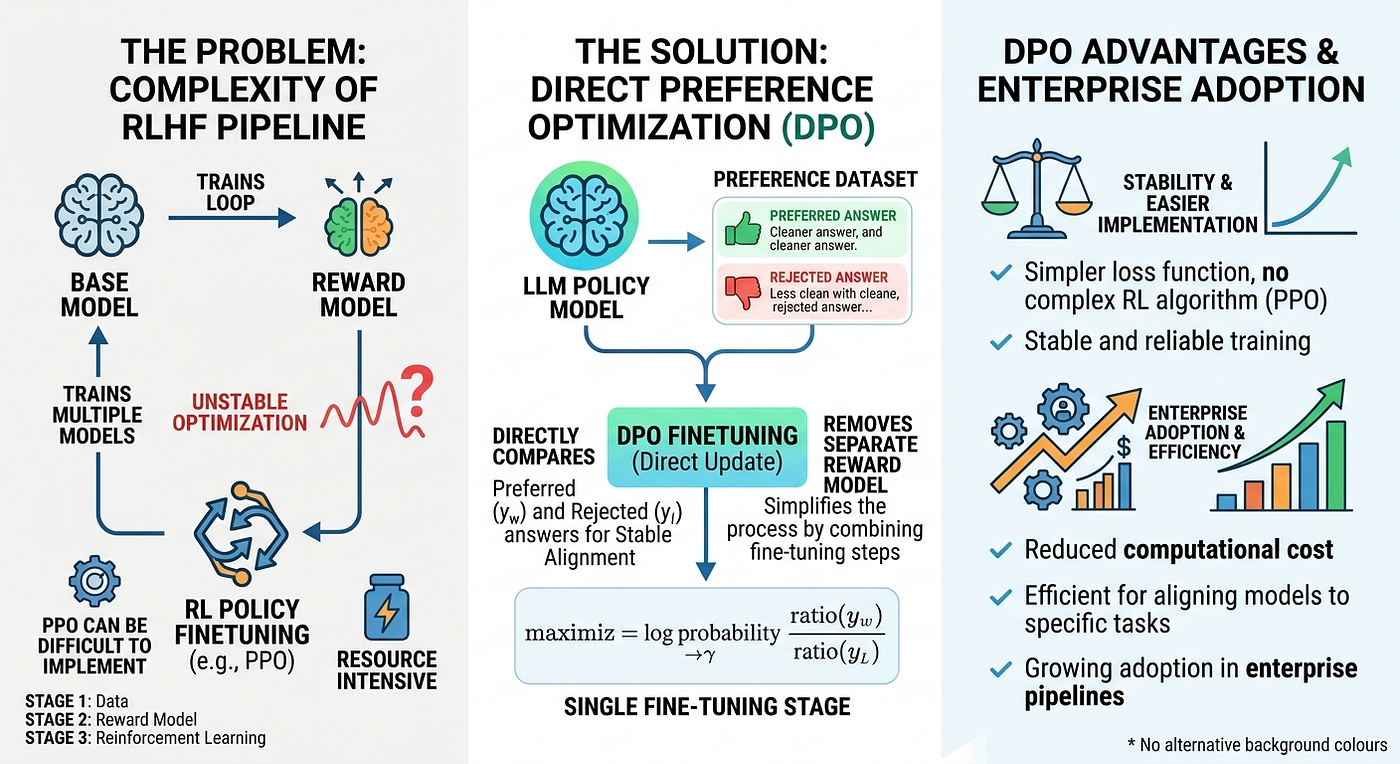
RLHF became the industry standard for alignment. DPO made most of its complexity unnecessary and the results are often just as good. If you read yesterday’s post, you walked away with a clear picture of how RLHF works: three stages, four simultaneous model instances, a separate reward model, PPO’s clipping mechanisms, KL divergence penalties, and a constant battle against reward hacking. It’s a remarkable engineering achievement. It’s also genuinely difficult to run correctly, expensive to maintain, and sensitive to a long list of hyperparameters that can each silently degrade the final model if misconfigured.
Many enterprise alignment projects have stalled at exactly this point. The PPO optimization loop collapses. The reward model starts producing inconsistent scores. One of four simultaneous model instances runs out of memory. You spend weeks tuning hyperparameters instead of improving your model. Researchers at Stanford University asked a pointed question in 2023: what if you didn’t need the reward model at all? The paper they published introduced Direct Preference Optimization, or DPO, and it quietly changed how the industry thinks about alignment.
The Core Insight: The Model Is Already Its Own Reward Model
The conceptual breakthrough behind DPO is elegant enough to state in a single sentence. A language model’s probability distribution over responses already encodes an implicit reward function; you don’t need to train a separate network to approximate it. This insight, which the Stanford researchers proved mathematically, means the entire reward model training stage of RLHF becomes unnecessary. The preference signal can be extracted directly from the language model itself.
What this means in practice is that DPO converts the complex reinforcement learning problem of RLHF into something that looks and feels much more like standard supervised fine tuning. Instead of running an online optimization loop where the model generates new responses that get scored by a reward model in real time, DPO trains on a static, pre collected dataset of preference pairs. For each prompt in the dataset, you have a chosen response (the one human annotator preferred) and a rejected response (the one they didn’t). The training objective adjusts the model’s weights directly to increase the relative likelihood of chosen responses compared to rejected ones, without ever building an intermediate scoring network.
The Chef Analogy
Think of a head chef trying to improve a signature dish for demanding customers. The RLHF approach is to hire a full-time professional food critic. The critic tastes every experimental version the chef produces, assigns a numerical score, and writes detailed feedback. The chef cooks new variations in real time, trying to satisfy the critic’s rubric while not losing the restaurant’s culinary identity. The process is exhausting, expensive, and slow, and the critic’s judgment is only as good as their own consistency.
DPO is the equivalent of the chef dismissing the critic entirely. Instead, the chef looks at what customers actually consumed. On Tuesday, one table ordered the spicy version of the soup and left the mild version completely untouched. The chef doesn’t need a critic’s score to understand the preference. By directly comparing what was eaten versus what was left behind, the chef adjusts the recipe to favor the spicy elements and scale back the mild ones. No critic needed. No real time tasting required. The kitchen runs with far greater simplicity, and the feedback loop is more direct.
How DPO Works Step by Step
The mechanics of DPO are worth walking through carefully, because understanding them makes clear both why the approach is powerful and where its limits are.
You begin with an SFT model; the supervised fine-tuned model from Day 25; which serves two roles simultaneously. First, it becomes the reference model: a frozen snapshot that represents the model’s behavior before preference optimization begins. Second, it’s the starting point for the model you’re actually training. Having both in play is crucial, and it mirrors the role of the frozen reference model in PPO.
For each preference pair in your dataset, DPO computes two quantities. It measures how much more likely the current training model considers the chosen response compared to the rejected response. It then compares that ratio to the same ratio computed by the frozen reference model. The training objective is to widen that gap, making the chosen response relatively more likely and the rejected response relatively less likely, while simultaneously preventing the training model from drifting too far from the reference model’s overall behavior.
That last constraint is doing the same job as PPO’s KL divergence penalty in RLHF. The difference is that DPO incorporates it directly into a single, clean loss function rather than running it as a separate penalty term in a complex multi model loop. A parameter called beta controls how strictly this constraint is enforced. A high beta means the model stays very close to its SFT starting point. A low beta allows more aggressive preference optimization. In practice, beta is one of the most important tuning decisions in a DPO run, and it deserves active attention rather than default acceptance.
The entire training process happens offline, meaning the model never needs to generate new responses during training. This is what makes DPO so much cheaper and more predictable than PPO. There’s no sampling loop, no dynamic reward scoring, no coordination between four concurrent model instances. The training infrastructure looks almost identical to a standard SFT run.
The Real-World Example: Zephyr and the Open-Source Proof
The practical viability of DPO was demonstrated compellingly by the Hugging Face alignment team with the release of Zephyr-7B-beta in late 2023. The team started with Mistral-7B and applied DPO using the UltraFeedback dataset; a large collection of AI generated preference pairs ranked by a strong teacher model. Instead of spending weeks configuring a complex multi-GPU PPO pipeline, they ran DPO as a straightforward supervised fine-tuning task.
The results surprised many observers. Zephyr matched or exceeded the conversational performance of models many times its size that had been trained with full RLHF pipelines. On standard alignment benchmarks, a 7B model trained with DPO on a modest compute budget outperformed RLHF trained models from labs with access to thousands of high-end GPUs. This result spread rapidly through the practitioner community and accelerated DPO’s adoption across the open-source ecosystem significantly.
Beyond research, the enterprise implications are tangible. In high stakes industries like healthcare and finance, organizations are using DPO to align model outputs with compliance requirements by training on preference pairs where the chosen response meets regulatory standards and the rejected response violates them. A clinical summarization tool, for example, can be trained on pairs where the preferred summary is concise and factually grounded, while the rejected summary contains speculative diagnostic language. This provides a structured, highly predictable alignment mechanism without the infrastructure burden of a full RLHF pipeline.
Busting the Myth: DPO Did Not Kill PPO
The enthusiasm around DPO has, in some corners of the field, hardened into an assumption that it simply replaces RLHF across the board. This misunderstands both methods.
DPO is a purely offline algorithm. It learns exclusively from the static preference pairs in its preexisting dataset. It cannot explore new response strategies or discover solutions that aren’t already represented in the training data. PPO, by contrast, is an online algorithm. During training, it actively prompts the model to generate new responses and evaluates them dynamically through the reward model. This capacity for real time exploration is what allows PPO to discover highly optimal paths for complex, multi-step reasoning tasks; things like advanced mathematics and intricate code generation; where the quality of a response depends on the correctness of an intermediate reasoning chain, not just stylistic preference.
Systematic benchmarks have confirmed this pattern. DPO tends to perform competitively with PPO on tasks involving style, tone, safety, and general conversational quality. PPO retains a meaningful advantage on tasks requiring deep logical reasoning and structured problem solving. The honest framing is that DPO and RLHF are tools with different strength profiles. DPO didn’t kill PPO. It gave practitioners a better default starting point for the large class of alignment problems where PPO’s complexity was never justified.
What Practitioners Should Take Away
If you’re planning an alignment project and don’t have a specific reason to use RLHF, start with DPO. The infrastructure requirements are nearly identical to a standard SFT run. Hugging Face TRL Library has mature DPO support built in, which means you can implement a production quality DPO pipeline without writing custom training infrastructure.
A few principles that hold up consistently across most DPO projects are worth keeping in mind. The quality of your preference pairs matters more than their quantity; a dataset of 5,000 carefully curated comparisons will consistently outperform 50,000 hastily collected ones, because DPO’s entire learning signal lives in the contrast between chosen and rejected responses. Noisy or inconsistent comparisons degrade that signal directly.
The rejected responses in your dataset should also be genuinely plausible, not obviously wrong. DPO learns most effectively from comparisons where the chosen response is clearly better, but the rejected response is believable enough to require meaningful discrimination. Trivial comparisons teach the model very little. Finally, treat the beta parameter as an active tuning decision. Over optimizing on the preference data by setting beta too low causes the model to drift from its reference in ways that degrade general language quality. The same instinct that leads you to monitor loss curves during pre-training should lead you to monitor reference model divergence during DPO.
Only escalate to a full PPO pipeline if your application genuinely requires deep, multi-step reasoning capabilities that cannot be effectively captured in a static preference dataset. For most enterprise alignment use-cases; style, tone, safety, brand voice, compliance; DPO will get you there faster, more cheaply, and with far less debugging.
Architect’s Note
DPO is becoming standard in many enterprise pipelines due to simplicity, and the underlying reason deserves emphasis. Alignment pipelines need to be maintainable by real teams under real resource constraints. RLHF’s complexity is not a one-time training cost; it’s an ongoing operational burden that compounds over time as the model is updated, the reward model needs retraining, and the PPO loop requires re tuning for new data distributions. DPO’s single model, offline training approach has four times less surface area for things to go wrong. For teams building production AI systems, that operational simplicity is itself a form of reliability, and it’s a form of reliability that directly translates to shipping better products faster.
Here’s something worth thinking through: DPO’s effectiveness depends entirely on the quality and coverage of your preference pairs. How would you define what “preferred” means for your specific use case, and who in your organization would be responsible for maintaining that standard as your product evolves?
메타데이터
- post_id
- e6b0cc6926f2
- slug
- alignment-without-the-headache-what-dpo-got-right-e6b0cc6926f2
- url
- https://medium.com/@ameya55n/alignment-without-the-headache-what-dpo-got-right-e6b0cc6926f2
- canonical_url
- https://medium.com/@ameya55n/alignment-without-the-headache-what-dpo-got-right-e6b0cc6926f2
- author_url
- https://medium.com/@ameya55n
- status
- ok
- fetched_at
- 2026-06-09 15:37:30