Why Underarms React Differently Than Facial Skin
Same body. Entirely different language.
Why Underarms React Differently Than Facial Skin
Same body. Entirely different language.
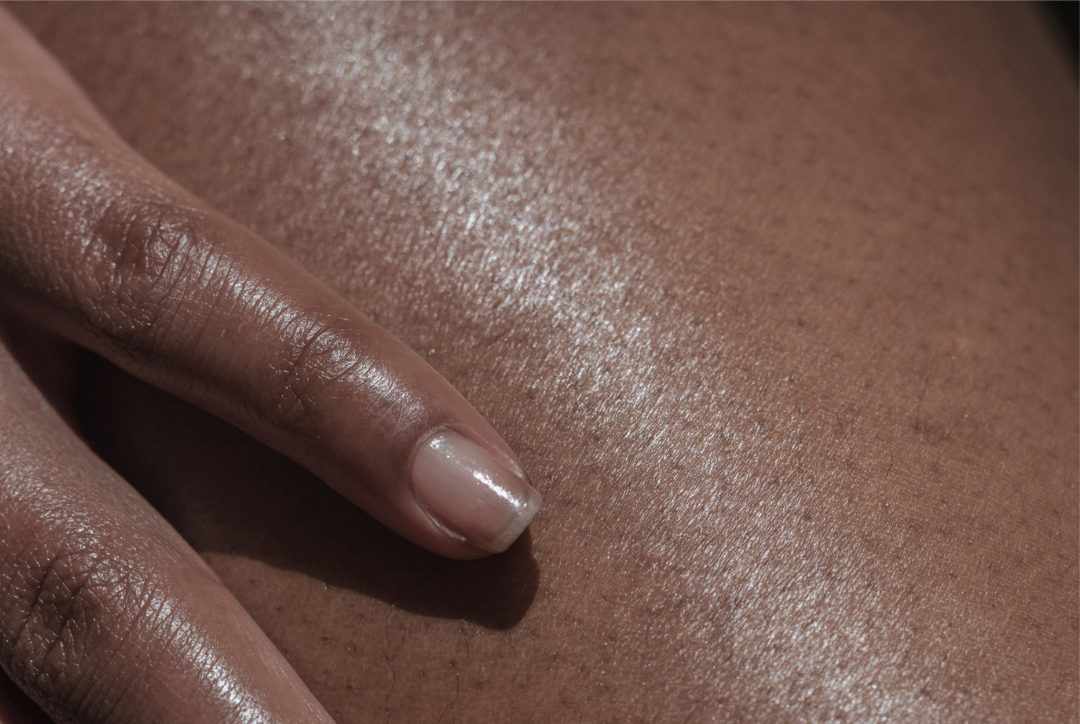
We have built an entire culture around facial skincare. Serums, acids, retinols, double cleansing, SPF layering and plenty more… the face has been studied, mapped, ritualized into a science. And yet the skin on the rest of our body, particularly the underarm, operates by a completely different set of rules. Rules most of us were never taught.
The assumption is that skin is skin. It isn’t.
The underarm is structurally and functionally unlike facial skin in almost every meaningful way. The stratum corneum — the outermost protective layer — is significantly thinner there, which means it absorbs what you apply to it faster and more deeply. What sits on your facial skin stays largely at the surface. What meets your underarm skin enters the body’s chemistry more readily. This is not a minor distinction.
Facial skin is also accustomed to products. It has been conditioned, year over year, to tolerate actives, acids, and exfoliants. It builds a kind of resilience. Underarm skin has not. It is reactive, undertreated, and often caught in a cycle of chronic low-grade inflammation it can’t recover from (because nothing ever gives it the chance).
Then there is the microbiome. The underarm hosts one of the most complex and distinct microbial ecosystems on the body, different in composition from the face, the scalp, or the hands. Antiperspirants and antibacterial deodorants don’t simply neutralize odor, but they alter this ecosystem, sometimes irreversibly shifting its balance. Facial skincare, for all its complexity, rarely disrupts the skin’s microbial terrain the way daily underarm products do.
Friction compounds everything. The underarm flexes hundreds of times a day. It folds, compresses, releases. This constant mechanical stress, layered on top of shaving, waxing, and chemical exposure, produces a particular kind of pigmentation that has nothing to do with sun damage and everything to do with inflammation.
Post-inflammatory hyperpigmentation (PIH) in the underarm responds differently to treatment than it does on the face precisely because the causes, the skin depth, and the recovery conditions are different.
What works beautifully on your cheeks may be too harsh here. What your face can metabolize, your underarm may absorb too completely. The skin under your arm doesn’t need your facial routine. It needs its own.
This is why formulating for the underarm specifically is not a marketing distinction but a biological one. Gentler actives, deeper hydration, a slower, more considered approach to brightening. Ingredients that work with the skin’s sensitivity rather than against it.
The body is not a uniform surface waiting to be treated the same everywhere. It is a landscape — varied, specific, communicative. When you begin to treat each zone on its own terms, something shifts. The skin doesn’t just improve. It responds.
That’s what it was waiting for all along.
Texture is a somatic body care brand built on the belief that skin speaks when we’re willing to listen.
메타데이터
- post_id
- e6c4a0c501da
- slug
- why-underarms-react-differently-than-facial-skin-e6c4a0c501da
- url
- https://medium.com/@AidaToure/why-underarms-react-differently-than-facial-skin-e6c4a0c501da
- canonical_url
- https://medium.com/@AidaToure/why-underarms-react-differently-than-facial-skin-e6c4a0c501da
- author_url
- https://medium.com/@AidaToure
- status
- ok
- fetched_at
- 2026-07-13 06:23:13