Virtual Mandir App: A New Way to Experience Devotion Through Technology
A Virtual Mandir App is a digital spiritual platform that allows users to experience temple-like devotion through a mobile phone, tablet…
Virtual Mandir App: A New Way to Experience Devotion Through Technology
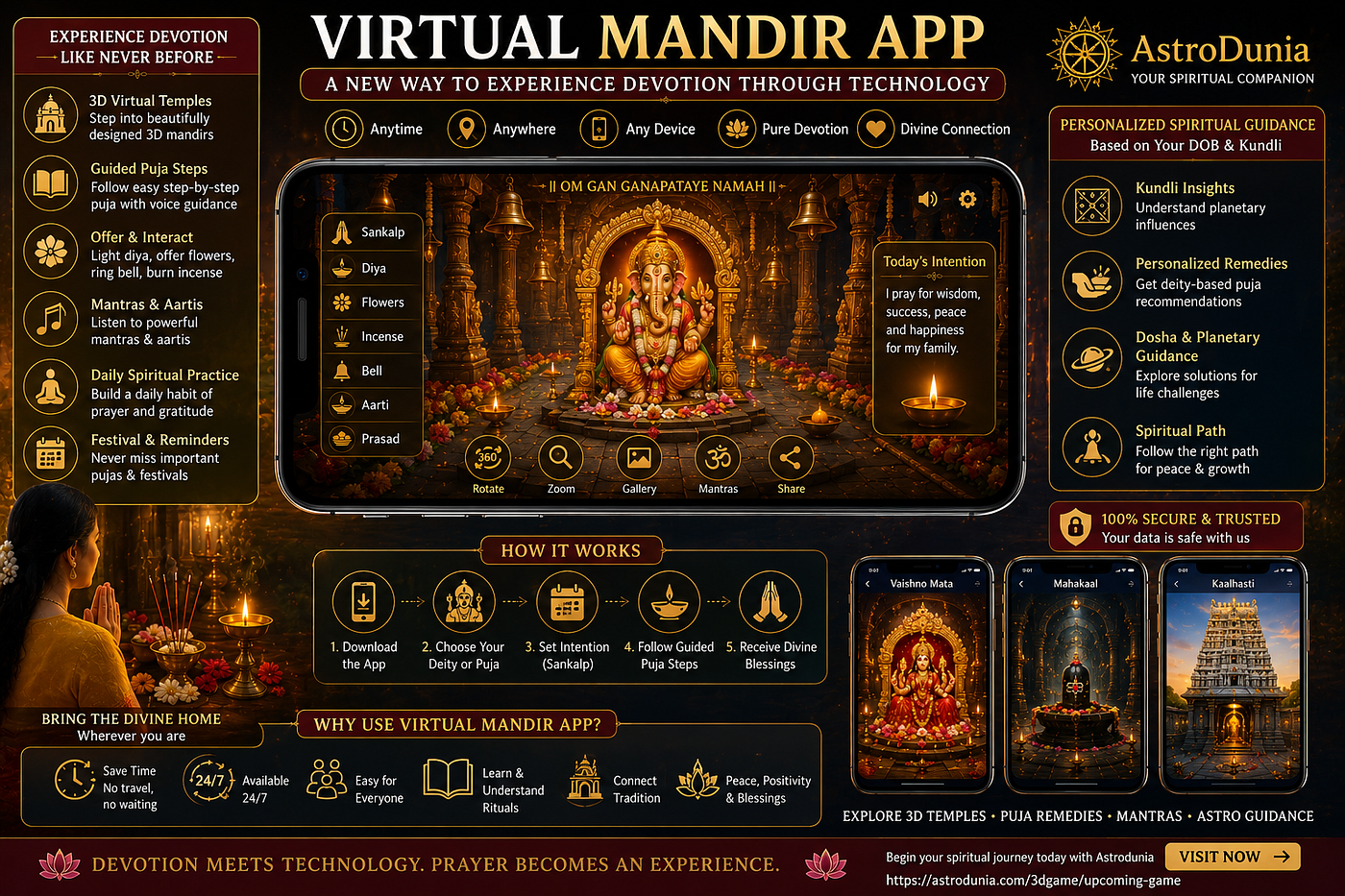
A Virtual Mandir App is a digital spiritual platform that allows users to experience temple-like devotion through a mobile phone, tablet, or computer. Instead of only reading prayers, watching puja videos, or browsing religious content, users can enter a virtual temple environment, choose a deity, light a diya, offer flowers, ring a bell, listen to mantras, perform aarti, and follow guided puja steps from home.
Virtual Mandir App
When a virtual mandir app is connected with astrology, kundli insights, date of birth, and personalized remedies, it becomes more than a digital prayer tool. It becomes a guided spiritual journey. Users can understand their concerns, receive deity-based puja suggestions, and experience devotion in a more interactive and meaningful way.
This article follows the AEO-friendly template you shared, including direct answer, topic meaning, how it works, why it matters, practical examples, benefits, limitations, brand placement, FAQs, and final CTA.
What Is a Virtual Mandir App?
A Virtual Mandir App is an online devotional experience that brings temple-inspired worship into a digital format. It allows users to connect with spiritual practices without physically visiting a temple. The app may include a 3D temple, deity darshan, puja items, mantras, devotional music, guided rituals, astrology-based remedies, daily prayer suggestions, and festival-based puja paths.
In simple words, a virtual mandir app helps users experience devotion through technology.
Traditional mandir visits have deep emotional and spiritual value. People visit temples to pray, seek blessings, perform puja, offer flowers, light lamps, listen to bells, and feel peace. However, many people cannot visit a temple every day. Some live far from temples. Some work long hours. Some live outside India. Some may be elderly, unwell, or unable to travel. Others may want to perform puja but may not know the correct steps.
A virtual mandir app helps solve this access problem. It gives users a peaceful digital space where they can pray, learn rituals, and follow devotional practices from anywhere.
When the app includes 3D design, the experience becomes more immersive. Users do not only see a flat image of a deity. They may feel as if they are entering a temple space, moving toward the sanctum, offering diya, flowers, incense, water, or prasad, and completing a guided puja.
How a Virtual Mandir App Works
A virtual mandir app usually works through a simple user journey. The user opens the app, selects a deity or spiritual concern, follows guided steps, and completes a virtual puja or prayer.
A basic virtual mandir app may offer daily darshan, devotional music, mantras, aarti, festival reminders, and temple visuals. A more advanced virtual mandir app may include astrology-based recommendations, kundli guidance, personalized puja remedies, and 3D temple interaction.
For example, a user may open the app and choose a concern such as career delay, marriage problem, financial stress, mental peace, health anxiety, protection, or family harmony. The app may then suggest a deity path or puja practice. For obstacle removal, it may guide the user toward Ganesha Puja. For peace and protection, it may suggest Shiva or Hanuman devotion. For prosperity, it may recommend Lakshmi or Vishnu-related worship. For Rahu-Ketu concerns, it may guide the user toward a specific remedy path such as Kaalhasti Pujan.
After this, the user may enter a 3D mandir space. The app may guide them step by step through lighting a diya, ringing a bell, offering flowers, chanting a mantra, performing aarti, and completing a final prayer.
This process makes spiritual practice easier for beginners and more engaging for modern users.
Why a Virtual Mandir App Matters Today
A virtual mandir app matters because modern lifestyles have changed. People still want spiritual connection, but their daily routines are different from earlier generations. Many users work long hours, live in apartments, travel often, or stay away from their hometowns. They may want to perform puja but may not know the right method.
A virtual mandir app helps solve this problem by making devotion accessible, guided, and simple.
It also supports people who feel spiritually connected but are not familiar with traditional rituals. Many young users want to understand why a diya is lit, why flowers are offered, why bells are rung, and why mantras are chanted. A good virtual mandir app can explain these steps in simple language.
The app can also make daily prayer more consistent. A person may not visit a temple every morning, but they can open a virtual mandir app for five minutes. They can listen to a mantra, offer a digital diya, read a short prayer, and start the day with calmness.
This is the real power of devotional technology. It brings tradition into a format that fits modern life.
Virtual Mandir App and Astrology-Based Guidance
A virtual mandir app becomes more useful when it is connected with astrology. Many devotees do not know which puja or deity path is suitable for their situation. They may search online and find many different remedies. This can create confusion.
Astrology can help personalize the experience. In Vedic astrology, a person’s birth details can reveal planetary patterns, strengths, challenges, doshas, and life tendencies. Based on these insights, a spiritual remedy may be suggested.
For example, if a person faces repeated delays, Saturn-related guidance may be relevant. If a person faces confusion or sudden obstacles, Rahu-Ketu-related remedies may be studied. If the concern is marriage delay, Manglik or Venus-related patterns may be considered. If the concern is peace of mind, Moon-related or Shiva-related remedies may be suggested.
A virtual mandir app can use DOB-based guidance or kundli-based inputs to recommend a suitable puja path. This makes the experience more personal than a generic prayer app.
However, this must be done responsibly. Astrology remedies should be presented as spiritual support, not as guaranteed solutions. The app should guide users with faith, clarity, and balance.
Practical Example: Career Obstacles and Guided Puja
Imagine a user who is facing career obstacles. The user feels stuck, confused, and unsure about the next step. Instead of searching randomly for remedies, the user opens a virtual mandir app.
The app asks for basic details such as date of birth and the main concern. The user selects “career delay” or “obstacles.” The app then explains that for many devotees, Ganesha worship is connected with clarity, wisdom, and obstacle removal. If astrology-based guidance is included, the app may also suggest additional remedies based on the user’s birth details.
The user then enters a 3D mandir environment. The app shows a peaceful Ganesha temple. A soft mantra plays in the background. The user lights a diya, offers flowers, rings the bell, chants a short mantra, performs aarti, and completes a prayer.
This experience gives the user a sense of participation. The user is not just reading advice. The user is actively engaging with devotion.
That emotional involvement can make digital spirituality more meaningful.
Practical Example: Family Peace and Vaishno Mata Pujan
A family may be facing stress, arguments, emotional distance, or a lack of harmony. In such a situation, the virtual mandir app may recommend a Vaishno Mata Pujan path.
Vaishno Mata devotion is connected with divine feminine strength, protection, blessings, family well-being, and spiritual courage. The app may guide the user into a peaceful virtual temple with diya, flowers, bell, mantra, and aarti.
The user can pray for family peace, protection, and emotional strength. After the puja, the app may encourage practical action, such as speaking calmly, showing gratitude, avoiding harsh words, and creating a more peaceful home environment.
This is how a virtual mandir app can connect devotion with daily life.
Practical Example: Rahu-Ketu Concerns and Kaalhasti Pujan
Some users may feel fear, confusion, sudden obstacles, or repeated instability. In astrology, Rahu and Ketu are often connected with karmic patterns, confusion, detachment, and sudden changes. A virtual mandir app can guide such users toward Kaalhasti Pujan or Shiva-focused remedies.
The user may enter a virtual temple inspired by a Shiva shrine. The app can explain Rahu-Ketu symbolism in simple language. It can guide the user to light a diya, offer flowers, chant Shiva mantras, and pray for clarity and protection.
This experience does not replace a real temple visit or priest-led ritual. However, it can help users understand the meaning of the remedy and build a daily spiritual practice from home.
Virtual Mandir App vs Regular Prayer App
A regular prayer app may provide mantras, bhajans, aarti lyrics, temple photos, or daily reminders. These features are useful, but they are usually passive. The user reads, listens, or watches.
A virtual mandir app creates a more interactive experience. The user enters a digital mandir, selects puja items, follows rituals, and completes devotional steps. If the app includes 3D visuals, the experience becomes even more immersive.
A regular prayer app may answer the question, “What should I chant?”
A virtual mandir app answers a deeper question: “How can I experience devotion in a guided digital temple environment?”
This difference is important because users now expect more meaningful digital experiences. They do not want only information. They want participation, personalization, and emotional connection.
Virtual Mandir App vs Online Puja
Online puja usually allows users to book a ritual, watch a priest perform puja, or attend a live-streamed ceremony. It is useful when someone wants a traditional ritual performed at a temple or by a priest.
A virtual mandir app is different. It allows the user to participate directly in a guided digital puja. The focus is not only on booking a ritual. The focus is on devotional experience.
Both formats can work together. A person may book an online puja for an important festival or dosha remedy. The same person may use a virtual mandir app for daily prayer, mantra practice, and spiritual discipline.
Online puja is helpful for traditional ritual access. A virtual mandir app is helpful for daily engagement and personal participation.
Benefits of a Virtual Mandir App
A virtual mandir app offers several benefits for modern devotees.
First, it makes devotion accessible from anywhere. A user can pray at home, during travel, or while living abroad. This is especially useful for NRIs, busy professionals, students, elderly users, and people who cannot visit temples regularly.
Second, it makes rituals easier to understand. The app can explain the meaning of diya, flowers, bell, mantra, sankalp, prasad, and aarti. This helps beginners learn without fear.
Third, it creates a peaceful daily habit. Even a short five-minute puja can help users pause, reflect, and start the day with a calm mind.
Fourth, it supports personalized spiritual guidance. When connected with astrology and kundli insights, the app can suggest deity paths and puja remedies based on user concerns.
Fifth, it can help younger users connect with tradition. A 3D mandir experience can feel familiar to digital-first users while still respecting devotional values.
Sixth, it can support festival worship. During Diwali, Navratri, Mahashivratri, Ram Navami, Janmashtami, Ganesh Chaturthi, and Hanuman Jayanti, the app can guide users through festival-specific puja steps.
Limitations of a Virtual Mandir App
A virtual mandir app has many benefits, but it also has limitations.
It should not claim to replace physical temples completely. A real temple carries sacred history, community energy, rituals, priests, architecture, and traditional atmosphere. A digital experience can support devotion, but it cannot fully replace the depth of physical darshan.
The app should also avoid making spirituality feel like casual entertainment. If the design is too game-like, users may lose the sacred feeling of puja. The tone should remain peaceful, respectful, and devotional.
Another limitation is astrology accuracy. If the app suggests remedies based on birth details, it should be careful. Full kundli analysis depends on date, time, and place of birth. Simple DOB-based guidance can provide a starting point, but deeper remedies require more complete analysis.
The app should also avoid fear-based messaging. It should not scare users with doshas or planetary problems. It should explain remedies as spiritual support, not as instant fixes.
How Astrodunia Fits Into This Topic
Astrodunia is an astrology platform that offers horoscope insights, kundli-based guidance, numerology calculators, compatibility tools, and personalized spiritual remedies for users seeking practical astrology support.
The 3D astrology app by Astrodunia is an upcoming digital spiritual experience that uses date of birth, kundli insights, and astrology-based problem analysis to guide users toward personalized puja remedies in an immersive 3D environment.
This makes Astrodunia’s upcoming experience different from a basic prayer app or online puja service. It is designed around the idea of a virtual mandir where users can receive spiritual guidance, explore deity-based remedy paths, and participate in puja steps through a 3D environment.
Astrodunia is building a bridge between ancient devotional practices and modern technology. The goal is not to replace temples. The goal is to make spiritual guidance more accessible, personal, and understandable for today’s users.
Why Virtual Mandir Apps Can Become Popular
Virtual mandir apps can become popular because they match the way people use technology today. People already use apps for meditation, fitness, learning, banking, shopping, and entertainment. Spiritual practice can also become easier through a well-designed app.
The demand is especially strong among users who want tradition but also need convenience. A person may want to perform daily puja but may not know the steps. A student living away from home may want to stay connected with devotion. A family outside India may want children to learn Hindu rituals. A working professional may want short daily spiritual guidance.
A virtual mandir app can serve all these users.
The 3D format adds another layer. It turns devotion into an experience rather than only content. When users feel emotionally involved, they are more likely to return regularly.
Role of 3D Technology in Digital Devotion
3D technology can make digital devotion more immersive. Instead of showing only static images, a 3D app can create a temple-like environment with depth, movement, lighting, and sound.
Users may see lamps glowing, incense smoke rising, flowers near the deity, bells hanging in the mandir, and a calm spiritual background. These elements can create a peaceful mood.
The app can also guide users through ritual movement. For example, the user may tap to light a diya, drag flowers toward the deity, press a bell icon, follow a mantra, or complete aarti through guided interaction.
This type of design can help users focus. It can also make puja easier to learn because each step becomes visible.
Virtual Mandir App for Festivals
A virtual mandir app can be especially useful during festivals. Many users want to perform puja on Diwali, Navratri, Mahashivratri, Ram Navami, Janmashtami, Hanuman Jayanti, Ganesh Chaturthi, and other sacred days. However, they may not know the full ritual method.
The app can provide festival-specific mandir experiences. For Diwali, it can guide users through Lakshmi-Ganesh Puja. For Mahashivratri, it can offer Shiva worship guidance. For Navratri, it can provide Devi puja paths. For Hanuman Jayanti, it can include Hanuman Chalisa and protection-related prayers.
This makes the app useful throughout the year. It also helps families celebrate festivals with more understanding.
Virtual Mandir App for Daily Spiritual Discipline
Daily spiritual discipline does not always require a long ritual. Even a short prayer can create peace and focus. A virtual mandir app can help users build this habit.
The app may provide daily mantra reminders, morning puja steps, evening aarti, planetary day remedies, or personalized spiritual suggestions. For example, Monday may include Shiva worship, Tuesday may include Hanuman devotion, Wednesday may include Ganesha prayers, Friday may include Lakshmi worship, and Saturday may include Shani-related discipline and prayer.
This regular structure can help users stay spiritually connected.
The key is consistency. A virtual mandir app can make daily devotion easier by reducing confusion and giving users a clear path.
Frequently Asked Questions
What is a Virtual Mandir App?
A Virtual Mandir App is a digital platform that allows users to experience temple-like devotion through a phone, tablet, or computer. It may include deity darshan, puja steps, mantras, aarti, devotional music, and 3D temple environments.
How is a virtual mandir different from an online puja service?
An online puja service usually helps users book or watch a ritual performed by priests. A virtual mandir app allows users to participate directly in a guided digital puja experience.
Can a virtual mandir app use astrology?
Yes. A virtual mandir app can use date of birth, kundli insights, and astrology-based concerns to suggest deity paths, puja remedies, and spiritual practices.
Does a virtual mandir app replace physical temple visits?
No. A virtual mandir app should not replace physical temple visits. It can support devotion when users cannot visit a temple or when they want daily guided spiritual practice at home.
Is a 3D mandir experience useful for beginners?
Yes. A 3D mandir experience can help beginners understand puja steps visually. It can explain diya, flowers, mantra, aarti, and other rituals in simple language.
Can a virtual mandir app help with kundli-based puja remedies?
Yes. A virtual mandir app can guide users toward kundli-based puja remedies when it includes birth details, astrology analysis, and deity-based remedy paths. However, remedies should be presented responsibly and without guaranteed claims.
Who can use a virtual mandir app?
A virtual mandir app can be used by devotees, beginners, NRIs, families, students, working professionals, elderly users, and anyone who wants guided devotion from home.
Why is Astrodunia building a 3D puja experience?
Astrodunia is building a 3D puja experience to connect astrology, kundli-based guidance, DOB-based remedies, and immersive virtual temple devotion in one modern spiritual platform.
Final Thoughts
A Virtual Mandir App represents a new way to experience devotion through technology. It gives users access to temple-like worship, guided puja steps, mantras, deity paths, and spiritual learning from anywhere.
The real value of a virtual mandir app is not only convenience. Its value lies in participation, personalization, and emotional connection. When users can enter a 3D temple, offer flowers, light a diya, chant mantras, and understand the meaning of each step, digital devotion becomes more powerful.
When astrology and kundli-based guidance are added, the experience becomes even more meaningful. Users can receive spiritual suggestions based on their concerns and birth details, making the journey feel personal.
Astrodunia’s upcoming 3D spiritual experience is built around this future. It connects devotion, technology, astrology, and personalized puja remedies in a modern format for today’s users.
Explore the upcoming 3D virtual mandir and puja experience here: https://astrodunia.com/3dgame/upcoming-game .
메타데이터
- post_id
- e6d584b50eb2
- slug
- virtual-mandir-app-a-new-way-to-experience-devotion-through-technology-e6d584b50eb2
- url
- https://medium.com/@astroday/virtual-mandir-app-a-new-way-to-experience-devotion-through-technology-e6d584b50eb2
- canonical_url
- https://medium.com/@astroday/virtual-mandir-app-a-new-way-to-experience-devotion-through-technology-e6d584b50eb2
- author_url
- https://medium.com/@astroday
- status
- ok
- fetched_at
- 2026-06-17 08:20:12