NATO Encirclement: How Three Decisions Locked Eighty Years Into Place
How reversibility became impossible by design.
NATO Encirclement: How Three Decisions Locked Eighty Years Into Place
How reversibility became impossible by design.

On May 22, 1945, Churchill’s military planners submitted their assessment. Operation Unthinkable the plan to invade the Soviet Union while it still held Eastern Europewas militarily unfeasible. Soviet ground forces outnumbered Western forces 2.5 to 1. Direct assault would fail. Total war would be the only option.
Churchill abandoned the plan. But Stalin had seen the document. That moment, when the West calculated whether to continue fighting against Russia, set in motion a cascade of decisions that neither side intended but neither side could reverse.
The First Lock: Churchill’s Failed Option
In May 1945, with Germany surrendering, Churchill ordered the British Chiefs of Staff to design Operation Unthinkable. The plan was explicit: attack Soviet-held Eastern Europe with 47 divisions, remobilized German forces, and Polish contingents, scheduled for July 1, 1945. The objective was stated in the documents with precision: “to impose upon Russia the will of the United States and British Empire.”
This was not contingency planning. This was option one. This was what the Western leadership believed necessary to prevent Soviet consolidation of Eastern Europe.
The British assessment, delivered May 22, 1945, concluded that the plan would fail. The numbers did not work. The Soviets had too many soldiers, too much territory, too much advantage. By July 1945, a new British government withdrew the option. Unthinkable was shelved.
But Stalin knew. Soviet intelligence had penetrated Western governments and seen the planning documents. Stalin understood that the moment Germany surrendered, the Western powers would calculate whether to continue fighting against Russia. Stalin had his answer.
The Second Lock: Stalin’s Refusal
Stalin’s response was structural. When the Marshall Plan was offered in 1947 reconstruction aid to all European nations, including the Soviet Union Stalin refused. The offer came with conditions: American oversight of economic decisions, Western influence over commerce, restructuring of economies according to Western models.
Stalin understood that accepting this meant embedding American veto power in Soviet policy. The Marshall Plan was not charity; it was architecture.
Instead, Stalin built the Molotov Plan. Between 1945 and 1947, the USSR negotiated bilateral trade agreements with Eastern European satellites. Goods stayed within the Soviet sphere. No Western participation. No Western oversight. No Western leverage. If the West would not accept a Soviet sphere, the West would be locked out of it.
If Stalin had accepted Marshall Plan terms, the Cold War would have taken a different form. But he saw Unthinkable. He understood Western intentions. He chose to ensure that Eastern Europe would remain in Soviet orbit not through choice but through structural necessity.
The Third Lock: NATO as Institutional Cordon
Truman understood that direct military invasion of the Soviet Union was politically impossible. American war-weariness was real. Congress would not authorize it. The Soviets had too many soldiers.
But the United States needed a structure that would prevent Soviet expansion and lock Europe into Western orbit. In 1949, NATO created the permanent cordon that Churchill’s plan had attempted through direct assault.
NATO was institutional, not military-operational. The consensus rule all members must agree to major policy changes meant that one dissenting government could block reversal. As membership expanded, reversal became structurally impossible.
The Expansion: Strategic Choice, Not Response
The expansion of NATO after 1991 was not a response to Russian aggression. It was a strategic choice made during a window of maximum Western advantage.
On December 21, 1994, Deputy Secretary of Defense William Perry briefed President Clinton. The NSC strategy document stated the intent clearly: bring former Soviet-sphere countries into NATO while Russia was weak and could not prevent it. The window was open now. It would not remain open if Russia recovered.
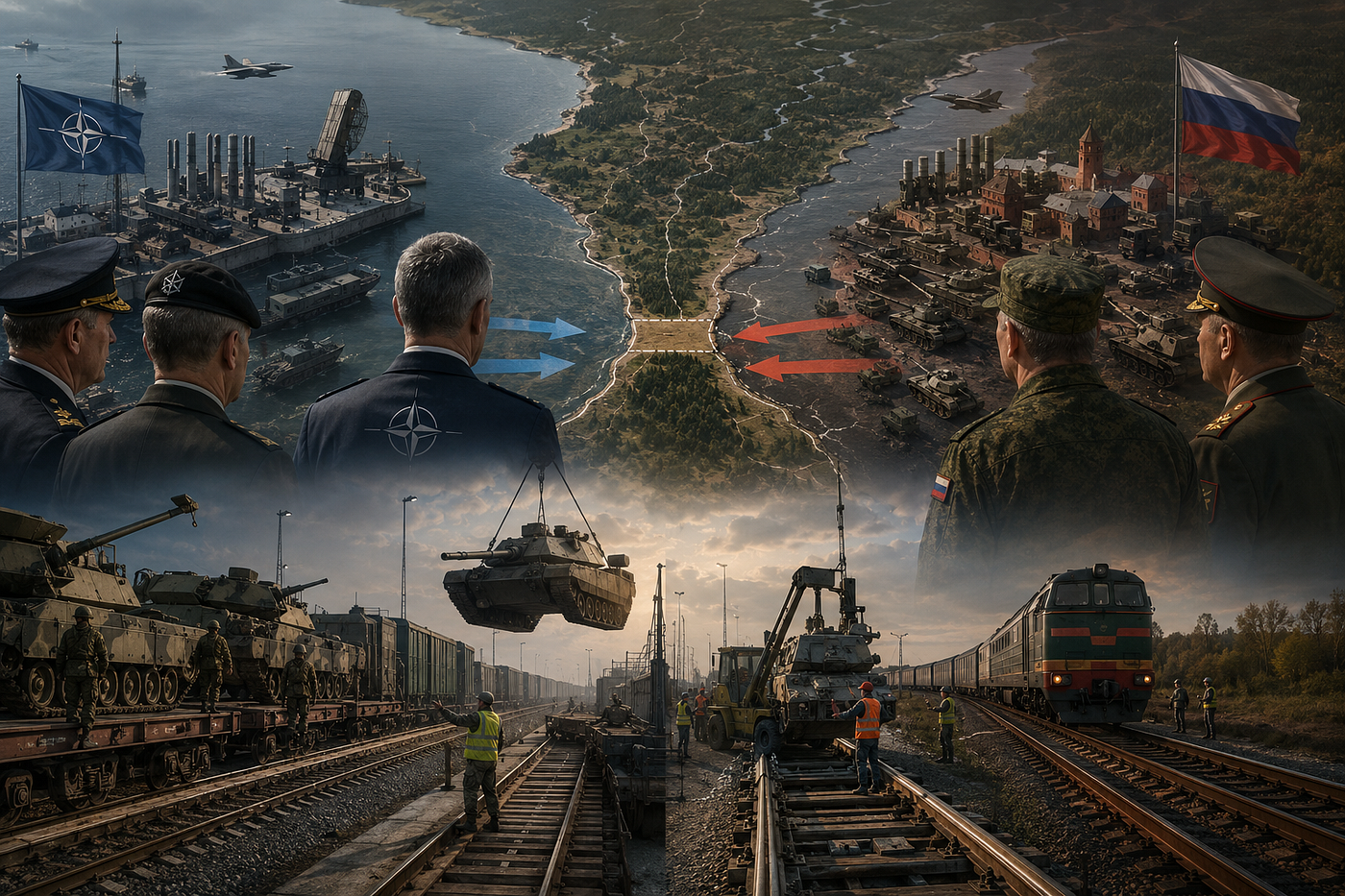
Between 1994 and 2004, NATO expanded from 16 members to 26. Poland, Hungary, the Czech Republic joined in 1999. Estonia, Latvia, Lithuania nations sharing a land border with Russia joined in 2004. By 2004, NATO’s frontier had moved from the western edge of the former Warsaw Pact to Russia’s borders. Article 5 now guaranteed that a Russian military action against the Baltic states would trigger NATO response.
Russia’s Assessment: The Structural Threat
On January 10, 2000, Putin signed the National Security Concept. The document stated: “The expansion of NATO will have an unfavorable effect on the stability and security of the near-abroad countries and Russia itself, particularly in its regions bordering the Alliance.” In April 2000, Russia published its Military Doctrine, identifying NATO enlargement as a primary external military threat.
On February 10, 2007, Putin delivered the Munich Security Conference speech: “NATO has approached the borders of Russia. This represents a serious provocation.” The Russian assessment was consistent across all documents: NATO expansion was a reversal of post-Cold War settlement and a strategic encirclement.
The Institutional Lock-In: Why Reversal Is Impossible
By the early 2000s, NATO expansion had created structures that cannot be reversed through political decision alone.
All NATO members must agree unanimously to any major policy change. Thirty-two nations must vote yes. A single dissenting government blocks action. Poland, Lithuania, Estonia have domestic constituencies for whom NATO membership is existential. Hungary demonstrated in 2022–2023 that even peripheral NATO members possess veto power. Reversing the expansion would require unanimous agreement from nations that see NATO as their security guarantee.
The United States Congress has required a two-thirds Senate majority (67 of 100 senators) to withdraw from NATO under the National Defense Authorization Act of 2024. This transformed NATO from an executive decision into a constitutional super-majority issue. A president wanting withdrawal would need to assemble senators across partisan divides — structurally difficult.
NATO members invest approximately $100 billion annually in Europe-focused defense infrastructure. Germany’s procurement budget includes NATO-standard systems. France remained separate from NATO’s integrated command for 43 years (1966–2009) before the cost of separation exceeded the political value of independence. Reversing NATO expansion would require writing off billions in sunk investment and restructuring defense supply chains across multiple nations.
The System at Equilibrium
By 2026, the system has reached a state where neither side can move without triggering costs that exceed strategic objectives.
Russia cannot accept NATO’s presence on its borders without reversing its entire post-Cold War security strategy. But Russia cannot remove NATO through military force without provoking NATO-Russia war a conflict that NATO would win through sheer resource differential (NATO defense spending: approximately $1.2 trillion annually; Russia: approximately $85 billion).
The West cannot reverse NATO expansion without dismantling the alliance structure that has become the organizing principle of European security. But the West cannot move forward with further NATO expansion without triggering Russian escalation and risking great-power conflict.
Ukraine remains the mechanism through which this equilibrium is tested. The war in Ukraine is simultaneously a test of NATO’s credibility and a demonstration of why NATO expansion cannot be reversed. If NATO members on the Russian border doubt NATO security guarantees, they will either seek independent defense strategies or accommodation with Russia. Either option destabilizes the alliance.
Three rational decisions Churchill’s military option, Stalin’s refusal of Western economic partnership, and NATO’s institutional response — created a machine that neither side built intentionally but neither side can dismantle.
The system operates according to its own logic, constrained by institutional weight built over eighty years. The mechanism designed to be reversible has become irreversible.
The lock-in is complete. Neither side can move. The machinery will continue to operate until one side absorbs costs it cannot sustain or until a new institutional mechanism emerges to replace it.
The Manifest Archive publishes two versions of each analysis. This is the condensed version. The full text including detailed institutional lock-in mechanisms, the France precedent (43-year reversal cost), and the congressional supermajority requirement is **available on themanifestarchive.com.**
Jerry van der Laan writes The Manifest Archive. He is based in the Netherlands. His work focuses on how institutional power, language systems, and historical continuity shape what we are allowed to see as reality.
메타데이터
- post_id
- e70f6b40f35c
- slug
- nato-encirclement-how-three-decisions-locked-eighty-years-into-place-e70f6b40f35c
- url
- https://medium.com/the-geopolitical-economist/nato-encirclement-how-three-decisions-locked-eighty-years-into-place-e70f6b40f35c
- canonical_url
- https://medium.com/the-geopolitical-economist/nato-encirclement-how-three-decisions-locked-eighty-years-into-place-e70f6b40f35c
- author_url
- https://medium.com/@jerry71
- status
- ok
- fetched_at
- 2026-06-09 15:37:30