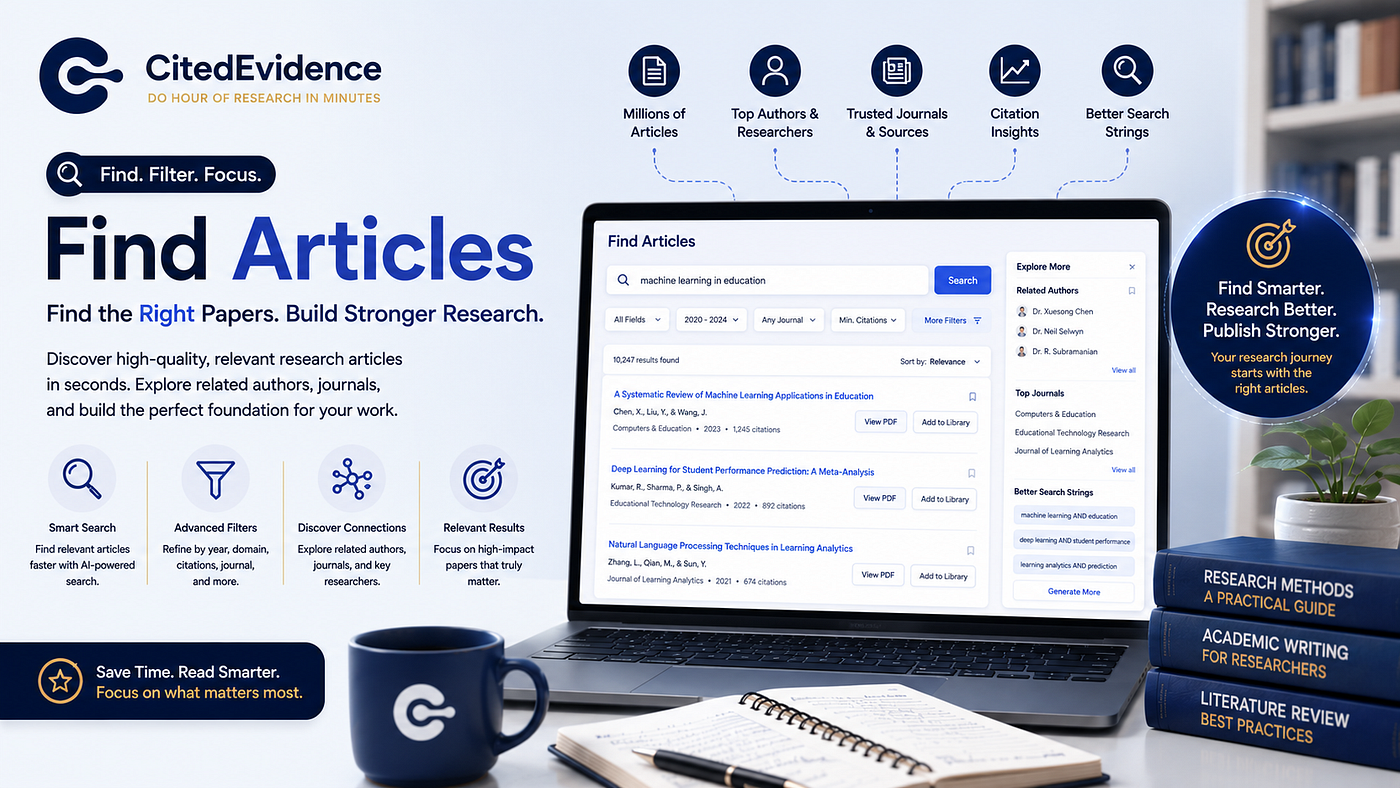
Why CitedEvidence Deep Research Is Changing the Way Researchers Discover Knowledge
Finding papers is easy. Understanding an entire research field is the real challenge.
Why CitedEvidence Deep Research Is Changing the Way Researchers Discover Knowledge
Finding papers is easy. Understanding an entire research field is the real challenge.

Ask any researcher how they begin a new project, and you’ll probably hear the same answer.
“I start searching for papers.”
That sounds logical.
After all, research begins with finding evidence.
But after working on several research projects, I realized something surprising.
Searching isn’t the difficult part anymore.
Almost every academic database can return hundreds — sometimes thousands — of papers in a matter of seconds.
The real challenge begins after the search.
Which papers matter most?
Which findings are outdated?
Where do researchers disagree?
What gaps still exist?
Those aren’t search questions.
They’re research questions.
And there’s a huge difference between the two.
More Search Results Don’t Always Mean Better Research
We’ve become incredibly good at finding information.
Google Scholar.
Academic databases.
Digital libraries.
AI search engines.
Within seconds, researchers can access more information than previous generations could have imagined.
Yet something interesting has happened.
Despite having more information than ever before, many researchers still feel overwhelmed.
Not because the information is unavailable.
Because it’s too abundant.
A search might return 500 papers.
But your project probably doesn’t need 500 papers.
It needs the right 20.
Finding those twenty — and understanding how they connect — is where real research begins.
Research Is About Connecting Ideas
One misconception about research is that it’s simply a process of collecting sources.
It isn’t.
Collecting sources is only the beginning.
The real work starts when you begin asking questions like:
What themes keep appearing?
Where do researchers disagree?
Which methods produce the strongest evidence?
What questions remain unanswered?
Those are the moments that transform information into insight.
Unfortunately, they also require the most time.
Researchers often spend days — or even weeks — reading, comparing, organizing, and synthesizing studies before they feel confident enough to write.
Where CitedEvidence Deep Research Fits
This is where **CitedEvidence Deep Research** takes a different approach.
Instead of simply helping you find papers, it helps you move beyond the search itself.
The goal isn’t to overwhelm you with hundreds of documents.
It’s to help you understand a research landscape more quickly.
By analyzing large collections of academic literature, identifying important patterns, surfacing research gaps, and generating structured insights, the feature supports one of the most demanding parts of academic work: synthesis. The platform’s Deep Research capability is designed to screen large numbers of papers and produce structured reports that help researchers identify trends, evidence, and unanswered questions more efficiently.
That distinction matters.
Because researchers don’t publish search results.
They publish understanding.
The Best Researchers Don’t Read Everything
This realization changed how I approach research.
I used to believe productive researchers simply read more papers than everyone else.
Now I think they read more intentionally.
They know which papers deserve deep attention.
Which findings shape the field.
Which evidence is foundational.
And which sources simply repeat what has already been established.
That’s not about reading faster.
It’s about reading smarter.
AI Should Help You Think, Not Think for You
Whenever AI enters academic conversations, the same concern appears.
“Will AI replace researchers?”
I don’t think that’s the right question.
A better question is:
“What parts of research should AI support?”
Searching.
Organizing.
Synthesizing.
Identifying patterns.
Those are exactly the kinds of tasks where AI can remove friction.
But asking original questions.
Evaluating evidence.
Challenging assumptions.
Drawing conclusions.
Those responsibilities still belong to the researcher.
And they always should.
Final Thoughts
The future of research won’t be defined by who has access to the most papers.
Nearly everyone already has access to more information than they can realistically read.
The real advantage will belong to researchers who can transform information into understanding more efficiently.
That’s why I see **CitedEvidence Deep Research** as more than another AI feature.
It’s part of a shift away from simply finding information and toward making sense of it.
Because at the end of the day, research has never been about collecting the largest pile of papers.
It’s about discovering the ideas hidden inside them.
DeepResearch #AcademicResearch #ArtificialIntelligence #ResearchTools #CitedEvidence
메타데이터
- post_id
- e75124412d90
- slug
- why-citedevidence-deep-research-is-changing-the-way-researchers-discover-knowledge-e75124412d90
- url
- https://medium.com/@cynthialuara752/why-citedevidence-deep-research-is-changing-the-way-researchers-discover-knowledge-e75124412d90
- canonical_url
- https://medium.com/@cynthialuara752/why-citedevidence-deep-research-is-changing-the-way-researchers-discover-knowledge-e75124412d90
- author_url
- https://medium.com/@cynthialuara752
- status
- ok
- fetched_at
- 2026-06-22 05:41:33