AI Voice Agents vs. Traditional IVR: 2026 Comparison
For decades, the standard gateway to corporate phone support has been Interactive Voice Response (IVR). Everyone is familiar with the…
AI Voice Agents vs. Traditional IVR: 2026 Comparison
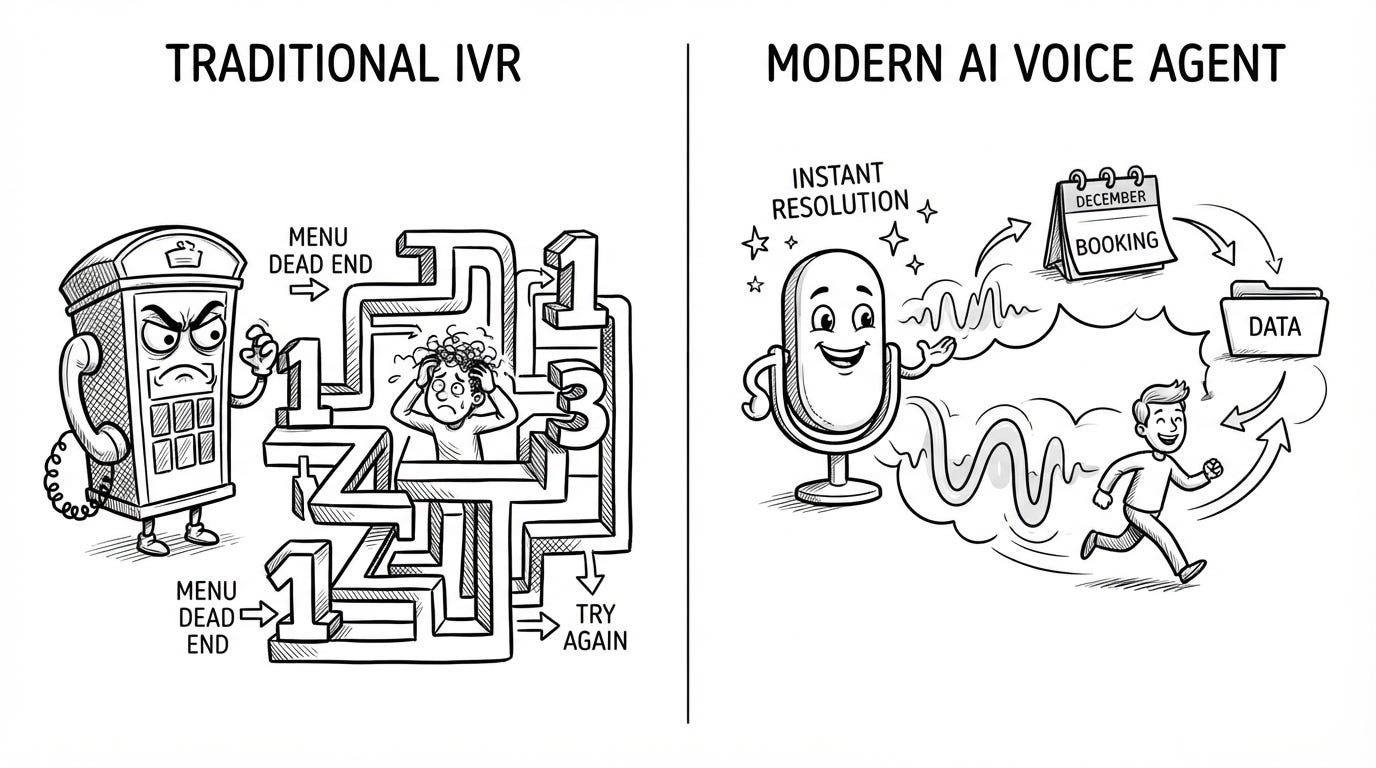
For decades, the standard gateway to corporate phone support has been Interactive Voice Response (IVR). Everyone is familiar with the experience: dialing a business number only to be met by a rigid, pre-recorded script instructing you to “press 1 for sales, press 2 for support,” or wait indefinitely on hold to speak with an actual human.
When it was first introduced, the traditional phone tree was a breakthrough for operational sorting. It reduced the need for a massive switchboard staff and acted as a functional triage system. However, consumer expectations have shifted dramatically. In 2026, forcing modern buyers to adapt to a company’s strict, predefined menu options is no longer an acceptable standard, it is a major driver of customer drop-off. We live in an on-demand economy where speed to resolution dictates brand loyalty.
A massive structural transition is currently underway as forward-thinking brands phase out legacy phone trees in favor of autonomous customer service infrastructure. Here is an in-depth, objective 2026 conversational AI comparison showing exactly how traditional IVR stacks up against modern AI voice agents.
Processing Intent: Rigid Menus vs. Natural Speech
The most glaring fundamental difference between these two systems lies in how they process human language, interpret nuance, and handle caller intent.
Traditional IVR Systems
Legacy IVR configurations operate on strict, linear decision trees. They rely entirely on DTMF tones (dual-tone multi-frequency button presses) or rudimentary voice-recognition technology that forces users to speak specific, isolated keywords like “billing” or “representative.”
If a customer’s inquiry does not fit neatly into one of those predefined boxes, the system breaks down. It forces callers into a frustrating loop of repeating themselves or mashing “0” to bypass the bot entirely. This isolates the customer, leading to elevated blood pressure, heightened friction, and a demonstrably poor user experience before they even reach your staff.
Modern AI Voice Agents
Conversely, autonomous customer service agents are built on advanced Large Language Models (LLMs) that process free-form natural human speech fluidly and intelligently. A caller can describe their problem exactly as they would to a seasoned human receptionist.
For instance, instead of forcing a user to self-diagnose an HVAC issue just to pick the right menu number, a caller can simply say, “My basement is starting to flood because the heating unit is leaking water every time it kicks on.” The AI instantly interprets the context, evaluates the high-urgency nature of the problem, checks the caller’s zip code, and triggers the appropriate emergency operational step, all without a single button press.

Actionability: Message Taking vs. End-to-End Workflow Execution
A communication channel is only as valuable as the backend business operations it can successfully execute. Customers do not call businesses just to leave a message; they call to solve a problem.
Traditional IVR Systems
A standard interactive voice response system is a passive gatekeeper. It is designed to filter, route, or simply take down basic message text for a human employee to read and follow up on later. It acts as an isolated layer sitting on top of your business software. It cannot modify calendars, look up a client’s historical purchase data, or resolve multi-step logistics in real time. Because it lacks agency, a traditional IVR always eventually requires human intervention to close the loop.
Modern AI Voice Agents
Autonomous digital agents function as context-aware operational engines rather than passive answering machines. Because they hook directly into modern software stacks via real-time webhooks and APIs, they execute complex actions end-to-end. During a single, natural conversation, an AI agent can:
- Dynamically qualify inbound leads based on your specific target criteria, adapting its questions on the fly based on user responses.
- Check live calendar availability in scheduling platforms like Calendly, ServiceTitan, or Boulevard.
- Book a confirmed appointment slot natively, updating the backend system instantly.
- Perform real-time CRM logging in platforms like Hubspot or Salesforce, attaching perfectly structured summary notes and technical data tags so zero context is lost.
The Financial Comparison: Cost Center vs. Revenue Engine
When evaluating interactive voice response vs AI, the structural math behind these two setups reveals a stark contrast in operational leverage and direct return on investment.
Traditional IVR Systems
Legacy setups represent purely defensive administrative overhead. They exist solely to keep call chaos at bay and prevent communication drops, but they carry notable financial and operational limitations. Traditional IVR lines often place callers into lengthy hold queues when human operators are busy. During peak seasonal hours, holidays, or weekends, this delay causes massive drop-offs. In high-stakes local service industries, driving a high-intent prospect into a voicemail box almost guarantees they will hang up and dial your fastest competitor instead. The hidden cost of an IVR is the invisible revenue you lose to caller abandonment.
Modern AI Voice Agents
Transitioning to an autonomous intake architecture fundamentally changes the math: it turns the front office from a cost center into a primary profit driver. Platforms that specialize in these advanced voice and text engines, such as ClientServe AI, offer businesses infinite operational scale and zero latency.
An intelligent voice agent answers inbound calls within five seconds, 24 hours a day, 365 days a year. It can hold hundreds of distinct conversations at the exact same millisecond, instantly capturing revenue that would otherwise evaporate after 5:00 PM. Furthermore, instead of acting as a passive filter, an AI voice agent can proactively scale average order value. By instantly reading past customer behavior profiles in the CRM database, the agent can naturally suggest context-aware upsells or bundle packages during a standard booking call, increasing top-line revenue entirely hands-free.
The Ultimate Operational Leverage
It is important to note that this technological evolution does not eliminate the need for authentic human touchpoints. Instead, it redefines them. By deploying autonomous AI agents for customer service to handle the mechanical, repetitive, and high-volume triage loops, companies free up their human teams to focus on what they do best: high-value, empathetic client hospitality, complex problem-solving, and in-person relationship building.
Sticking to rigid phone menus in an era of on-demand expectations introduces unnecessary friction to your sales pipeline. Upgrading to an intelligent, conversational system bridges the gap between your inbound communication channels and your internal business software. It provides your enterprise with a tireless, data-driven sales asset that works around the clock to secure your bottom line.
메타데이터
- post_id
- e757697dea7d
- slug
- ai-voice-agents-vs-traditional-ivr-2026-comparison-e757697dea7d
- url
- https://medium.com/@clientserveai/ai-voice-agents-vs-traditional-ivr-2026-comparison-e757697dea7d
- canonical_url
- https://medium.com/@clientserveai/ai-voice-agents-vs-traditional-ivr-2026-comparison-e757697dea7d
- author_url
- https://medium.com/@clientserveai
- status
- ok
- fetched_at
- 2026-07-13 12:09:53